

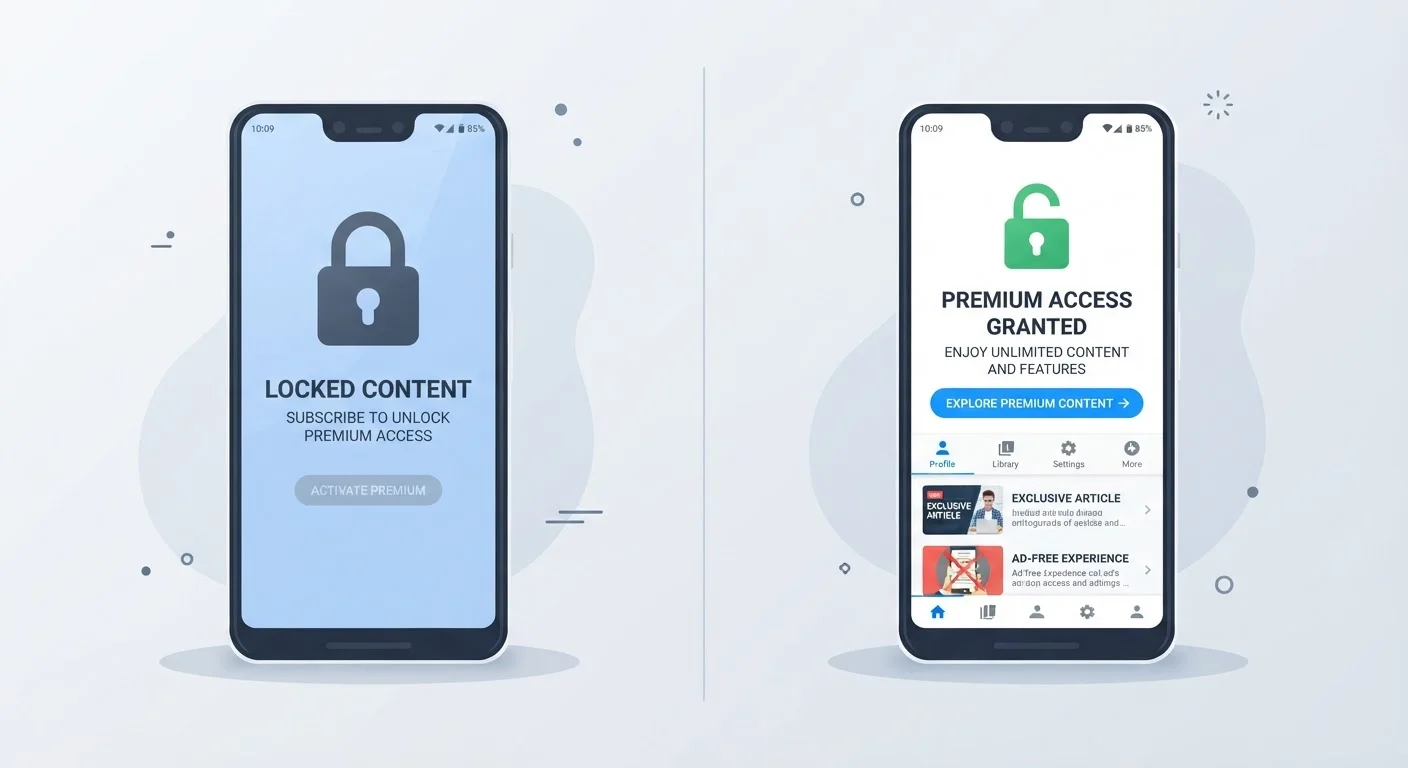
Option A
Free App Tier
The no-cost entry point with built-in limits.
Best for: Casual or occasional users who need basic functionality without a recurring expense.
Option B
Paid App Tier
The full-featured experience designed for regular, serious use.
Best for: Users who rely on an app daily and need advanced features, more storage, or an ad-free experience.
How Free Tiers Are Actually Designed
App developers don't offer free tiers out of generosity - they offer them as a calculated business strategy. The free plan is engineered to deliver enough value to hook you, while withholding enough to make the paid plan feel necessary. Understanding this dynamic helps you evaluate what you're actually getting.
The most common restrictions on free tiers fall into a few categories: usage caps (a limit on how many projects, documents, or actions you can perform), storage limits (often just a few gigabytes of cloud space), advertising (banner, interstitial, or audio ads that interrupt your experience), and feature gates (tools like collaboration, export options, or automation locked behind a paywall).
Not all restrictions are equal. A storage cap might never affect someone who uses an app occasionally, while the same cap can become a daily frustration for a heavy user. Before assuming you need to upgrade, it's worth auditing which restrictions you're actually running into - versus which ones exist on paper but don't affect your real usage.
| Criterion | Free Tier | Paid Tier |
|---|---|---|
| Cost | $0 per month | Typically $5-$20/month |
| Advertising | Usually present | Usually removed |
| Cloud storage | Limited (often 2-5 GB) | Expanded (often 50 GB+) |
| Cross-device sync | Often restricted | Typically included |
| Advanced features | Locked or unavailable | Fully unlocked |
| Customer support | Community forums only | Priority or direct support |
| Data privacy exposure | Higher (ad-based tracking) | Lower (reduced tracking) |
| Offline access | Rarely available | Commonly included |
What Paid Plans Actually Unlock
Paid tiers generally fall into two camps: those that simply remove friction (ads, caps, nags), and those that genuinely expand what the app can do. The distinction matters when you're evaluating whether an upgrade is worth its cost.
Ad removal is the most straightforward benefit. Free music, podcast, and news apps frequently interrupt playback with unskippable ads; paid plans eliminate these entirely. For apps you use during commutes or focus sessions, this alone can justify a subscription for many users.
Storage and sync upgrades are significant for productivity and note-taking apps. Many free tiers cap cloud storage in ways that prevent syncing across all your devices effectively. Paid plans typically multiply available storage and enable real-time sync across phones, tablets, and computers.
Advanced features vary widely by app category. In project management tools, this often means automation rules, integrations with other services, and admin controls. In creative apps, it may mean higher export quality, additional templates, or access to premium asset libraries. In security apps, it can mean real-time threat monitoring rather than scheduled scans.
2-5%
Free-to-paid conversion rate for most apps
Industry analyses of freemium software consistently find that only a small fraction of free users ever convert to paid plans, which shapes how free tiers are designed.
~$273
Average annual US consumer app subscription spend
A 2023 survey by Revenuecat found the average American spends significantly more on app subscriptions than most people realize, underscoring the value of auditing your subscriptions regularly.
It's also worth understanding the licensing angle: what rights you actually have over data you create in an app can differ between free and paid plans. Our guide on software licenses and what you can and can't do with apps you own covers how those terms can affect your data ownership.
Making the Call: Is Upgrading Worth It?
The honest answer depends on three things: how often you use the app, which specific restrictions are creating friction, and whether the cost is proportionate to that value.
A useful mental test: if the free tier disappeared tomorrow, would you pay to get the app back? If the answer is an immediate yes, that's a strong signal the paid plan is worth it for you. If you'd shrug and find an alternative, the free tier is probably serving you well enough.
Before committing, it's worth reviewing exactly how subscription app pricing works and what to watch for before you sign up - particularly auto-renewal terms and what happens to your data if you cancel. Some apps lock your files in proprietary formats, meaning a lapsed subscription can cut off access to your own content.
Also consider that premium pricing doesn't always mean a meaningfully better product. Some paid tiers add features that sound impressive in a marketing list but that the vast majority of users never touch. Evaluate the specific features you would actually use - not the full feature comparison chart.
Finally, free tiers don't exist in isolation from security. Apps that monetize through advertising sometimes collect more behavioral data on free users than on paid subscribers. If you're sharing sensitive information with an app, understanding its data practices is essential - just as keeping the app updated is. Outdated apps introduce their own risks, as covered in our piece on why skipping software updates is riskier than most people realize.
Family and Annual Plans Can Change the Math
Many paid tiers offer annual billing at a discount - often 20-40% less than paying month-to-month. Family or group plans can further reduce the per-person cost if multiple household members use the same app. If you've already decided a paid tier is worth it, it's worth checking whether a different billing structure lowers the effective price before subscribing.
The content on this site is provided for informational purposes only and should not be considered a substitute for professional advice. While we strive to provide accurate and up-to-date information, we make no guarantees regarding its completeness or accuracy. Always consult a qualified professional for advice specific to your circumstances before making any decisions.