

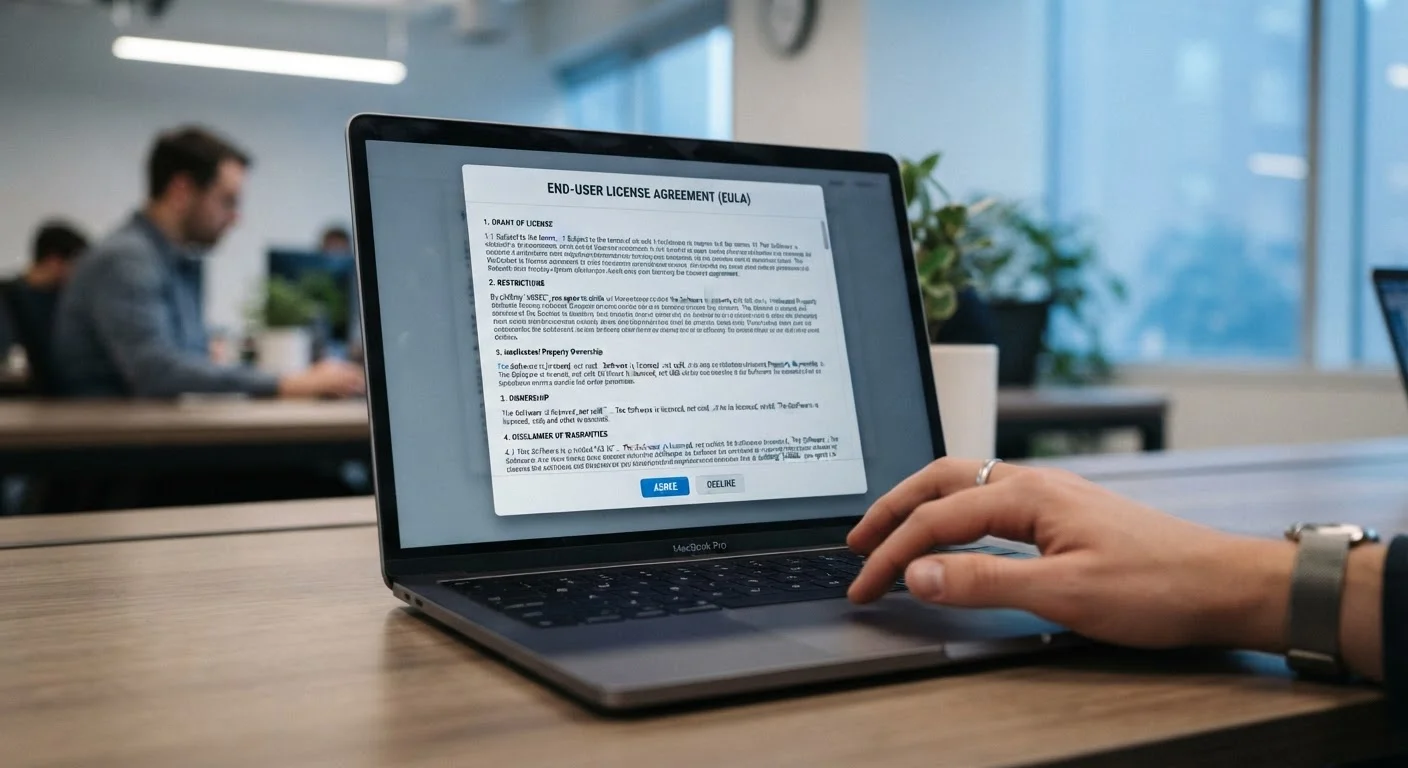
You Don't Own Software - You License It
When you pay for an app or software program, it's natural to assume you own it the same way you own a book or a kitchen appliance. You don't. What you purchase is a license - a legal permission granted by the software developer that allows you to use their product under specific conditions. The developer retains copyright ownership of the underlying code.
This distinction isn't just semantic. It determines whether you can install the software on multiple computers, share it with a family member, resell it, or continue using it after the company shuts down. The document that spells all of this out is called an End User License Agreement (EULA) - the lengthy text most people click past without reading.
Courts in the United States have generally upheld EULAs as binding contracts, meaning those terms have real legal weight even when acceptance is just a checkbox click. Understanding the basics of how licenses work helps you make smarter decisions about what you install and pay for.
Before purchasing any software for professional use, search the product name plus 'EULA commercial use' to find the relevant licensing page. Many licenses distinguish between personal and business use, and the commercial tier may require a separate, pricier agreement.
Businesses and freelancers frequently underestimate this distinction. Using consumer-licensed software for commercial work can expose individuals and companies to license violations, even if the software was legitimately purchased.
When evaluating subscription software, look specifically for an 'export' or 'data portability' feature before committing. The ability to export your data in a standard format gives you an exit path if pricing changes or the company folds.
Vendor lock-in through proprietary file formats is one of the most overlooked risks in software adoption. Having a clear export path protects your work regardless of what happens to the software provider.
Common License Types and What They Allow
Software licenses fall into several broad categories, each with different rules about use, sharing, and modification.
Proprietary (Closed-Source) Licenses
Most commercial software - operating systems, productivity suites, creative tools - uses proprietary licenses. These restrict copying, redistribution, and reverse-engineering. You get the right to run the software; you do not get access to its underlying source code.
Open-Source Licenses
Open-source licenses grant users the right to view, modify, and often redistribute the source code. However, they vary significantly in their requirements. The GNU General Public License (GPL) requires that any derivative work also be released under the same open-source terms. The MIT License is far more permissive, allowing use in proprietary products with minimal conditions. Learn more about what open source actually means for everyday users.
Freeware and Shareware
Freeware is software available at no cost, but it is still proprietary - redistribution and modification are typically prohibited. Shareware is a try-before-you-buy model where a limited version is free and full features require payment. Neither term means the software is open source.
Creative Commons (for Content)
While not strictly a software license, Creative Commons licenses govern text, images, and media bundled with software. Some allow reuse with attribution; others prohibit commercial use. Checking the specific CC variant matters before incorporating such assets into your own work.
What the Fine Print Actually Restricts
EULAs routinely contain clauses that most users would find surprising. Here are the restrictions that come up most often:
- Device limits: Many licenses authorize installation on only one or two devices. Installing the same copy on a work laptop and a home PC may technically violate the agreement.
- No resale: Unlike physical goods, most software licenses explicitly prohibit resale or transfer to another person. The "first sale" doctrine that lets you sell a used book does not straightforwardly apply to software licenses under U.S. law.
- No reverse-engineering: Attempting to decompile or analyze the software's code to understand how it works is prohibited in most proprietary licenses.
- Data collection rights: Some EULAs grant the developer broad rights to collect usage data. This overlaps with what app permissions on your phone actually allow.
- Termination clauses: Developers can revoke your license if you violate the terms, potentially cutting off access to files created in that software.
Proprietary Formats Can Lock In Your Data
If you create documents, designs, or projects in software that uses a proprietary file format, canceling or losing access to that software may make those files difficult or impossible to open. Before committing to a platform, check whether it supports widely compatible export formats. This is especially important for subscription software where access ends when payments stop.
Understanding these restrictions before you commit - especially for business use - can prevent costly surprises later.
Subscription vs. Perpetual Licenses
How you pay for software has a direct impact on your rights and long-term access.
Perpetual Licenses
A perpetual license is a one-time purchase that grants indefinite use of a specific version of the software. If the company stops selling it or goes out of business, you can generally keep using that version. The trade-off is that major updates and new versions typically cost extra. Some older productivity and creative software was sold this way.
Subscription Licenses
Subscriptions grant access only for as long as you continue paying. Cancel the subscription and the software stops functioning - or in some cases, you lose access to files saved in a proprietary format. Understanding how subscription app pricing works before signing up can help you avoid unexpected charges or access loss.
Subscriptions often include continuous updates and cloud features, which can be valuable - but they represent an ongoing cost rather than a fixed one. For budget planning and long-term access, this distinction matters considerably. See also what you actually lose with a free app tier for a closer look at tiered pricing trade-offs.
68%
Users who skip reading EULAs entirely
Research from Deloitte has found that the vast majority of consumers accept software license agreements without reading them.
~174 hrs
Estimated annual reading time for all EULAs
A widely cited 2008 study by researchers Lorrie Faith Cranor and Aleecia McDonald estimated it would take roughly 174 hours per year to read every privacy policy and license agreement the average American encounters.
Practical Steps to Protect Yourself
You don't need to read every line of a EULA to make an informed decision, but a few targeted habits go a long way.
- Search for the EULA summary: Many reputable software tools have user-written plain-language summaries of their license terms available online. Sites dedicated to license analysis can highlight the most restrictive clauses.
- Check the device limit before buying: If you work across multiple machines, confirm the license explicitly covers that use case.
- Know what format your data is saved in: If software uses a proprietary file format, losing access to the app can mean losing access to your work. Prefer software that supports open or widely compatible formats where possible.
- Track subscriptions actively: Unused subscriptions continue billing. Review what you're paying for periodically and cancel services you no longer use.
- For business use, consult IT or legal: Commercial licenses often differ significantly from consumer licenses. Using personal software on company hardware - or vice versa - can violate both agreements.
Staying informed about how software is delivered also matters. Browser-based vs. desktop apps each carry different licensing implications and keeping software updated is part of responsible use - skipping updates carries risks beyond just missing new features.
The content on this site is provided for informational purposes only and should not be considered a substitute for professional advice. While we strive to provide accurate and up-to-date information, we make no guarantees regarding its completeness or accuracy. Always consult a qualified professional for advice specific to your circumstances before making any decisions.