

Why Spec Sheets Exist - and Why They're Not Neutral
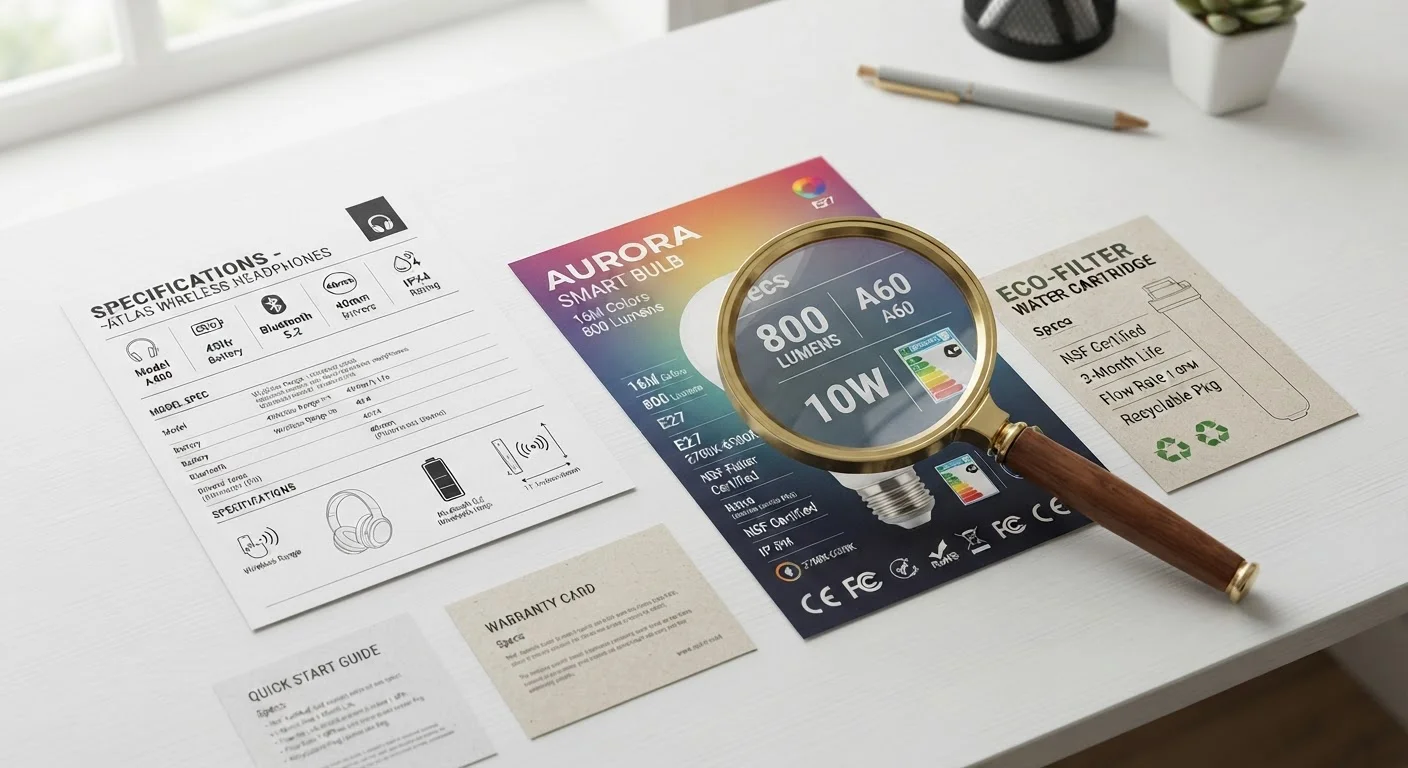
Manufacturers publish specifications for two reasons: to give buyers objective information, and to position their product favorably against competitors. Both goals coexist in every spec sheet, which means the information is useful but not unbiased. Understanding this upfront changes how you read the numbers.
A spec sheet is a legal and commercial document. The numbers in it are usually accurate in a narrow, technical sense - but they're selected and framed to highlight strengths. Specs that would reflect poorly on a product are rarely volunteered. You'll rarely see a manufacturer list "heavy" or "slow-to-charge" as product attributes, even if those are the honest descriptors.
For a broader framework on reading the information printed on products, see our guide on certifications, ratings, and fine print.
~70%
Shoppers who misinterpret at least one spec
Consumer research from multiple usability studies suggests a large majority of shoppers misread or misapply at least one key specification when evaluating products - often overweighting a single, highly visible number.
3-5
Specs that typically drive 80% of real-world performance
Product engineers and independent reviewers commonly find that a small cluster of specifications - usually three to five - accounts for most of the performance variation consumers actually notice between competing products.
The Difference Between Signal Specs and Noise Specs
Not all specs carry the same weight. Some directly predict whether a product will perform well for your intended use. Others exist primarily because they're easy to inflate and create a favorable impression on a comparison chart. Knowing which is which is the core skill.
Signal specs are directly tied to performance in real conditions. For a vacuum cleaner, suction measured in air watts under standardized testing conditions matters. For a laptop, the processor generation and type of storage drive (SSD vs. older spinning-drive technology) have clear, measurable effects on everyday speed. These specs track closely to actual user experience.
Noise specs are technically real but have little practical bearing on what you care about. Megapixel counts in smartphone cameras beyond a certain threshold, for example, are frequently cited but have a diminishing relationship to photo quality - which is more determined by sensor size, lens quality, and image processing software. Similarly, extremely high thread counts in bedding can reflect aggressive counting methods rather than superior feel or durability.
The fastest way to identify signal specs in an unfamiliar category is to read independent reviews that test products under conditions similar to your own, rather than relying on the manufacturer's comparison charts. Reading consumer reviews without being misled explains how to extract useful signal from review pages.
How Specs Are Measured - and What That Changes
The conditions under which a spec is measured matter as much as the number itself. Two products may list identical specifications but perform very differently because they were tested using different protocols.
Battery life is a useful illustration. A device rated at "12 hours" may achieve that figure with the screen at minimum brightness, Wi-Fi off, and a passive task running. A different product rated at "10 hours" tested under heavier, more realistic conditions might actually outlast it in daily use. Without knowing the test conditions, the numbers are difficult to compare.
This is where third-party standards and certifications provide genuine value. When a spec is tied to a published testing protocol - such as an ANSI standard for flashlight brightness, or an EPA test cycle for appliance energy use - you have a consistent basis for comparison. Manufacturer-only claims don't offer that baseline. For a deeper look at what certifications actually verify, our plain-language guide to safety certifications breaks down the major marks.
Search for the Test Standard, Not Just the Number
When a spec matters to you, look up whether it references a recognized testing standard (e.g., ANSI, IEC, EPA, UL). A number tied to a published standard is far more comparable across products than a manufacturer-defined figure. If no standard is cited, treat the number as informational rather than comparative.
Matching Specs to Your Actual Use Case
The most underused question when reading a spec sheet is: Does this spec matter for how I'll actually use this product? A spec that's critical for one user is irrelevant for another.
Consider water resistance ratings on electronics, expressed as IP (Ingress Protection) codes. An IP67 rating means the device can withstand submersion in up to one meter of water for 30 minutes under controlled conditions. If you work outdoors or near water, that spec is directly meaningful. If you'll use the device at a desk, it's worth noting but shouldn't drive the decision. The same logic applies to load ratings on furniture, lumens output on lighting, and BTU capacity on HVAC equipment.
A practical approach: before reading a spec sheet, write down the two or three ways you'll most regularly use the product and the conditions it'll face. Then look specifically for specs that map to those scenarios. This filters out the noise and focuses your attention on the numbers that will predict your actual experience.
Specs are one layer of the quality picture. For a fuller view of what drives how long a product holds up, see our article on build quality vs. brand name. And if you're building this kind of product evaluation skill from the ground up, Product Knowledge From Scratch is a useful starting point.
Frequently Asked Questions
"Up to" signals a best-case figure measured under ideal or controlled conditions. In real-world use, performance often falls short of that ceiling. Treat any "up to" claim as an upper boundary, not a typical expectation.
Not necessarily. Higher numbers often signal more capability, but only if you need that capability. Excess specs beyond your actual use case add cost without adding value, and can sometimes indicate marketing inflation rather than meaningful engineering differences.
Look for third-party certifications or test standards printed on the product or packaging - such as Energy Star ratings or ANSI/ISO ratings for protective gear. Manufacturer-only figures lack external accountability. Our article on <a href="/smart-shopping/product-knowledge/safety-certifications-for-consumer-products-a-plain-language-reference">safety certifications for consumer products</a> covers the major marks to look for.
No. The relevant specs differ significantly by category. For appliances, energy efficiency and capacity tend to matter most. For electronics, the relevant specs depend on your specific tasks. Learning the two or three specs that drive real performance in a given category is more valuable than reading the full list.
Specs are one input among several. Build quality, certifications, warranty terms, and real-user reviews all carry weight that raw numbers can't capture. Specs are best used to screen out products that clearly can't meet your needs, rather than as the sole basis for a decision.
The content on this site is provided for informational purposes only and should not be considered a substitute for professional advice. While we strive to provide accurate and up-to-date information, we make no guarantees regarding its completeness or accuracy. Always consult a qualified professional for advice specific to your circumstances before making any decisions.