

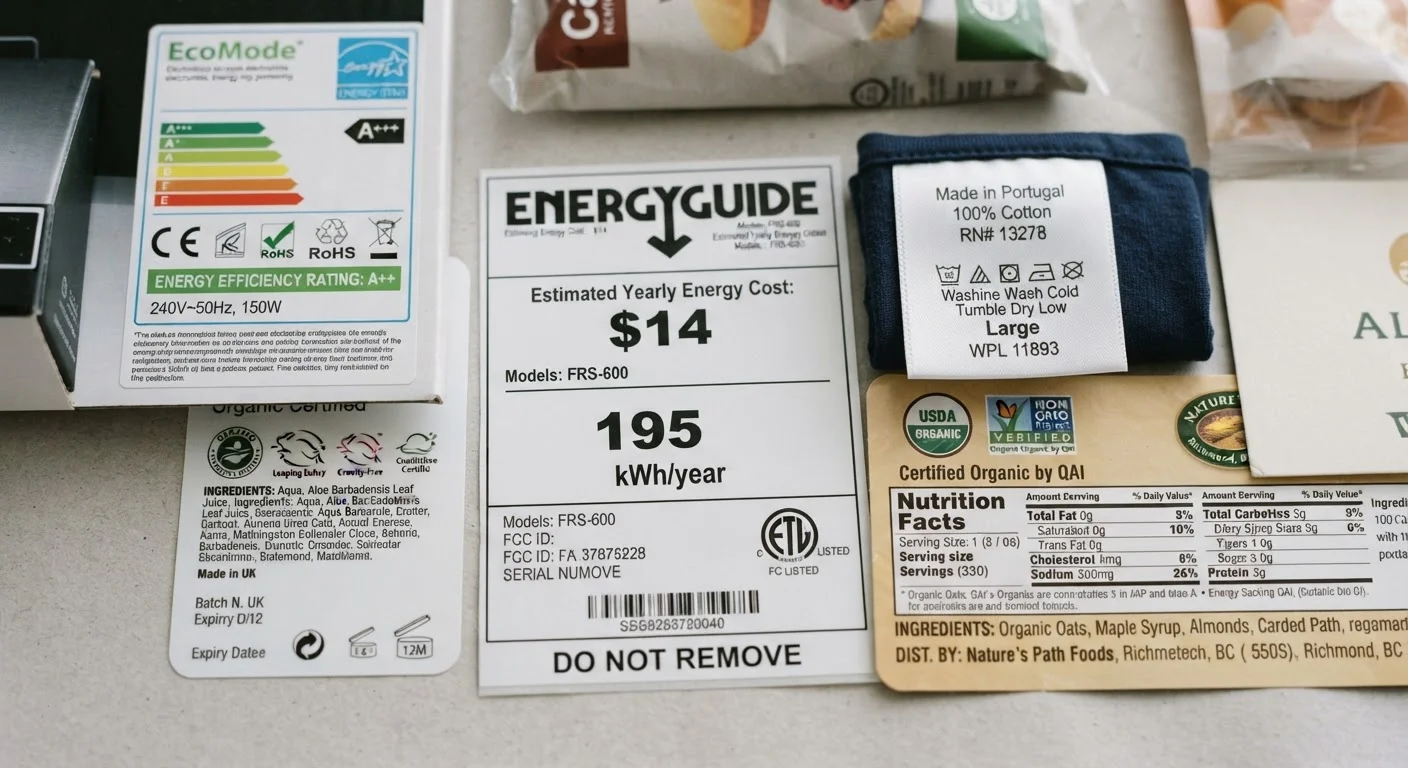
Why Product Labels Are Worth Decoding
Most shoppers scan a product label for the price and maybe the brand. But a label's real value sits in the small print, the stamped logos, and the rating scales that marketers didn't choose - because most of those elements weren't placed there voluntarily. They reflect third-party testing, regulatory mandates, or industry-wide standards that exist whether a company likes them or not.
Understanding what those marks mean shifts you from relying on advertising language to reading objective signals. That's a meaningful advantage when you're evaluating quality and safety across similar products. For a broader framework on how to put all these signals together, see our complete product evaluation framework.
| UL Mark Requirement | Not federally mandated for most products, but required by many jurisdictions and retailers (UL.com, general certification information) |
| ENERGY STAR Program Operator | U.S. Environmental Protection Agency (EPA) (energystar.gov) |
| EnergyGuide Label Authority | Federal Trade Commission (FTC) (FTC Appliance Labeling Rule) |
| WaterSense Water Savings Threshold | At least 20% less water than standard comparable products (EPA WaterSense program specifications) |
| CE Marking Verification | May be self-certified by manufacturer; independent testing not always required (European Commission product regulation guidance) |
| IP Rating Standard | IEC 60529 - international standard for enclosure protection ratings (International Electrotechnical Commission) |
Safety and Compliance Certifications
Safety marks are among the most regulated symbols on a consumer product. In the United States, several carry specific legal weight:
- UL Listed / UL Recognized: Underwriters Laboratories (UL) is an accredited third-party testing organization. A UL Listed mark means the complete product was tested against UL's safety standards. UL Recognized applies to components intended for use inside larger products. Neither mark guarantees the product will last a long time - only that it met defined safety benchmarks at the time of testing.
- FCC ID: Required by the Federal Communications Commission for electronics that emit radio frequency energy. An FCC ID confirms the device was authorized before reaching market - it's a compliance marker, not a quality indicator.
- ETL Listed: ETL marks, issued by Intertek, carry equivalent legal standing to UL marks for electrical safety purposes. Products may carry one or the other; both are OSHA-recognized Nationally Recognized Testing Laboratories (NRTLs).
- CE Marking: A self-declaration mark used on products sold in the European Economic Area. It indicates the manufacturer claims conformity with applicable EU directives. Unlike UL or ETL, CE marking does not always require independent third-party verification - the manufacturer may self-certify.
For a full breakdown of these and related marks, our plain-language safety certifications reference covers which products are required to carry each one.
Efficiency Ratings and Environmental Labels
Performance and environmental labels occupy a different tier from safety marks - they measure how well a product does its job and at what cost to energy or resources.
- ENERGY STAR: A voluntary program administered by the U.S. Environmental Protection Agency (EPA). Products earning this label meet efficiency thresholds the EPA sets for each product category. The thresholds vary - a certified refrigerator meets different criteria than a certified light fixture - so the mark signals meaningful efficiency within its category, not a universal standard.
- EnergyGuide Label: Required by the Federal Trade Commission (FTC) on many appliances, this yellow-and-black label estimates annual energy consumption and operating cost. The range shown reflects where the model falls compared to similar products - a useful apples-to-apples comparison tool.
- WaterSense: An EPA partnership program for water-efficient fixtures and irrigation products. Products must be independently certified to use at least 20% less water than standard models while maintaining performance.
NRTL
Nationally Recognized Testing Laboratory - an organization accredited by OSHA to test products against established safety standards. UL, ETL (Intertek), and CSA Group are common NRTLs in the U.S. market.
EnergyGuide Label
A yellow label required by the FTC on many home appliances that estimates annual energy use and operating cost, and shows where the product ranks among comparable models.
IP Rating
Ingress Protection rating - a two-digit code indicating a product's tested resistance to dust and water. The first digit covers solids; the second covers liquids, with higher numbers indicating greater protection.
Self-Declaration Mark
A certification that the manufacturer applies based on their own testing or documentation, without mandatory independent third-party verification. The CE mark on products sold in the EU is a common example.
Limited Warranty
A warranty that covers only specific defects, parts, or conditions defined by the manufacturer. It may exclude labor costs, accidental damage, or coverage beyond a prorated period.
Total Cost of Ownership
The full cost of a product over its useful life, including purchase price, energy use, maintenance, and eventual replacement - not just the upfront price.
These labels directly affect total cost of ownership, which spec sheets alone often obscure. For guidance on reading specs alongside these ratings, see what product specifications actually mean.
Fine Print That Actually Matters
Beyond certification marks, product labels carry several categories of fine print worth reading before purchase.
Country of origin is a federally required disclosure for most goods sold in the U.S. It tells you where the product was substantially transformed or assembled - though it says little about component sourcing or actual build quality. Manufacturing origin and product quality explores what this label does and doesn't predict.
Warranty duration and scope are frequently printed on packaging but rarely read carefully. Key distinctions: a limited warranty excludes specific failure types or conditions; a full warranty under federal law requires the manufacturer to repair or replace a defective product at no charge within the warranty period. Note whether labor and parts are both covered, and whether coverage is prorated over time.
IP ratings (Ingress Protection) appear on electronics and indicate resistance to solids and liquids using a two-digit code - IP67, for example, means dust-tight and water-resistant to 1 meter for 30 minutes under lab conditions. Real-world conditions vary.
Prop 65 warnings (California's Safe Drinking Water and Toxic Enforcement Act) appear on products sold in California that contain listed chemicals above threshold levels. A Prop 65 warning doesn't automatically mean a product is dangerous for typical consumer use, but it does signal a substance worth researching further.
Once you're comfortable reading labels, a practical walk-through for evaluating a product before purchase shows how to apply this knowledge systematically.
The content on this site is provided for informational purposes only and should not be considered a substitute for professional advice. While we strive to provide accurate and up-to-date information, we make no guarantees regarding its completeness or accuracy. Always consult a qualified professional for advice specific to your circumstances before making any decisions.