

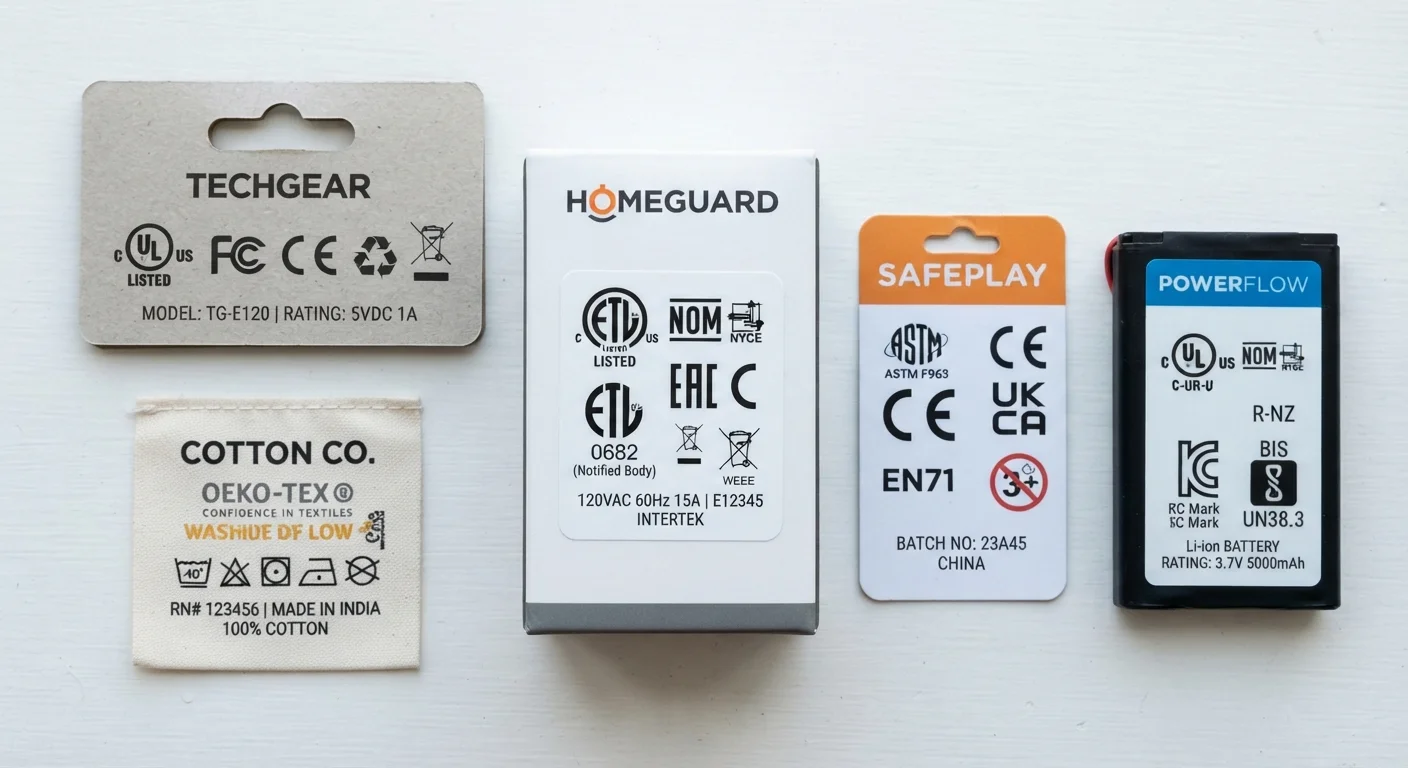
Why Safety Marks Exist - and What They Actually Guarantee
Every year, millions of consumer products enter the U.S. market. Safety certification marks are one of the few tools shoppers have to quickly gauge whether a product has been tested against an established standard - or whether it's been self-declared safe by the manufacturer with no independent check.
The critical distinction: some certifications are mandatory (required by law before a product can be legally sold), while others are voluntary (pursued by manufacturers to signal quality or gain market access). A mark doesn't guarantee a product will never fail, but it does indicate that specific tests were conducted and specific thresholds were met at the time of evaluation.
For a broader look at reading product labels in context, see our full label decoding guide.
| UL certification type | Voluntary, third-party tested (Underwriters Laboratories) |
| FCC authorization | Mandatory for RF-emitting devices sold in the U.S. (Federal Communications Commission) |
| CE mark verification | Self-certified by manufacturer; no independent lab required (European Commission) |
| Energy Star oversight body | U.S. Environmental Protection Agency (EPA) (EPA Energy Star Program) |
| RoHS scope | Limits hazardous substances in electrical and electronic equipment (EU RoHS Directive) |
| Counterfeit mark verification | Check UL Product iQ or the FCC ID search tool online |
The Major Certifications Decoded
Here's what each widely encountered mark actually represents:
UL (Underwriters Laboratories)
A voluntary mark issued by a U.S.-based third-party testing organization. UL evaluates products - primarily electrical and fire-safety related - against published safety standards. A UL Listed mark means independent lab testing was performed. Common on appliances, extension cords, power strips, and electronics.
FCC (Federal Communications Commission)
A mandatory U.S. federal requirement for any device that emits radio frequency energy - which includes most electronics sold today. FCC authorization verifies that a device won't harmfully interfere with radio communications. It does not address electrical or fire safety. Look for the FCC ID on the device or its packaging.
CE Mark
Mandatory for products sold in the European Economic Area (EEA). It covers a wide range of directives including electrical safety, electromagnetic compatibility, and toy safety. When you see CE on a product sold in the U.S., it signals the manufacturer complied with EU standards - but CE does not indicate U.S. regulatory approval, nor is it verified by an independent body; manufacturers self-certify.
RoHS (Restriction of Hazardous Substances)
An EU directive restricting the use of specific hazardous materials - including lead, mercury, and cadmium - in electrical and electronic equipment. Products labeled RoHS-compliant have been designed to limit these substances below set thresholds. This is especially relevant for electronics, circuit boards, and cables.
Energy Star
A voluntary U.S. Environmental Protection Agency (EPA) program. Products earning the Energy Star label meet energy efficiency guidelines that typically exceed federal minimums. Relevant for appliances, HVAC equipment, lighting, and electronics. Reducing energy draw can lower operating costs over a product's lifetime.
CARB (California Air Resources Board)
Relevant to products with engines, certain paints, adhesives, and even some furniture. CARB standards often exceed federal requirements and apply broadly across the U.S. because California's market size drives manufacturers toward compliance nationally.
Third-party certification
Testing and verification performed by an independent organization - not the manufacturer - against a published standard. UL Listed is a common example. Third-party certification generally provides stronger assurance than self-certification.
Self-certification
When a manufacturer declares its own product compliant with a standard without independent lab testing. The CE mark on products sold in the EU is self-certified. It indicates the manufacturer believes the product meets requirements, but no outside party has verified this claim.
Mandatory certification
A certification required by law before a product can be legally sold in a given market. FCC authorization for RF-emitting devices sold in the U.S. is mandatory. Products without it cannot legally be marketed.
Voluntary certification
A certification that manufacturers pursue by choice to demonstrate quality or access certain markets. UL and Energy Star are voluntary. Absence of a voluntary mark doesn't mean a product is unsafe, but presence adds confidence.
RoHS compliance
Adherence to the EU's Restriction of Hazardous Substances directive, which limits lead, mercury, cadmium, and other materials in electronics. Products labeled RoHS-compliant have been formulated to keep these substances below specified thresholds.
FCC ID
A unique identifier assigned to RF-emitting devices that have received FCC authorization. It can be searched in the FCC's online database to verify a device's authorization and view its technical test reports.
How to Use This Knowledge When Shopping
Spotting a mark is step one - interpreting it correctly is what matters. A few practical rules of thumb:
- Mandatory marks are a floor, not a ceiling. FCC authorization means a device meets interference rules; it says nothing about build quality or longevity.
- Third-party verification is stronger than self-certification. UL Listed (tested by an independent lab) carries more weight than a CE mark (manufacturer self-declares compliance).
- Counterfeit marks exist. Fraudulent UL and CE marks appear on low-quality imports. Cross-check using UL's online Product iQ database or check the FCC ID at the FCC's official ID search tool.
- Multiple marks can be complementary. An appliance might legitimately carry UL, Energy Star, and RoHS - each covering a different dimension of performance or safety.
For structured guidance on evaluating any product before purchase, the practical product evaluation walk-through lays out a systematic process. And if decoding spec sheets alongside certifications feels overwhelming, understanding what product specifications actually mean is a useful companion read.
The content on this site is provided for informational purposes only and should not be considered a substitute for professional advice. While we strive to provide accurate and up-to-date information, we make no guarantees regarding its completeness or accuracy. Always consult a qualified professional for advice specific to your circumstances before making any decisions.