

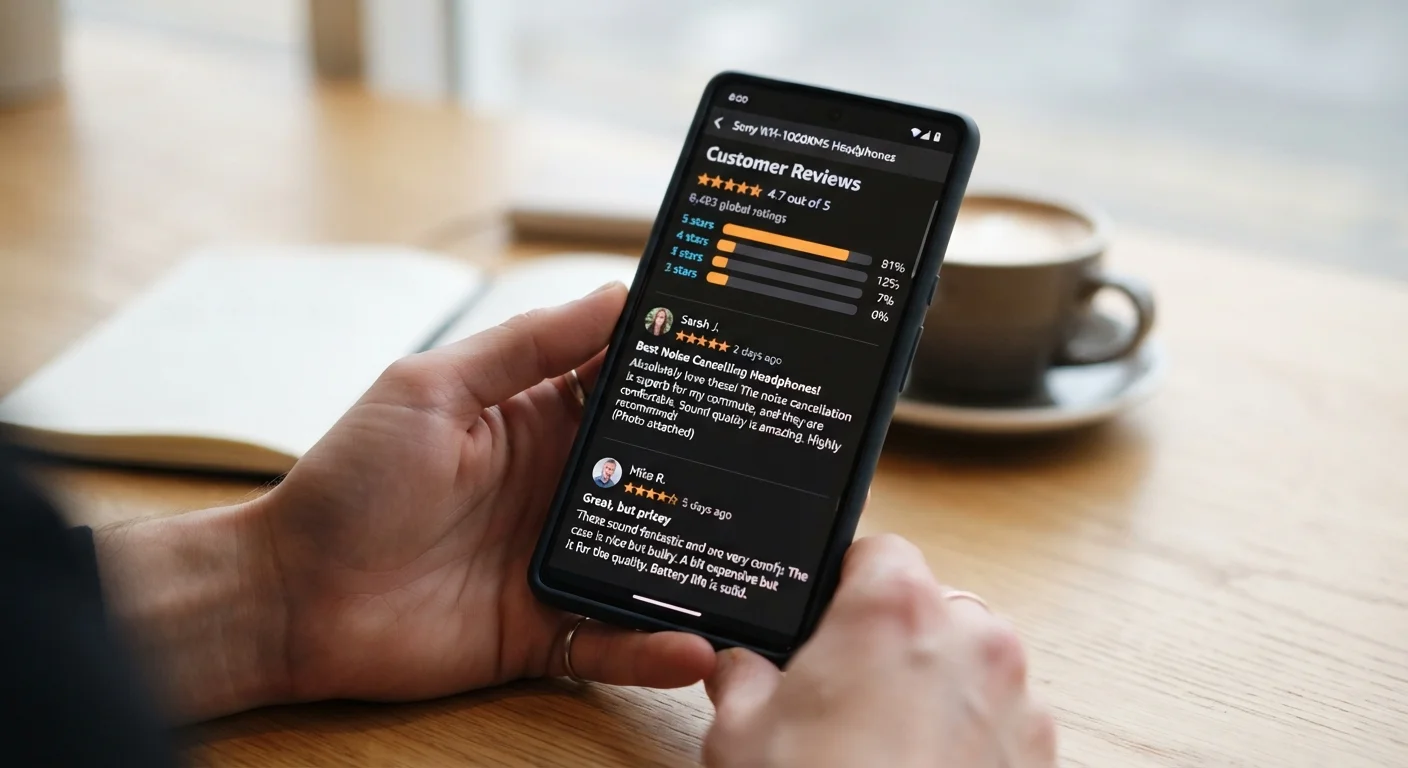
Why Star Ratings Mislead More Than They Inform
A 4.4-star rating sounds reassuring - until you notice it's built on 11 reviews, seven of which arrived in the same week. Or that the distribution shows hundreds of 5-star and 1-star reviews with almost nothing in between. Both scenarios tell you something is off, but the aggregate number hides it completely.
Average ratings compress complex, varied consumer experiences into a single number. That compression loses the information you actually need: who had problems, what went wrong, and when. Before treating any star rating as a quality signal, look at the full distribution. A bimodal distribution - heavy at both extremes - often means the product works well for one use case and poorly for another, or that the reviews themselves are compromised.
Review counts matter too, but not linearly. A product with 3,000 reviews accumulated over three years is a very different dataset than one that hit 3,000 reviews in three months. Platform algorithms sometimes surface fast-growing review counts as social proof, but rapid accumulation warrants closer scrutiny, not more trust.
How to Spot Fake and Incentivized Reviews
Fake and incentivized reviews are a documented, persistent problem on every major retail platform. Researchers and investigative journalists have repeatedly found that product categories with high margins - electronics, supplements, kitchenware - show especially high rates of review manipulation.
42%
Online reviews estimated to be fake or unreliable
A 2021 analysis by the World Economic Forum estimated that a significant share of online consumer reviews across major platforms lack authenticity, citing incentivized and fraudulent submissions.
3 in 4
Shoppers who say reviews influence purchase decisions
Research consistently finds that a large majority of American consumers consult online reviews before buying, making review integrity a consequential consumer issue.
Several patterns reliably flag suspicious reviews. Watch for: generic, non-specific praise that could apply to almost any product in the category; reviewers who have left dozens of 5-star reviews in a short period across unrelated categories; reviews that read as templates with slightly varied wording; and a sudden spike in reviews following a product launch or price change.
Incentivized reviews - where buyers received a discount or free product in exchange for a review - are required by the FTC to be disclosed, but that disclosure is often buried or omitted entirely. A review that leads with enthusiasm about receiving the item for free or at a discount is telling you its objectivity is limited, regardless of what the reviewer says next.
Tools that analyze review patterns across time (several browser extensions do this for major retail sites) can surface these anomalies automatically, but you can catch most red flags by spending two minutes on the reviewer profile and the review date histogram before trusting a rating.
Where the Useful Signal Actually Lives
The most actionable review content is almost never in 5-star reviews. Highly satisfied customers tend to be brief and non-specific. The useful signal lives in three places: detailed mid-range reviews (3-4 stars), well-reasoned critical reviews (1-2 stars), and Q&A sections.
Sort reviews by most recent, not most helpful, to catch quality changes after product revisions.
Manufacturers update products - sometimes improving them, sometimes cutting costs - without changing the listing. A product that earned strong reviews two years ago may have since changed. Recency filtering catches this drift before you buy.
Read the lowest-rated reviews that include verified purchase badges first.
Verified purchase status doesn't guarantee legitimacy, but it does raise the floor on credibility. Low-rated verified reviews are where you're most likely to find honest accounts of failure modes, durability issues, and unmet expectations.
Look for recurring specific complaints rather than reacting to individual extreme opinions.
One furious 1-star review is anecdote. Five unrelated reviewers independently describing the same hinge failure, seam splitting, or error code is a pattern - and patterns are reliable predictors of your own experience.
Check reviewer profiles for credibility signals before weighting their opinion.
A reviewer who has left 40 five-star reviews in 30 days across unrelated product categories is not a reliable consumer voice. A reviewer with a history of mixed ratings, detailed writing, and product-specific knowledge is far more credible.
Use the Q&A section to find answers to specific use-case questions you care about.
Q&A responses come from real owners who have used the product in real conditions. Unlike reviews, they're structured around specific questions, making the information easier to apply to your own situation.
When reading critical reviews, look for specificity. A review that says "broke after three months of normal use" is more informative than "terrible product." If multiple unrelated reviewers describe the same failure - a hinge cracking, a seal leaking, a battery degrading - that pattern is a genuine product signal, not noise.
Q&A sections are underused. Real owners answering real questions often reveal durability details, compatibility issues, and use-case limitations that never appear in formal reviews. They're also harder to game.
For a fuller picture of any product, pair your review research with a look at what the specs actually tell you. Our guide on what product specifications actually mean can help you connect review complaints to underlying design and material choices.
Cross-Platform Verification and When to Trust Reviews
No single retail platform has a clean review ecosystem. The most reliable approach is cross-referencing: check the same product's reviews on at least two different retail sites, and look for independent forum discussions or owner communities where there's no purchase incentive at all.
Specialty forums, subreddits, and category-specific communities tend to have experienced users who describe real ownership experiences in detail. These posts age well and aren't subject to the same manipulation incentives as retail review systems.
Once you've read reviews critically, integrate that information into a broader evaluation. The practical walk-through for evaluating a product before you buy shows how to combine review signals with physical inspection and spec analysis into one coherent assessment.
If you're evaluating a vehicle rather than a consumer product, the same skepticism about self-reported information applies. Our guide on reading a vehicle history report without missing the red flags walks through a similar discipline of pattern-spotting in a different context.
The content on this site is provided for informational purposes only and should not be considered a substitute for professional advice. While we strive to provide accurate and up-to-date information, we make no guarantees regarding its completeness or accuracy. Always consult a qualified professional for advice specific to your circumstances before making any decisions.