

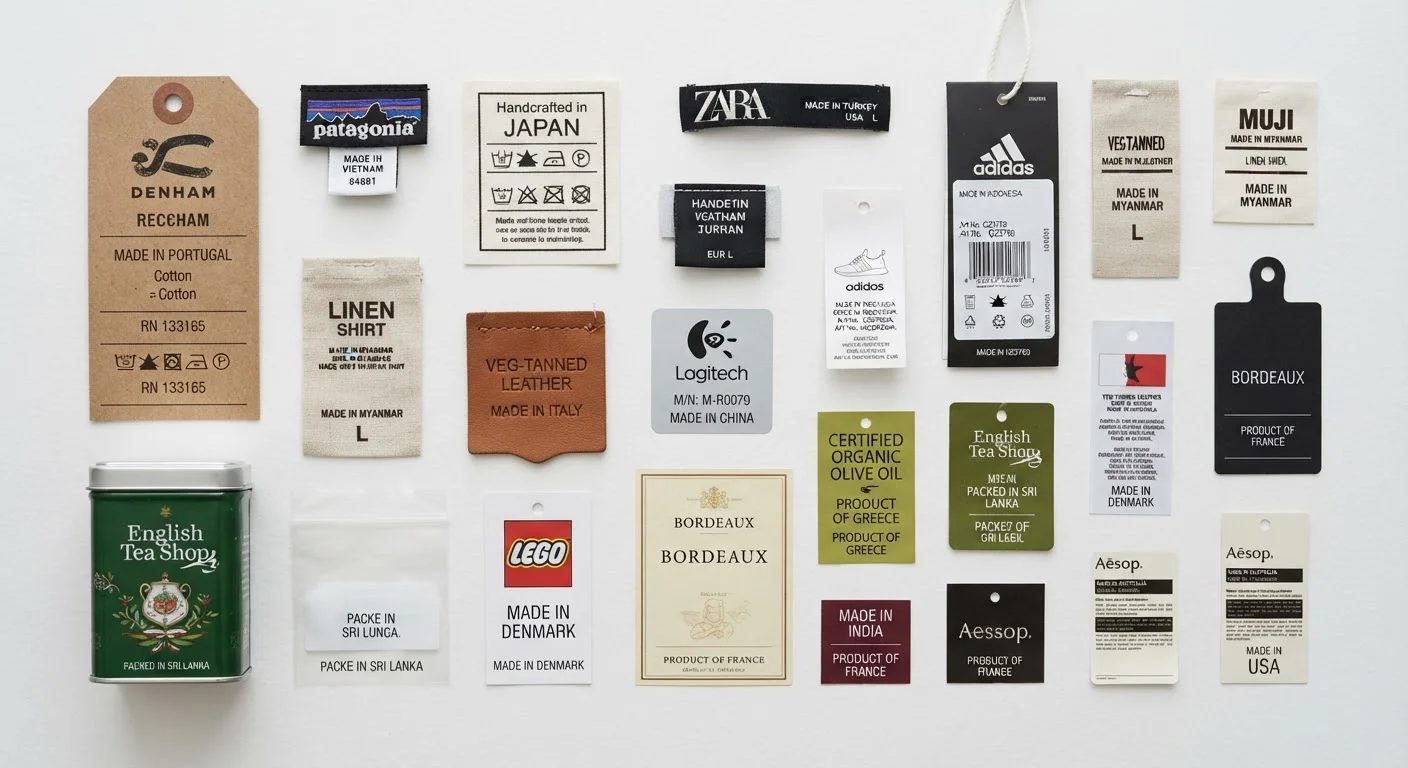
Why Origin Labels Persist as Quality Signals
Shoppers have long used "Made in" labels as a mental shortcut for quality. The intuition isn't irrational - there was a period when country-of-origin strongly correlated with manufacturing capability. Postwar decades cemented reputations: German engineering, Japanese precision, American steel. Those associations stuck in consumer memory long after global supply chains scrambled the picture.
Today, most physical goods are the product of multinational manufacturing networks. A single consumer product may source raw materials from one continent, process them in another, and assemble the final unit in a third location - yet carry a single country label. Understanding what that label actually certifies is the starting point for cutting through the myths.
For a fuller view of how labels communicate quality (and when they don't), see how to decode product certifications and fine print.
Myth
"Made in [Country]" means the entire product was designed and built there.
Fact
Origin labels legally reflect where the last substantial transformation occurred - typically final assembly - not where components were sourced or engineered.
U.S. Customs rules and the FTC's "Made in USA" standard both define origin based on transformation thresholds, not total content. A product assembled domestically from largely imported parts may still carry a domestic label under some labeling frameworks. Conversely, a product designed in one country and assembled in another carries the assembler's location on its label. The label tells you where the final step happened - nothing more.
Myth
Products made in lower-wage countries are inherently lower quality.
Fact
Wage levels in a manufacturing region do not determine output quality; specifications, process controls, and quality audits do.
Labor cost is one input among many. Facilities in lower-wage regions routinely produce components and finished goods to tight aerospace, medical, and consumer electronics specifications for global brands. The deciding factor is what the contracting company demands and how rigorously it enforces those demands. Many high-end electronics, precision instruments, and performance textiles are manufactured in regions with lower average wages - and meet or exceed quality expectations consistently.
Myth
If a country has a strong manufacturing reputation, all products from there are high quality.
Fact
Country-level reputations are statistical generalizations; individual factories and products vary enormously within any nation.
National manufacturing reputations reflect historical industry strengths in particular sectors, not a universal guarantee. Germany's reputation for engineering precision applies strongly to certain industrial and automotive sectors but says little about a generic household good produced there. Similarly, Japan's electronics heritage doesn't automatically extend to every product category manufactured within its borders. Evaluate at the product and manufacturer level, not the country level.
Myth
Reshoring production automatically improves product quality.
Fact
Moving production closer to home changes cost structure and supply chain risk - quality outcomes depend on how well the transition is managed.
Reshoring can improve quality if it brings manufacturing under tighter direct oversight, reduces logistics complexity, or allows faster defect feedback loops. But it can also introduce new quality challenges if the workforce or equipment isn't well-matched to the product's requirements. Quality improvements from reshoring are the result of deliberate investment in process capability, not a geographic automatic. For insight into how build quality signals durability independent of brand or origin, see what actually predicts how long a product lasts.
Myth
A product with more countries in its supply chain is lower quality.
Fact
Global supply chains exist because different regions have specialized capabilities; multi-country sourcing is standard practice for quality products.
Modern supply chains are built around specialization. Semiconductor fabrication, precision optics, high-grade steel, and specialty chemicals each have regional centers of expertise. A finished product drawing on multiple specialized sources isn't a quality compromise - it's often the opposite. What matters is whether each supplier in the chain meets the required specifications, not how many countries are involved.
What Actually Drives Manufacturing Quality
Quality in manufactured goods is primarily a function of process discipline: the specifications a company sets, the tolerances it enforces, and the quality-control systems it runs - regardless of which facility executes the work. A factory in any country can produce excellent or poor output depending on how it is managed and what standards it is required to meet.
70%+
Global trade in intermediate goods
World Trade Organization data consistently shows the majority of international trade involves components and intermediate inputs, not finished consumer goods.
~40%
Foreign content in U.S. imports labeled as domestic
Research from the Federal Reserve has found that goods labeled as U.S.-origin often contain substantial imported content, reflecting complex assembly chains.
This is why the same global brand often manufactures identical product lines in multiple countries and achieves consistent results. The specifications travel with the contract; the geography is incidental. Conversely, a facility in a country with a strong quality reputation can produce substandard output if the buyer sets loose specifications or skips independent audits.
When evaluating a product, the more informative signals are material grades, dimensional tolerances, testing certifications, and warranty terms - the kinds of details covered in understanding which product specifications actually matter. Origin is one data point among many, and rarely the most predictive one.
Don't Mistake Certification for Origin
A product can be manufactured anywhere and still carry legitimate third-party certifications (UL, CE, ISO, Energy Star) that reflect real, independently verified performance and safety standards. Conversely, a domestic origin label carries no implied certification. When safety or performance is critical, look for relevant certifications rather than relying on geography as a proxy.
The relationship between price and quality is similarly complicated by origin assumptions. For a grounded look at when higher prices reflect genuine engineering versus positioning, see when premium pricing reflects real quality. And to understand how brand-name, OEM, and store-label products relate to manufacturing origin, OEM vs. generic vs. store-brand explained is worth reading alongside this piece.
The content on this site is provided for informational purposes only and should not be considered a substitute for professional advice. While we strive to provide accurate and up-to-date information, we make no guarantees regarding its completeness or accuracy. Always consult a qualified professional for advice specific to your circumstances before making any decisions.