

Why Shady Spots Are Worth Cultivating
If a large tree dominates your backyard or your home casts long shadows across a side yard, it can feel like those areas are simply off-limits for gardening. But shaded spaces are genuinely rich growing environments - they just require a different plant vocabulary than sun-drenched borders.
Before selecting any plant, identify the type of shade you're working with. Partial shade means two to four hours of direct sun daily, usually in the morning or late afternoon. Full shade means less than two hours of direct sun, with filtered or reflected light for the rest of the day. Deep shade - found under dense evergreens or in narrow alleys - receives virtually no direct sunlight and presents the steepest challenge.
Most shade-tolerant plants are adapted to these conditions naturally, often originating in forest understories. That ecological context is worth keeping in mind: pairing your shade plants with regionally native species can reduce maintenance and support local wildlife. For a broader look at that approach, see our article on native plants and why ecologists keep recommending them.
Hostas
Hostas are arguably the most reliable shade perennials available to American gardeners. They come in an enormous range of leaf sizes, colors - from chartreuse to deep blue-green - and textures, making them highly versatile as focal points or mass plantings. They grow back each year from the same crown, slowly expanding their clump size over time.
Plant hostas in moist, well-drained soil and keep them consistently watered during dry spells. Slugs are their primary pest; a layer of coarse mulch or diatomaceous earth around the base can help deter them without chemical intervention.
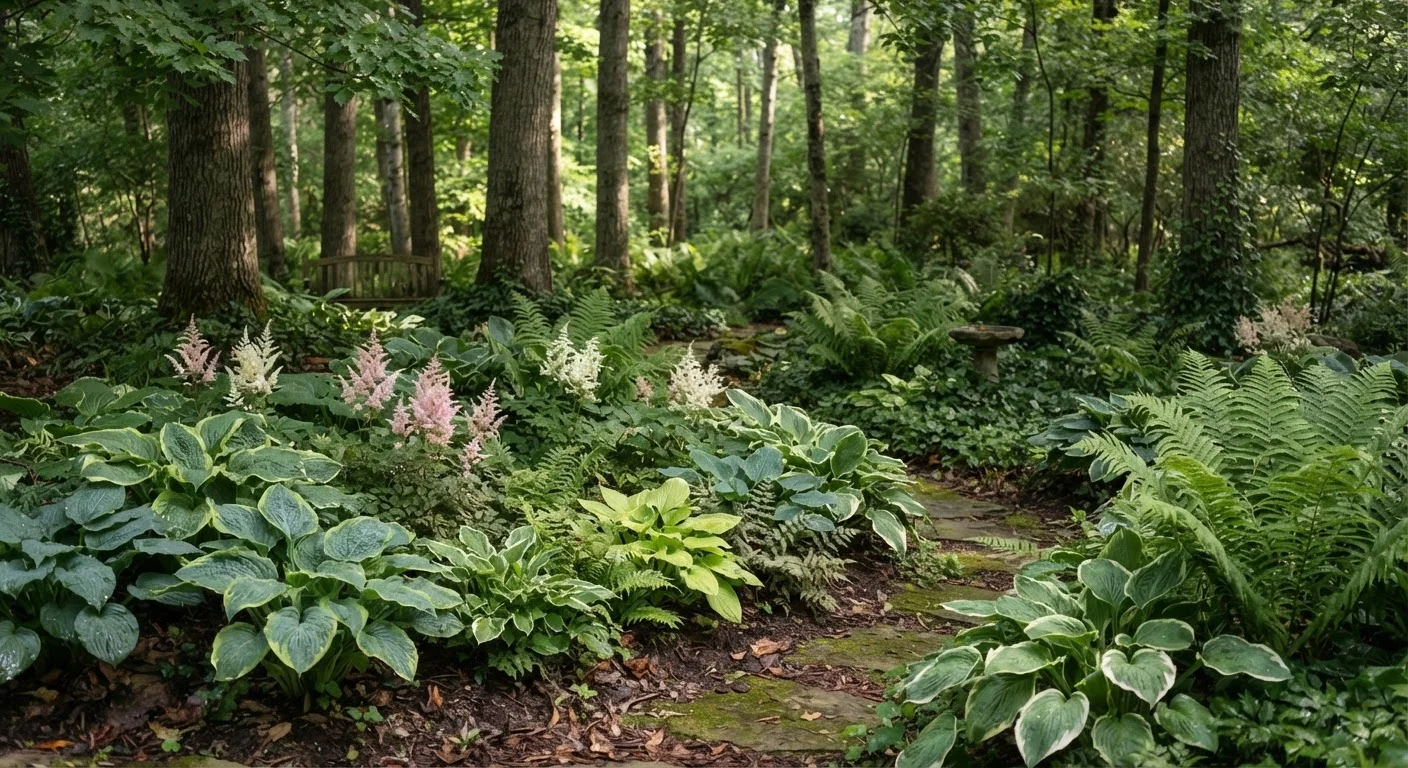
Hostas return year after year, gradually expanding into dramatic, low-maintenance clumps of foliage.
Ferns
Hardy ferns bring a soft, feathery texture to shaded borders that few other plants can match. Varieties such as ostrich fern (Matteuccia struthiopteris), autumn fern (Dryopteris erythrosora), and lady fern (Athyrium filix-femina) are well-suited to much of the continental United States. Most prefer consistently moist soil and will struggle if allowed to dry out completely.
Ferns pair beautifully with hostas and astilbe, providing contrasting textures that make a shade bed feel dynamic even without many flowers. Many native fern species also support local invertebrate populations, adding ecological value to your garden.
Ferns offer unmatched feathery texture and pair naturally with almost every other shade-tolerant perennial.
Astilbe
If you want color in a shaded garden, astilbe delivers reliably. Its plume-like flower spikes rise in shades of white, pink, red, and lavender during summer, depending on the variety. After blooming, the dried seed heads add visual interest well into fall and can be left standing for winter texture.
Astilbe performs best in partial shade with consistently moist soil - it does not tolerate drought well. Divide established clumps every three to four years to keep plants vigorous and blooming freely.
Astilbe produces striking flower plumes in summer and tolerates shade better than most flowering perennials.
Bleeding Heart
Bleeding heart (Lamprocapnos spectabilis, formerly Dicentra spectabilis) is a classic cottage-garden perennial well adapted to part shade. Its arching stems carry rows of pendulous, heart-shaped flowers in pink or white during spring. The foliage dies back naturally in midsummer heat, so plan to fill that gap with later-emerging plants like astilbe or hostas.
Fringed bleeding heart (Dicentra eximia), a native species, blooms over a much longer season and stays evergreen in mild climates, making it an excellent alternative for gardeners who want low-maintenance coverage.
Bleeding heart's distinctive heart-shaped spring blooms make it one of the most recognizable shade perennials.
Lungwort (Pulmonaria)
Lungwort is an underappreciated workhorse of the shade garden. It blooms very early in spring - often before many other perennials emerge - with tubular flowers that shift from pink to blue as they age. Its leaves, typically spotted or silvered, remain attractive throughout the growing season and provide low ground-level coverage.
Lungwort prefers cool, moist conditions and can scorch in afternoon sun, making it well-suited to deep or full shade situations where other flowering plants struggle. It spreads gradually but is not aggressively invasive.
Lungwort blooms earlier than almost any other shade perennial, bridging the gap between winter and spring.
Sweet Woodruff
Sweet woodruff (Galium odoratum) is a low-growing ground cover that forms a weed-suppressing mat of bright green, whorled foliage topped with tiny white flowers in spring. It thrives in part to full shade and spreads readily, making it an efficient solution for bare soil under trees where little else will grow.
While sweet woodruff's spreading habit is a benefit under challenging trees, it can become a nuisance in more open beds. Choose its location deliberately and contain it with edging if needed. Its fragrant, hay-like scent when dried has made it a traditional inclusion in sachets and herbal crafts.
Sweet woodruff's spreading mat of foliage is one of the most effective weed suppressors for dry shade under trees.
Japanese Forest Grass (Hakonechloa)
Japanese forest grass (Hakonechloa macra) is a graceful, clump-forming ornamental grass that performs beautifully in partial to full shade - unusual for grasses, which almost universally prefer sun. Its cascading, golden-green or variegated foliage adds a softening, flowing quality that contrasts well with bold-leafed hostas or the vertical structure of ferns.
It grows slowly but is long-lived and very low-maintenance once established. In fall, the foliage often takes on warm amber and russet tones, extending seasonal interest well beyond summer.
Japanese forest grass is one of very few ornamental grasses that genuinely thrives in shaded conditions.
Designing Your Shade Garden for Long-Term Success
Once you've chosen your plants, a few design principles will help the space feel intentional rather than accidental. Layer plants by height - taller shrubs in the back, mid-height perennials in the middle, and low ground covers at the front - to mimic the natural structure of a woodland floor. This approach also ensures that light reaching the ground is used as efficiently as possible.
Amend Soil Before You Plant
In shaded areas under established trees, soil is often compacted and nutrient-poor due to root competition. Work in a two- to three-inch layer of compost before planting to improve both fertility and moisture retention. Avoid adding soil directly on top of large surface roots, as this can suffocate them and damage the tree.
Soil preparation is especially important in shaded areas. Tree roots compete aggressively for water and nutrients, so amending your soil with compost before planting gives new additions a real advantage. Mulching with two to three inches of shredded bark helps retain moisture and reduces competition from weeds - both welcome benefits in low-maintenance shade beds.
If you're working with a small or unconventional space, container gardening is another way to bring shade-tolerant plants to spots where in-ground planting isn't practical. Our guide on container gardening without a yard covers the setup basics. And when spring arrives, don't overlook your shaded beds during seasonal prep - the spring yard prep checklist includes guidance for all garden zones, shady ones included.
The content on this site is provided for informational purposes only and should not be considered a substitute for professional advice. While we strive to provide accurate and up-to-date information, we make no guarantees regarding its completeness or accuracy. Always consult a qualified professional for advice specific to your circumstances before making any decisions.