

Before You Begin: The Declutter-First Principle
The most common mistake in home organization is reaching for storage bins before deciding what actually deserves a home. Organizing clutter just means clutter with lids. The sequence matters: declutter first, then organize.
For each room, sort items into four categories - keep, donate, relocate (belongs in another room), and discard. Only after this edit should you think about where things live and what containers, if any, they need. If you've never done a full home declutter before, the starting your first real declutter guide walks through the mindset and first steps in depth.
Also worth knowing: common organization myths - like the idea that more bins automatically solve a clutter problem - can quietly undermine your efforts before you start.
When setting up a zone, stand in the position you're in when you use those items - then store them within arm's reach of that exact spot. Most people store for tidiness, not workflow.
Proximity to point of use is the single biggest factor in whether people consistently put things back where they belong, which is what sustains an organization system over time.
Label the inside of cabinet doors with what belongs on that shelf. It takes five minutes and becomes a memory aid for every person in the household, not just the person who set up the system.
Shared household systems break down when only one person knows the logic. Inside-door labels externalize that knowledge so the system runs without enforcement.
Kitchen: Zones, Cabinets, and Counter Control
The kitchen works best when it is organized around activity zones - grouping items by their function and the location where they are used. A coffee zone near the kettle, a cooking zone beside the stove, a prep zone near the cutting board. When everything needed for a task lives together, you stop hunting.
- Cabinets: Store everyday dishes and glasses at eye level. Move rarely used items - specialty bakeware, holiday serving pieces - to higher shelves or elsewhere entirely.
- Drawers: Use dividers to separate utensils by type. A junk drawer is fine; a junk half the kitchen is not.
- Counters: Apply the rule that only daily-use appliances earn counter space. Everything else goes inside a cabinet.
- Pantry or food storage: Group by category (grains, canned goods, snacks) and place older items in front when restocking so nothing expires unnoticed.
Vertical organizers inside cabinets - such as shelf risers or tension rods for cutting boards - dramatically multiply usable space without any construction.
25%
Homes with a two-car garage that can't fit one car
According to a U.S. Department of Energy study, roughly one in four two-car garages cannot accommodate even a single vehicle due to stored items.
40%
Of housework eliminated by reducing clutter
Research from the National Soap and Detergent Association has suggested that eliminating clutter reduces the amount of housework in the average home by roughly 40 percent.
Bedroom and Closet: Calm Starts Here
Bedrooms carry both practical and psychological weight - visual clutter in a sleep environment is linked to poorer rest. The goal here is a room where everything stored has an intentional home.
Closet organization benefits most from a category-first approach: group all tops together, all pants together, all dresses together, rather than organizing by outfit or color. This makes it immediately obvious when a category is overcrowded - which is information, not a problem to hide.
- Add a second hanging rod below shorter garments (jackets, folded trousers) to double hanging capacity instantly.
- Use shelf dividers to keep folded stacks from toppling.
- Store seasonal items - heavy coats in summer, swimwear in winter - in labeled bins on high shelves or under the bed in flat storage containers.
The area under the bed is prime real estate for seasonal or low-frequency items, provided items are in closed containers to prevent dust accumulation. If you have children, the keeping a tidy home with kids guide addresses the particular challenge of bedroom organization in family households.
Bathroom: Small Space, Big Impact
Most bathrooms suffer from too many products and too little surface area. The fix is ruthless editing and vertical thinking.
Start by pulling everything out from under the sink and inside the medicine cabinet. Discard expired medications, empty bottles, and products you haven't used in six months. What remains should earn its place based on how often it is actually used.
- Under the sink: Install a small tension rod to hang spray bottles, freeing up floor space for baskets or bins grouping similar items (hair care, first aid, cleaning supplies).
- Medicine cabinet or wall shelves: Reserve for daily-use items only. Contact lens supplies, medications, toothpaste - not the backup stock of six shampoos.
- Back of door: An over-door organizer or hooks can hold blow dryers, robes, or a pouch of frequently used items without taking any floor or shelf space.
If a bathroom renovation is also on your radar, thoughtful built-in storage planning is covered in the bathroom renovation planning guide.
Living Spaces: Function Meets Comfort
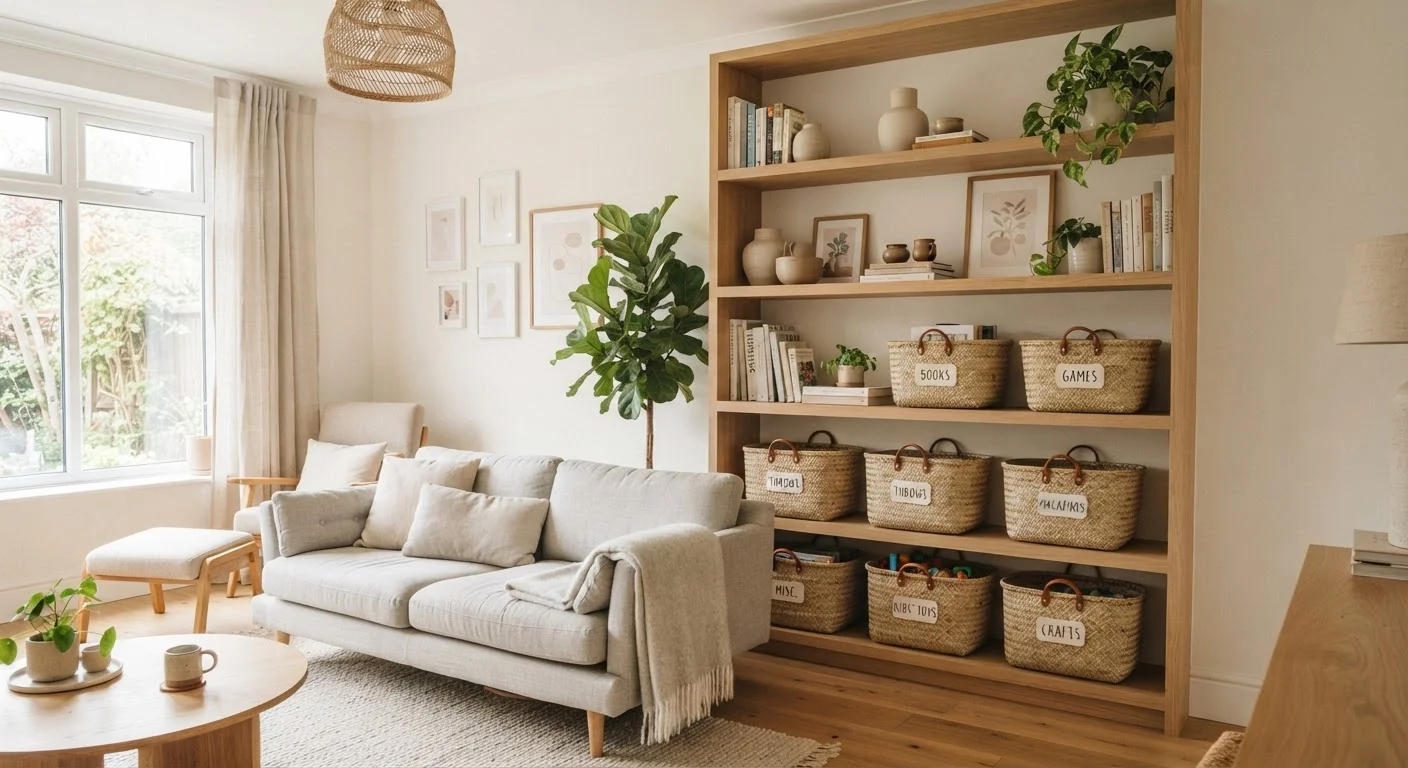
Living rooms and family rooms often accumulate the highest variety of items - books, remotes, toys, paperwork, hobby supplies - because they serve multiple people and purposes. The key is giving each category a specific, visible home so things can be returned easily.
- Media and remotes: A small tray or designated drawer keeps remotes corralled and prevents the nightly search.
- Books and magazines: Shelving works only if it is edited periodically. A shelf stuffed beyond capacity is harder to use than a curated, half-full one.
- Cords and cables: Velcro ties, cord clips, or a simple cable box underneath a media console prevent cable tangles from becoming visual noise.
- Catch-all clutter: A single decorative basket can corral everyday items - throw blankets, children's toys, in-progress projects - so the room reads as tidy even during active family life.
For unfamiliar terms like zone system or capsule storage that appear throughout organization guides, the home organization glossary is a useful quick reference.
Garage and Storage Areas: Taming the Overflow
Garages function best when treated like a warehouse with departments. Wall-mounted shelving, pegboards, and ceiling-mounted storage for seasonal items (holiday decorations, camping gear) all keep the floor clear - which is where most garages fail.
- Group by category and frequency: power tools near the workbench, garden supplies near the exterior door, sports gear together.
- Label every bin, box, and basket. Labeling is the step most people skip and the reason systems collapse within weeks.
- Hazardous materials - paints, pesticides, fuels - must be stored in cool, dry conditions, out of reach of children, and in their original containers. Check your local municipality's guidelines for disposal of expired or unwanted chemicals.
Never Store Flammables Near Ignition Sources
Gasoline, propane, paint thinner, and other flammable liquids should never be stored near water heaters, furnaces, or any appliance with a pilot light or open flame. Even vapors at room temperature can ignite. Store these materials in a detached shed or clearly designated, ventilated area per local fire codes.
Once a garage system is in place, a seasonal declutter checklist run each spring and fall prevents accumulation from undoing the work.
Maintaining Order Over Time
Organization is not an event - it is a set of repeating habits. The rooms that stay orderly are those where the system is easy enough to follow daily, not just on a motivated Saturday afternoon.
Three habits support long-term order in any home:
- One in, one out: When a new item enters a category (a new coat, a new kitchen gadget), an existing one leaves. This keeps volume stable without a major purge.
- Reset before bed: A 10-minute walkthrough returning items to their homes prevents overnight drift from becoming weekend chaos.
- Quarterly review: Every few months, assess one room with fresh eyes. Needs change - a system that worked six months ago may need adjustment.
If your home is approaching a sale, the same organizational thinking applies practically to presentation: the room-by-room home listing checklist walks through each space with that specific goal in mind.
The goal of home organization is not a perfect showroom - it is a space that supports how you actually live, reduces daily friction, and is easy enough to maintain that it becomes second nature.
The content on this site is provided for informational purposes only and should not be considered a substitute for professional advice. While we strive to provide accurate and up-to-date information, we make no guarantees regarding its completeness or accuracy. Always consult a qualified professional for advice specific to your circumstances before making any decisions.