

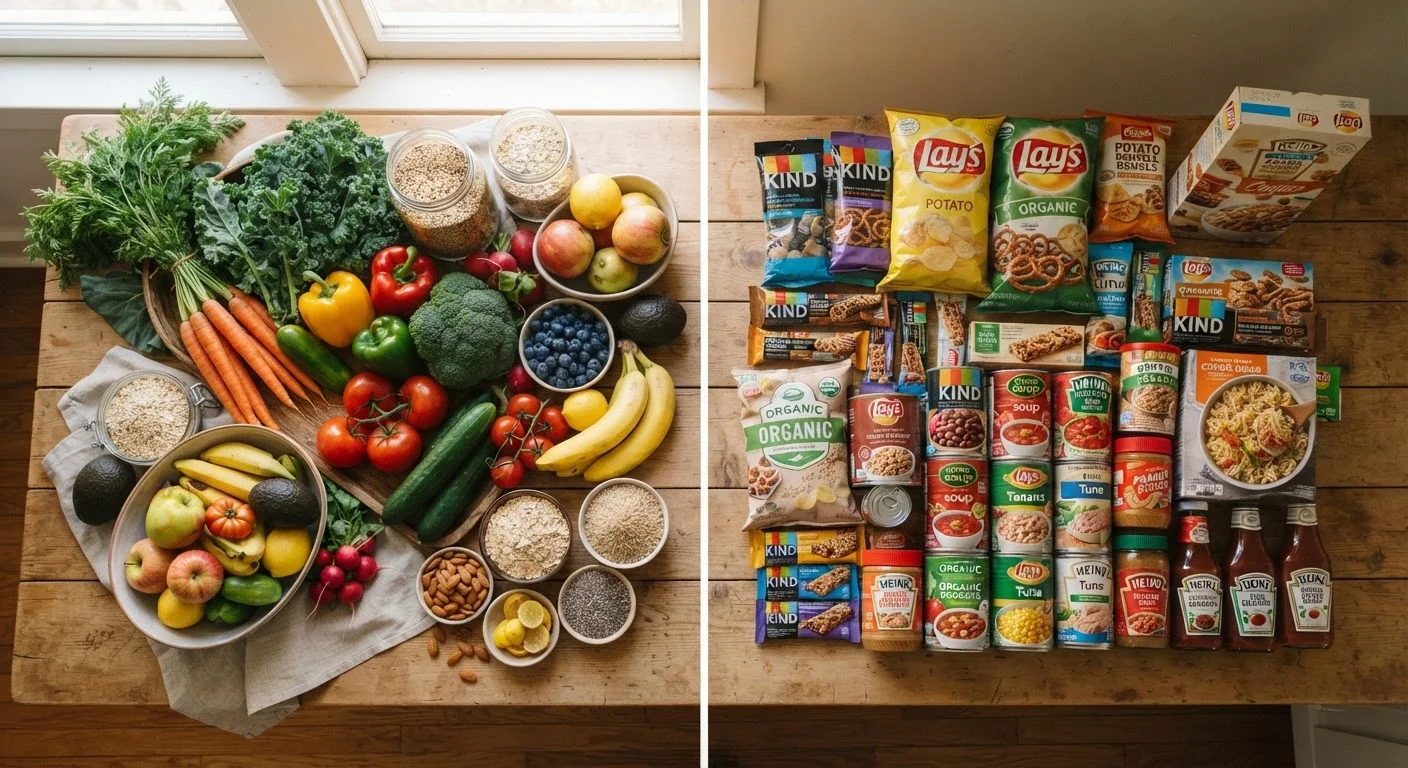
Option A
Whole Foods
Foods in their natural or minimally altered state.
Best for: People looking to maximize nutrient density and minimize additives in their daily diet.
Option B
Processed Foods
Foods altered from their natural state through industrial or culinary methods.
Best for: People navigating convenience, budget, or shelf-stability needs - with context on which types to prioritize.
What Do 'Whole' and 'Processed' Actually Mean?
These terms get thrown around constantly in nutrition conversations, but they're rarely defined clearly. Let's fix that.
Whole foods are foods that remain close to their natural state - think an apple, a handful of almonds, a piece of salmon, or dry lentils. They haven't been stripped of key nutrients or loaded with additives during manufacturing.
Processed foods, by contrast, have been altered from their natural state in some way. That definition is deliberately broad, and that's where the confusion starts. Washing, freezing, canning, fermenting, and milling are all forms of processing. So is adding artificial flavors, colors, stabilizers, and emulsifiers to create a shelf-stable snack product that barely resembles any recognizable ingredient.
Nutrition researchers often use a framework called NOVA, developed by researchers at the University of São Paulo, which sorts foods into four groups based on how extensively they've been processed - from unprocessed whole foods to ultra-processed formulations. This spectrum model is far more useful than a simple whole/processed binary.
| Criterion | Whole Foods | Processed Foods |
|---|---|---|
| Processing level | None or minimal | Ranges from mild to extensive |
| Nutrient density | Generally high | Varies widely by product |
| Fiber content | Naturally present | Often reduced or removed |
| Added sugars & sodium | Absent or trace | Frequently elevated, especially ultra-processed |
| Additives & preservatives | None | Common, especially in ultra-processed |
| Shelf life | Short to moderate | Extended, often months to years |
| Convenience | Requires more prep time | Ready-to-eat or quick to prepare |
| Cost | Varies; fresh produce can be pricier | Often lower upfront cost |
The Spectrum: From Minimal to Ultra-Processed
Thinking in categories rather than extremes helps clarify everyday choices:
- Unprocessed or minimally processed foods: Fresh fruit, vegetables, eggs, plain meat, plain legumes, and unsalted nuts. These form the nutritional foundation most health guidance recommends building around.
- Processed culinary ingredients: Olive oil, flour, butter, sugar, salt. These are rarely eaten alone but used to prepare whole foods into meals. In reasonable amounts, they're part of virtually every healthy diet on earth.
- Processed foods: Canned fish, canned beans, cheese, plain yogurt, whole-grain bread with a short ingredient list. These are altered to extend shelf life or add flavor, but their core nutritional value remains largely intact.
- Ultra-processed foods: Packaged snacks, instant noodles, flavored cereals, reconstituted meat products, sweetened beverages. These are industrial formulations containing ingredients rarely found in a home kitchen - emulsifiers, flavor enhancers, artificial colorings. They tend to be calorie-dense, low in fiber, and high in sodium and added sugar.
Knowing which tier a food falls into is often more informative than scanning a single nutrient on its label. Our guide to reading nutrition labels can help you decode what you're actually looking at.
57%
Share of U.S. caloric intake from ultra-processed foods
A study published in BMJ Open estimated that ultra-processed foods account for roughly 57% of energy intake in the average American diet.
4x
Greater fiber content in whole vs. ultra-processed grains
Whole grains retain the bran and germ, delivering substantially more fiber than their refined, ultra-processed counterparts used in many packaged foods.
10-14%
Higher all-cause mortality risk linked to ultra-processed diets
Multiple large cohort studies have found elevated mortality associations with high ultra-processed food consumption, though these are observational findings.
What the Research Actually Shows
Large epidemiological studies - including research published in journals such as The BMJ and JAMA Internal Medicine - have found consistent associations between higher ultra-processed food consumption and increased risk of cardiovascular disease, obesity, type 2 diabetes, and all-cause mortality. These are associations, not confirmed causes, but the patterns are striking enough that major health bodies take them seriously.
On the other side of the ledger, diets emphasizing whole and minimally processed foods - like the Mediterranean or DASH dietary patterns - are among the most well-studied eating approaches in nutrition science, with strong evidence supporting their role in long-term health.
One key mechanism: ultra-processed foods are often engineered to override the body's natural satiety signals, making it easy to consume more calories than intended. Whole foods, rich in fiber and water content, tend to support a more natural sense of fullness. It's also worth noting that added sugars are significantly more prevalent in ultra-processed products than in whole foods.
This article provides general nutrition information and is not a substitute for personalized medical or dietary advice. Please consult a qualified healthcare professional or registered dietitian for guidance suited to your individual health needs.
Practical Steps for Everyday Eating
Choosing more whole foods doesn't require an overhaul of everything in your kitchen. A few consistent habits make a meaningful difference over time:
- Use the ingredient list as your guide. A shorter list of recognizable ingredients usually signals a less processed product. If a bread's ingredient list includes whole wheat, water, yeast, and salt - that's a very different product than one with 30 ingredients including high-fructose corn syrup and multiple emulsifiers.
- Embrace the freezer aisle strategically. Plain frozen vegetables and unseasoned frozen fish retain most of their nutritional value and are among the most affordable ways to eat more whole foods.
- Don't demonize convenience entirely. Canned beans, plain Greek yogurt, and hard-boiled eggs from the store all qualify as minimally processed - and they anchor quick, nourishing meals. Our article on building a balanced plate offers a practical meal-structuring framework.
- Notice patterns, not individual meals. One bag of chips doesn't undermine a nutritious diet. What matters is the overall composition of what you eat over days and weeks.
For a closer look at how your shopping patterns shape your nutrition outcomes, see why grocery habits matter.
The content on this site is provided for informational purposes only and should not be considered a substitute for professional advice. While we strive to provide accurate and up-to-date information, we make no guarantees regarding its completeness or accuracy. Always consult a qualified professional for advice specific to your circumstances before making any decisions.