

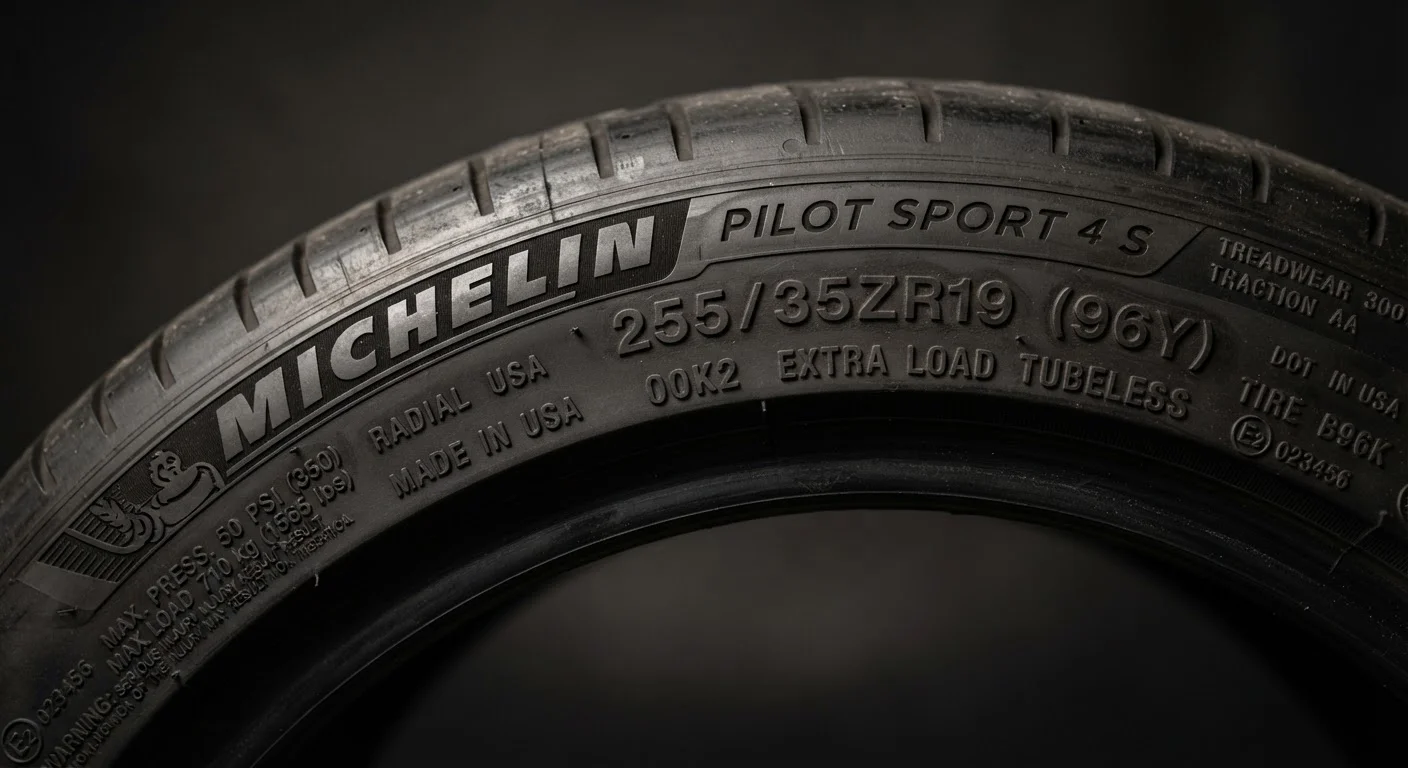
The Basic Code: What That Long String Actually Means
Look at the sidewall of almost any passenger car tire and you'll find a sequence like P215/65R16 98H. Each part of that string carries a specific, standardized meaning - and understanding it takes the guesswork out of tire shopping, replacement, and safety checks.
| Tire width measurement | Millimeters (e.g., 215 mm) (Standardized by ETRTO and TRA industry bodies) |
| Rim diameter measurement | Inches (e.g., 16 in.) |
| Aspect ratio definition | Sidewall height as % of section width |
| Most common construction type | Radial (R) (Standard on virtually all modern passenger vehicles) |
| DOT manufacture date digits | Last 4 digits of DOT code (week + year) (U.S. Department of Transportation) |
| Recommended max tire age | 10 years from manufacture date (General manufacturer guidance; verify with your vehicle's manual) |
Here's how to read the sequence left to right:
- P - The service type. "P" stands for passenger vehicle. "LT" indicates a light truck tire. Some tires carry no letter prefix, which typically denotes a European metric standard with slightly different load ratings.
- 215 - The section width in millimeters. This is the measurement across the widest point of the tire from sidewall to sidewall when mounted and inflated.
- 65 - The aspect ratio. This two-digit number is the tire's sidewall height expressed as a percentage of the section width. A ratio of 65 means the sidewall height is 65% of 215 mm, roughly 140 mm tall.
- R - The construction type. "R" stands for radial, which is by far the most common construction on modern vehicles. You may occasionally see "B" (bias-belt) or "D" (diagonal/bias) on older or specialty tires.
- 16 - The rim diameter in inches. This must match your wheel size exactly - a 16-inch tire will not seat correctly on a 17-inch rim.
Unlike the label on a nutrition panel or a TV spec sheet, tire codes are governed by strict industry and government standards, meaning the numbers are consistent across manufacturers. For more on decoding product labels in general, see what product specifications actually mean.
Load Index and Speed Rating: The Safety Numbers
The final portion of the code - 98H in our example - tells you how much weight the tire can safely carry and how fast it's rated to operate continuously.
Load Index
A standardized two- or three-digit number that corresponds to the maximum weight a single tire can carry when properly inflated. Higher numbers indicate greater load capacity.
Speed Rating
A letter code indicating the maximum sustained speed a tire is designed to handle safely under load. It is not a recommendation to drive at that speed.
Aspect Ratio
The tire sidewall height expressed as a percentage of the section width. A lower number means a shorter sidewall and typically a wider, lower-profile look.
UTQG
Uniform Tire Quality Grading - a U.S. government-required rating system covering treadwear, traction, and temperature resistance, established through manufacturer testing.
Three-Peak Mountain Snowflake
A certification symbol indicating a tire has passed standardized severe snow traction testing, making it suitable for winter driving conditions.
DOT Code
A Department of Transportation identification sequence molded into every tire sidewall. The final four digits encode the week and year the tire was manufactured.
Load Index
The number (98 here) is a standardized index, not a direct weight figure. Index 98 corresponds to a maximum load of 1,653 lbs per tire. Higher numbers mean greater load capacity. You should never replace a tire with one that has a lower load index than the original equipment specification listed in your owner's manual or door-jamb placard - doing so risks tire failure under normal driving loads.
Speed Rating
The letter suffix indicates the maximum sustained speed the tire is engineered to handle safely. Common ratings you'll encounter include:
| Letter | Max Speed | Typical Application |
|---|---|---|
| S | 112 mph | Family sedans, minivans |
| T | 118 mph | Sedans, light trucks |
| H | 130 mph | Sport sedans, coupes |
| V | 149 mph | Performance vehicles |
| W | 168 mph | High-performance sports cars |
If you mix speed ratings across axles, the lower rating governs the safe operating limit for the entire vehicle. Most drivers rarely approach these limits, but using a tire rated below your vehicle's original specification can affect handling, heat dissipation, and warranty coverage.
Once you know your tire size and ratings, keeping the tires properly inflated is your most impactful day-to-day task. Our guide on how to check tire pressure correctly walks through the right process step by step.
Other Markings Worth Knowing
Beyond the primary size and rating code, several other markings appear on sidewalls and carry practical meaning.
- DOT code: Required by the U.S. Department of Transportation, this begins with "DOT" followed by a series of characters. The last four digits are the most useful: they encode the week and year of manufacture. For example, "2322" means the 23rd week of 2022. Tires age even when unused - most manufacturers and safety organizations recommend inspecting tires older than six years and replacing those beyond ten years regardless of tread depth.
- UTQG ratings: The Uniform Tire Quality Grading system, required for most passenger tires sold in the U.S., shows three grades: Treadwear (a relative durability index), Traction (AA, A, B, or C - wet stopping performance), and Temperature (A, B, or C - heat resistance). These grades allow rough comparisons within the same category but are established by manufacturers using their own testing, so treat them as directional rather than absolute.
- M+S / Three-Peak Mountain Snowflake: "M+S" (mud and snow) indicates the tire meets minimum all-season traction requirements. The three-peak mountain snowflake symbol - a mountain outline with a snowflake inside - is a more stringent certification indicating the tire has passed standardized severe snow traction tests. If you drive in winter conditions regularly, the snowflake symbol matters more than the M+S designation alone.
Reading these codes puts you in a much stronger position when comparing replacement options or verifying that a used vehicle's tires meet its original equipment specifications. For a broader look at how to interpret the numbers on your vehicle's service schedule, see what the numbers on your maintenance schedule actually mean.
The content on this site is provided for informational purposes only and should not be considered a substitute for professional advice. While we strive to provide accurate and up-to-date information, we make no guarantees regarding its completeness or accuracy. Always consult a qualified professional for advice specific to your circumstances before making any decisions.