

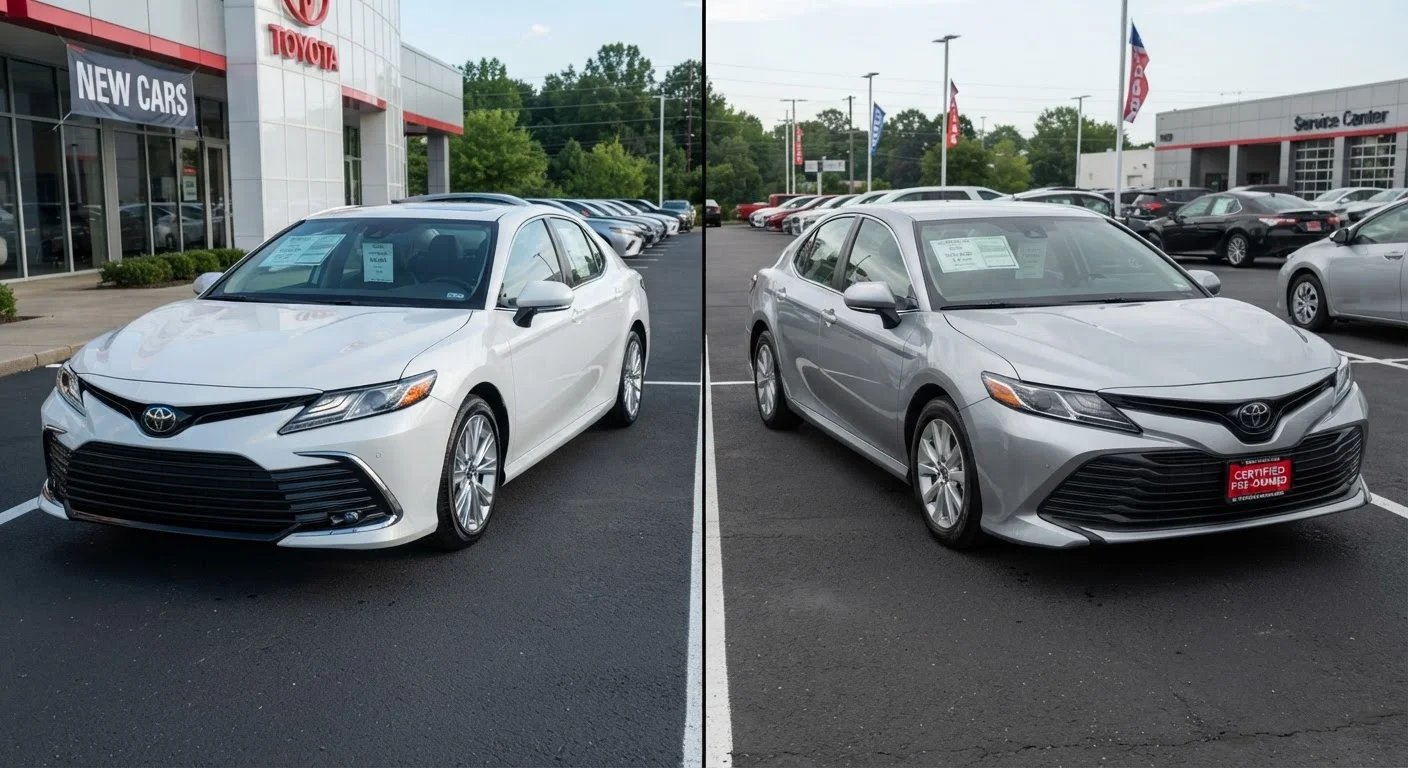
Option A
New Car
The full-warranty, zero-history choice.
Best for: Buyers who prioritize warranty coverage, the latest safety features, and predictable ownership costs over the first several years.
Option B
Used Car
The depreciation-aware, lower-entry-cost alternative.
Best for: Cost-conscious buyers willing to accept some ownership unknowns in exchange for a significantly lower purchase price and slower depreciation.
Depreciation: The Cost That Hits Before You Leave the Lot
Depreciation is the single largest financial factor separating new from used vehicles - and it works against new-car buyers fastest in the early years. A new vehicle can lose a substantial share of its market value within the first year alone, with steeper losses continuing through years two and three. By the time a car is three years old, a large portion of that initial depreciation has already occurred.
This is not a flaw - it is simply how automotive markets work. The practical implication is that a used-car buyer is effectively purchasing a vehicle after its previous owner has absorbed that early value drop. For detail on how this curve works across different vehicle types, see how vehicle depreciation works.
Buyers who plan to own a vehicle for a decade or longer partially offset the new-car depreciation disadvantage - because over a long enough timeline, the annual depreciation cost averages out. Short-term owners, however, bear the steepest cost when buying new.
| Criterion | New Car | Used Car |
|---|---|---|
| Purchase Price | Higher upfront cost | Lower upfront cost |
| Depreciation Exposure | Steepest in years 1-3 | Prior owner absorbed early drop |
| Typical Loan Rate | Generally lower | Generally higher |
| Warranty Coverage | Full manufacturer warranty | Limited or none (CPO varies) |
| Insurance Cost | Higher (greater replacement value) | Lower for older models |
| Ownership History | None - known condition | Requires verification |
| Safety Technology | Current standards | May lack newer features |
Financing Rates, Insurance, and What the Monthly Payment Actually Reflects
New vehicles typically qualify for lower interest rates on auto loans. Lenders view new cars as lower-risk collateral, and manufacturers sometimes offer promotional financing rates on new models. Used vehicles, by contrast, generally carry higher loan rates - sometimes meaningfully so - which can offset part of the lower purchase price when comparing monthly payments directly.
Insurance costs also diverge. Comprehensive and collision coverage on a new vehicle costs more than on an older one because the insurer's replacement cost is higher. Older used vehicles may qualify for liability-only coverage if their market value is low enough to make full coverage financially impractical.
~20%
Typical first-year depreciation for a new vehicle
Industry estimates commonly place new vehicle depreciation at roughly 15-25% in the first year, though the actual rate varies by make, model, and market conditions.
1-2%+
Typical rate premium on used auto loans vs. new
Used vehicle loans have historically carried higher average interest rates than new vehicle loans, according to data tracked by the Federal Reserve and consumer finance sources.
~50%
Value retained after approximately five years
Many mainstream vehicles retain roughly half their original value at the five-year mark, though this varies considerably by segment and individual model.
The full picture of what you'll pay beyond the sticker price - fuel, insurance, maintenance, and registration - is worth mapping out before committing. Our breakdown of the true cost of owning a car covers each of these categories in detail.
Warranty, Reliability, and Managing Ownership Risk
New cars come with manufacturer warranties - typically a bumper-to-bumper coverage period followed by a longer powertrain warranty. This coverage shifts financial risk away from the owner for major repairs during those early years. Used vehicles outside of warranty transfer that repair risk entirely to the buyer.
Certified pre-owned (CPO) vehicles represent a middle path. CPO programs require vehicles to pass a manufacturer-specified inspection and come with extended limited warranty coverage. They cost more than standard used vehicles but less than new ones. Understanding exactly what a CPO designation covers - and what it does not - matters before paying the premium. See what the CPO designation actually means for a full breakdown.
When buying a standard used vehicle, a pre-purchase inspection by an independent mechanic and a thorough vehicle history review are essential steps. Our used car verification checklist outlines what to examine before signing anything.
Used Car Purchases Carry More Due Diligence
Unlike buying new, purchasing a used vehicle requires independent verification of its history, mechanical condition, and title status. A vehicle history report and a pre-purchase inspection by a qualified mechanic are not optional steps - they are basic risk management. Skipping them can expose buyers to costly surprises that eliminate any savings gained from buying used.
How to Frame the Decision for Your Situation
Neither new nor used is categorically superior - the better answer depends on how long you plan to own the vehicle, how much financial risk you can absorb, and what your financing options look like. A buyer with access to low-rate financing who intends to keep a vehicle for eight-plus years may find a new car cost-competitive over the full ownership period. A buyer with tighter cash flow or a shorter intended ownership window will generally get more financial efficiency from a used vehicle.
It is also worth comparing this decision against the leasing alternative. Leasing vs. buying introduces a different set of trade-offs - particularly around equity, mileage, and flexibility - that some buyers find more suited to their circumstances.
Whichever direction you go, the purchase price is only the starting point. Running the full cost of ownership across your expected ownership period gives a far more honest comparison than comparing sticker prices alone.
This article is for general informational purposes only and does not constitute financial or legal advice. Consult a qualified financial professional before making significant purchase decisions.
The content on this site is provided for informational purposes only and should not be considered a substitute for professional advice. While we strive to provide accurate and up-to-date information, we make no guarantees regarding its completeness or accuracy. Always consult a qualified professional for advice specific to your circumstances before making any decisions.