

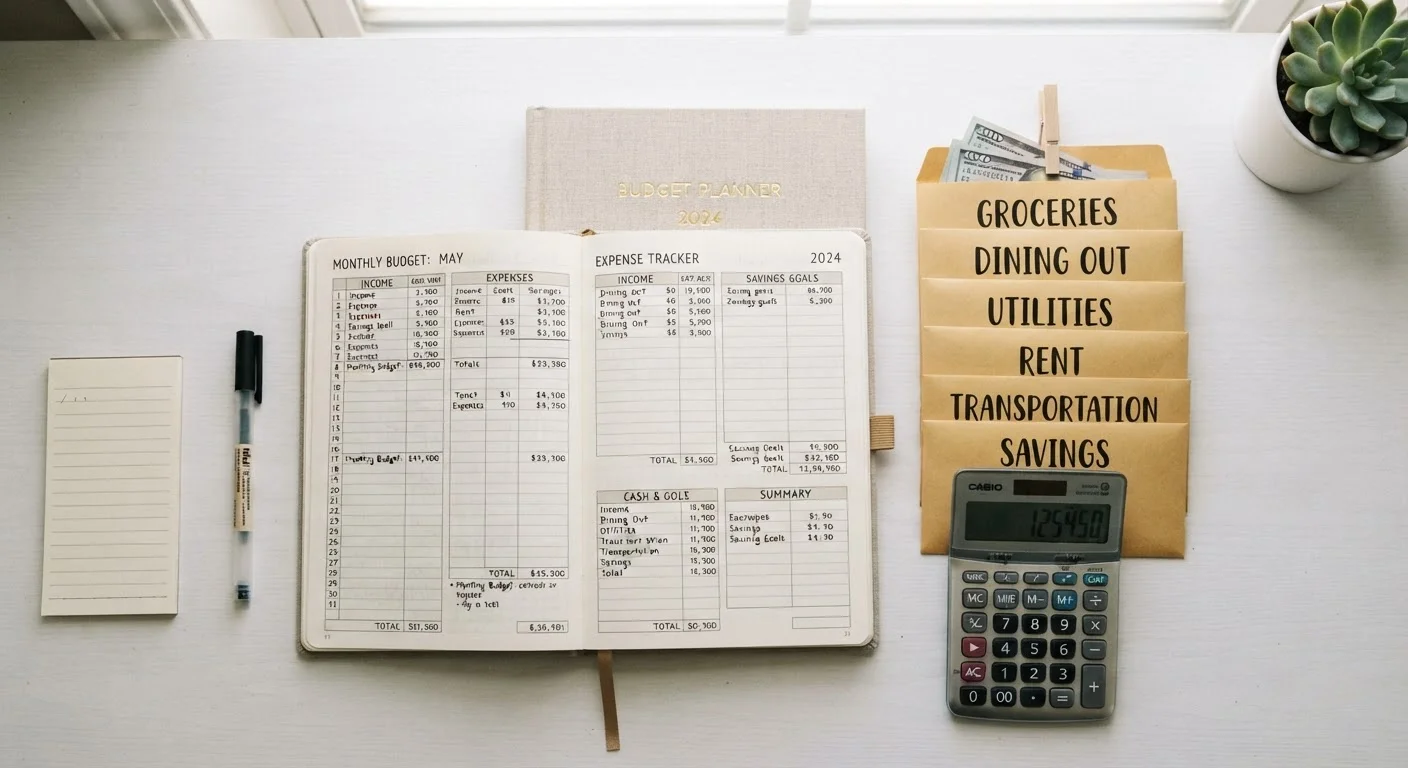
Option A
The 50/30/20 Rule
The percentage-based framework for flexible, big-picture budgeting.
Best for: People who want a simple structure without tracking every transaction in detail.
Option B
Envelope Budgeting
The hands-on, category-by-category cash control system.
Best for: People who overspend in specific categories and need a hard physical or visual spending limit.
How Each Method Works
The 50/30/20 rule divides your monthly after-tax income into three buckets: 50% toward needs (rent, groceries, utilities, insurance), 30% toward wants (dining out, subscriptions, hobbies), and 20% toward savings and debt repayment. The method is designed to give you a macro-level view of your finances without requiring you to log every latte. It was popularized in personal finance literature as a practical starting framework, and it remains widely referenced because of its simplicity.
Envelope budgeting works differently. You divide your spending money into labeled categories - groceries, gas, dining, clothing, etc. - and place a set amount of cash in each physical envelope at the start of the month. When an envelope is empty, spending in that category stops. Digital versions replicate this using virtual envelopes in spreadsheets or apps. The system forces conscious allocation before spending begins, not after. For a broader look at how these and other methods fit together, see our end-to-end budgeting guide.
| Criterion | 50/30/20 Rule | Envelope Budgeting |
|---|---|---|
| Structure | Three broad percentage buckets | Multiple specific dollar-amount categories |
| Tracking effort | Low - periodic check-ins | High - ongoing category management |
| Best for income type | Steady, predictable income | Variable or irregular income |
| Spending control | Macro-level guardrails | Category-by-category hard limits |
| Flexibility | High within each bucket | Low - envelope is the limit |
| Setup complexity | Simple - calculate percentages once | Moderate - requires category planning |
| Works well digitally | Yes, easily adapted | Yes, but cash version adds friction |
Where Each System Excels - and Falls Short
The 50/30/20 rule's strength is accessibility. It doesn't demand granular tracking, which means most people can follow it without changing their daily routine significantly. Its weakness is the same: because the buckets are broad, it's easy to quietly overspend within a category without noticing. If you spend 32% on wants instead of 30%, you might not catch it until a monthly review. That's why pairing this method with a monthly budget audit checklist is worth doing.
Envelope budgeting excels at category-level discipline. The finite nature of a physical envelope creates a natural stopping point. Research in behavioral economics suggests that paying with cash tends to make spending feel more tangible than card transactions - which is partly why this method helps some people curb impulsive spending. The downside: it's more labor-intensive to set up and maintain, and it can be cumbersome for people whose spending is mostly digital. The 50/30/20 rule also sidesteps a common budgeting friction point - the blurry line between needs and wants. Envelope budgeting forces you to classify every category explicitly, which can itself be a valuable exercise. See why the needs vs. wants distinction is harder than it looks for a more nuanced take.
~33%
Americans with a detailed household budget
Gallup polling has consistently found that fewer than one in three American adults maintains a detailed monthly budget, highlighting how many people lack a structured spending plan.
18%
Reduction in spending with cash vs. card
Studies in consumer behavior, including research published in the Journal of Consumer Research, have found that paying with physical cash can reduce spending relative to card payments in comparable conditions.
Choosing, Combining, or Adapting
Neither method is objectively superior - the one that works is the one you'll actually stick with. A few questions worth asking: Do you tend to overspend in specific categories, or does your budget drift overall? Do you prefer digital tools or tactile systems? Is your income steady each month or unpredictable?
Many people find that a hybrid approach works well: use the 50/30/20 percentages to set the overall allocation, then apply envelope-style limits within the wants category to stay accountable on the spending lines most likely to creep up. If you're managing finances with a partner, either method can work, though the transparency of envelope budgeting tends to reduce ambiguity. See budgeting as a couple for strategies specific to shared finances.
If you're also evaluating how to track your budget - digitally or on paper - the tool matters as much as the method. Paper ledger vs. budgeting app weighs those trade-offs in detail. And if you want even tighter control than envelope budgeting provides, zero-based budgeting - which assigns every dollar a specific job before the month begins - is worth exploring as a third option.
This article is for general informational purposes only and does not constitute personalized financial advice. Consult a qualified financial professional for guidance specific to your situation.
The content on this site is provided for informational purposes only and should not be considered a substitute for professional advice. While we strive to provide accurate and up-to-date information, we make no guarantees regarding its completeness or accuracy. Always consult a qualified professional for advice specific to your circumstances before making any decisions.