

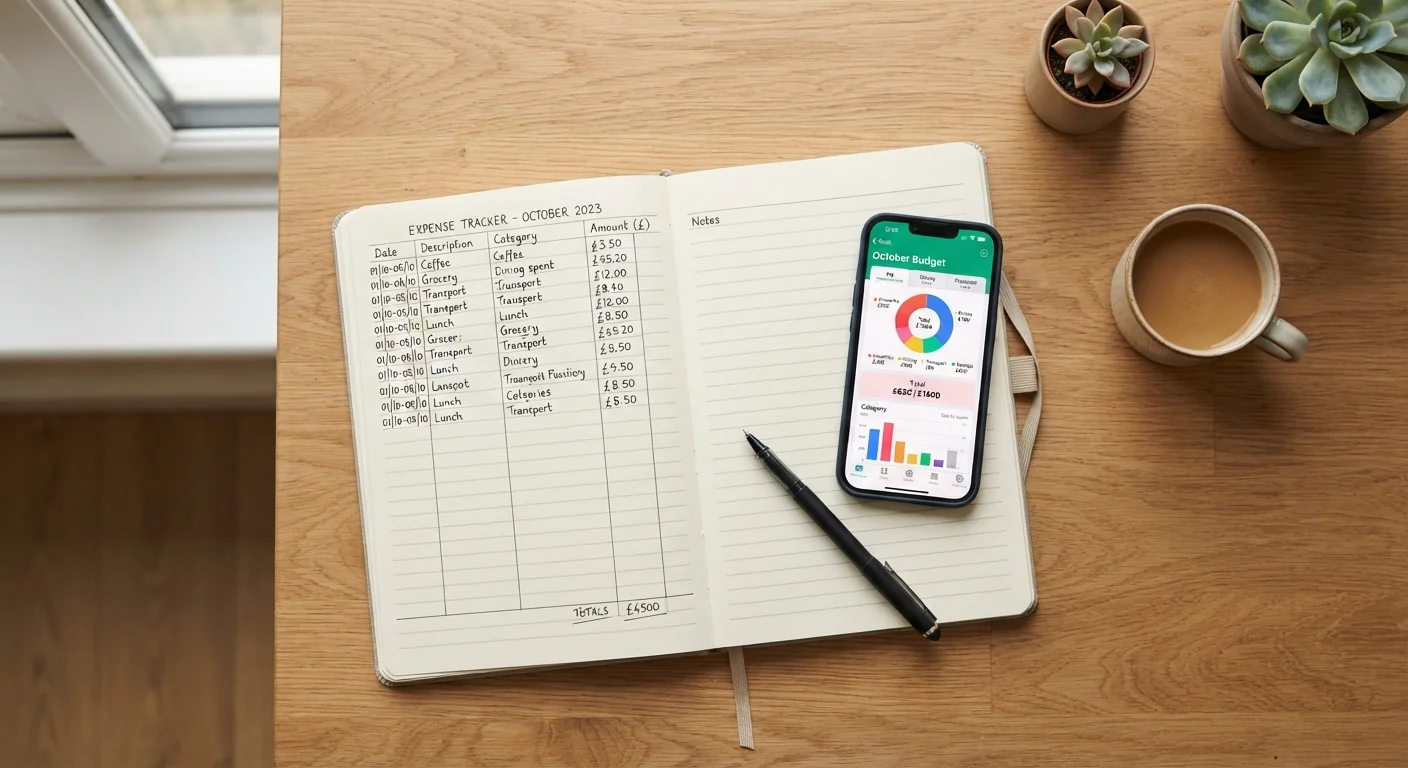
Option A
Paper Ledger
The deliberate, tactile method that builds awareness through friction.
Best for: People who want to slow down spending decisions and build habits through manual, mindful record-keeping.
Option B
Budgeting App
The automated, data-rich tool for tracking spending at scale.
Best for: People managing multiple accounts, frequent transactions, or who want real-time visibility without manual entry.
What Each Method Actually Asks of You
Choosing between a paper ledger and a budgeting app is really a question about how you want to interact with your own money. Both track the same thing - income, expenses, and remaining balance - but they ask very different things of the person using them.
A paper ledger requires you to write down every transaction, usually at the end of the day or week. That friction is a feature, not a bug. Each time you record a purchase, you're reinforcing the memory of making it. Over time, that repetition can sharpen your intuition about where money goes. The downside: it's easy to fall behind, and catching up after a week of missed entries can feel discouraging enough to quit entirely.
A budgeting app typically connects to your bank and credit card accounts and imports transactions automatically. You categorize or review, rather than record from scratch. This dramatically lowers the time cost per transaction and makes it easier to stay current. The trade-off is distance - when the app does the heavy lifting, the psychological impact of logging each purchase is reduced. You may see the data clearly without really feeling it.
For a broader look at how to build a tracking habit regardless of tool, see Tracking Where Your Money Actually Goes.
| Criterion | Paper Ledger | Budgeting App |
|---|---|---|
| Setup time | Minutes - notebook and pen | Minutes to hours - account linking, configuration |
| Daily effort | Manual entry required | Auto-import; review only |
| Spending awareness | High - each entry is deliberate | Lower - automation reduces friction |
| Data completeness | Only what you remember to record | Near-complete via bank sync |
| Privacy risk | None - fully offline | Moderate - third-party data aggregation |
| Reporting and analysis | Manual calculations only | Automatic charts, trends, alerts |
| Cost | Minimal - paper and pen | Free to subscription-based |
| Portability | Notebook goes anywhere | Mobile app; requires charged device |
Habit Durability: Which One Do People Stick With?
The best budgeting method is the one you actually use past month three. Both options have high abandonment rates - the question is why people quit each one, and whether those reasons apply to you.
Paper ledger users most commonly abandon the method after missing a few days and feeling unable to reconstruct lost transactions accurately. The system breaks when life gets busy, and there's no auto-sync to fall back on. On the upside, people who do maintain a ledger often report stronger emotional connection to their budget goals - the physical act of writing appears to reinforce intention in ways that tapping a screen does not. Behavioral research on note-taking and memory supports this general principle, even if direct budgeting studies remain limited.
App users, meanwhile, often disengage when the novelty of the interface fades, when bank connection errors pile up uncorrected, or when the sheer volume of auto-categorized data feels like noise rather than signal. Apps also introduce privacy considerations - most connect directly to financial accounts using third-party aggregation services, which carry real (if generally managed) security trade-offs worth understanding before linking accounts.
~33%
Adults who follow a formal budget
Gallup polling has consistently found that fewer than one in three American adults maintain a detailed household budget, underscoring how challenging long-term tracking is regardless of method.
~$200+
Monthly spending underestimation (typical)
Consumer finance researchers have found that most people underestimate their discretionary spending by $100-$300 per month when surveyed without access to their actual records.
66%
Better recall with handwriting vs. typing
Cognitive science studies, including widely cited work from Princeton and UCLA, suggest handwritten note-takers retain conceptual information more effectively than those who type - a dynamic that may apply to financial record-keeping.
The structural insight here: habit durability comes from review routines, not from the recording method itself. Whether you're using a notebook or an app, scheduling a fixed weekly review - even fifteen minutes - is the single highest-impact behavior for long-term tracking success. A monthly budget audit checklist can help structure that review regardless of which tool you use.
When Complexity Changes the Calculus
For someone with a single checking account, one credit card, and relatively stable monthly spending, a paper ledger is entirely practical - and may actually be the more effective tool. The complexity ceiling is low enough that manual entry doesn't become burdensome.
That calculus shifts when financial life gets more complicated: multiple bank accounts, split direct deposits, automatic bill payments, variable freelance income, shared household expenses, or frequent small transactions (daily coffee, transit fares, digital subscriptions). At that level, manual entry starts consuming time that most people simply won't protect, and the odds of abandonment climb sharply.
Apps are built for that complexity. Aggregating five accounts automatically and presenting a unified view in a few seconds is a genuine capability advantage. Just note that this advantage only materializes if you review the imported data regularly - a synced app you never open is no more useful than a ledger you never write in.
If you're exploring whether a structured budgeting framework might complement either tool, the comparison in The 50/30/20 Rule vs. Envelope Budgeting is a useful companion read. And for a full foundation, Smart Budgeting from the Ground Up covers how to pair any method with a durable plan.
The Hybrid Approach Is Valid
Many people find that neither method alone fits their life perfectly. A common middle path: use an app for automatic transaction import across accounts, but maintain a simple weekly paper summary to review and internalize the numbers. This captures the convenience of automation while preserving the reflective habit that drives awareness. There's no rule requiring you to pick just one.
This article provides general financial information for educational purposes only and does not constitute personalized financial advice. Consult a qualified financial professional for guidance specific to your situation.
The content on this site is provided for informational purposes only and should not be considered a substitute for professional advice. While we strive to provide accurate and up-to-date information, we make no guarantees regarding its completeness or accuracy. Always consult a qualified professional for advice specific to your circumstances before making any decisions.