

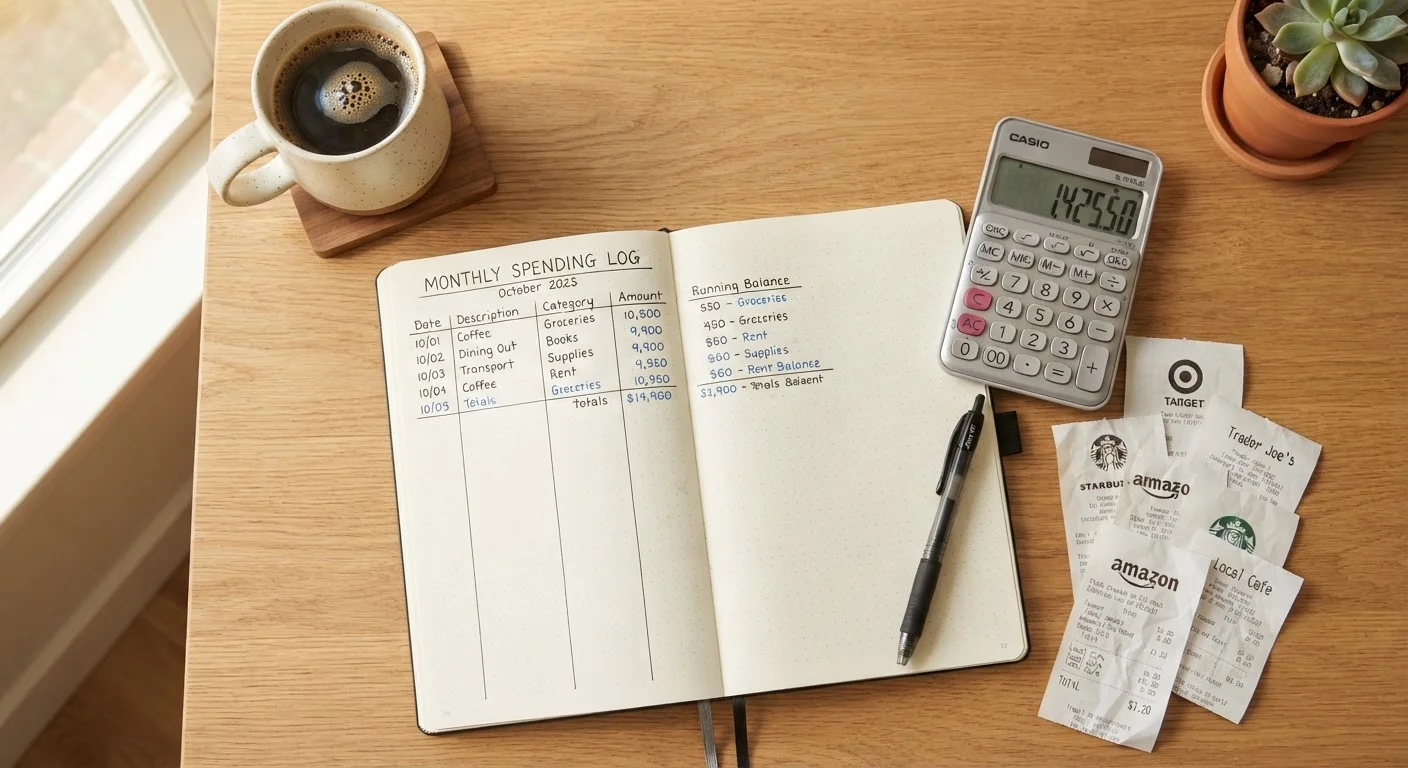
Why Most People Don't Know Where Their Money Goes
The gap between what people think they spend and what they actually spend is well-documented in consumer research. Discretionary categories - dining out, entertainment, small convenience purchases - are routinely underestimated because the individual transactions feel too small to remember. Those amounts add up to real money over a month.
Intuitive budgeting, where you mentally track spending without recording it, works only when your life is highly routine and your purchases are predictable. For most households, neither condition holds. Irregular expenses, subscription creep, and small-ticket habits create a spending reality that doesn't match the mental model.
The fix isn't willpower - it's visibility. When you can see a complete, categorized picture of where your money went, you're making decisions with real information instead of approximations. That's the entire purpose of a tracking system.
Don't Rely on Memory Alone
Research consistently shows that people underestimate discretionary spending when asked to recall it mentally. Gut-feel budgeting tends to overlook small, frequent purchases that accumulate quickly. Always pull from actual transaction records, not estimates.
Understanding the behavioral dimension of spending helps, too. Our piece on the psychological side of overspending explains why accurate tracking is the first step toward lasting change.
What You'll Need Before You Start
What you will need
Bank and credit card statements (last 30-90 days)
Provides the raw transaction data that forms the foundation of your spending picture.
Spreadsheet software (e.g., Google Sheets or Excel)
Used to organize, categorize, and total transaction data across spending areas.
Budgeting app
Automates transaction import and categorization for readers who prefer a digital workflow.
Printed or digital expense categories list
A predefined category structure keeps your tracking consistent month over month.
Notebook or paper ledger
An analog alternative for readers who find handwriting reinforces awareness of spending.
You don't need specialized software to track your spending effectively. A spreadsheet and your actual statements are sufficient. That said, choosing a method you'll use consistently matters more than which tool you pick.
Choose One Method and Commit to It
The best tracking method is the one you'll actually use. Whether you prefer a spreadsheet, a notebook, or a budgeting app, consistency beats sophistication. See our comparison of paper ledgers vs. budgeting apps to weigh the real trade-offs before deciding.
How to Track Your Spending Step by Step
Pull your complete transaction history
Log in to every bank account, credit card, and payment app you use and download or print your last 30 days of transactions. Include accounts you rarely think about - store cards, PayPal, Venmo, and any buy-now-pay-later accounts. Gaps in your data create gaps in your picture.
Build a simple category structure
Before sorting any transactions, set up your categories. Common ones include: housing, groceries, dining out, transportation, utilities, subscriptions, health and personal care, entertainment, clothing, and miscellaneous. Keep the list short enough to be usable - around 8 to 12 categories works for most households.
Avoid categories so narrow that every transaction needs a judgment call. The goal is pattern recognition, not perfect accounting.
Categorize every transaction
Go line by line through your transaction list and assign each one to a category. This step is deliberately manual - the act of reading each transaction forces recognition of spending you might otherwise overlook. Mark any ambiguous transactions as miscellaneous and revisit them at the end.
Total each category and compare to expectations
Sum up each spending category. Then, without looking at the totals, write down what you expected to spend in each area. Compare the two sets of numbers. Most people find at least two or three categories where actual spending is meaningfully higher than their intuitive estimate.
These gaps - not the numbers themselves - are the insight. They tell you where your spending habits and your mental model of your spending don't match.
Identify patterns and outliers
Look beyond the totals. Are dining charges concentrated on weekends? Do transportation costs spike mid-month? Are there subscriptions you didn't recognize? Patterns reveal the context behind the numbers, which makes it far easier to decide what, if anything, you want to change.
This is also where you'd flag one-time expenses - a car repair, a medical bill - that skewed a category and shouldn't be treated as a baseline. For deeper context on spending behavior, see our article on the psychological side of overspending.
Set a monthly review cadence
Tracking once is informative. Tracking consistently is transformative. Block 20-30 minutes on the same day each month to repeat this process. Over three to four months, you'll have enough data to spot true behavioral patterns versus one-off anomalies.
A structured monthly checklist can help you stay on track. Our monthly budget audit checklist walks through each review step so nothing gets missed.
This Is General Financial Information
This article provides general educational guidance about personal spending habits and is not personalized financial advice. Everyone's financial situation is different. For decisions specific to your circumstances, consult a qualified financial professional.
What to Do With What You Find
Tracking alone doesn't change spending - it creates the information needed to make deliberate choices. Once you've completed your first month of tracking, you're in a position to build or refine a budget grounded in reality rather than optimism.
High grocery spending is one of the most common surprises in a first tracking exercise - and one of the more controllable. Our article on grocery spending strategies that actually reduce the bill covers practical approaches that don't require sacrificing quality.
For a broader budgeting foundation, the guide on smart budgeting from the ground up covers how to move from tracking data to a complete, working budget. Spending tracking is the essential first step - every other adjustment depends on knowing your actual baseline.
This article provides general financial information for educational purposes and does not constitute personalized financial advice. Consult a qualified financial professional for guidance specific to your situation.
The content on this site is provided for informational purposes only and should not be considered a substitute for professional advice. While we strive to provide accurate and up-to-date information, we make no guarantees regarding its completeness or accuracy. Always consult a qualified professional for advice specific to your circumstances before making any decisions.