

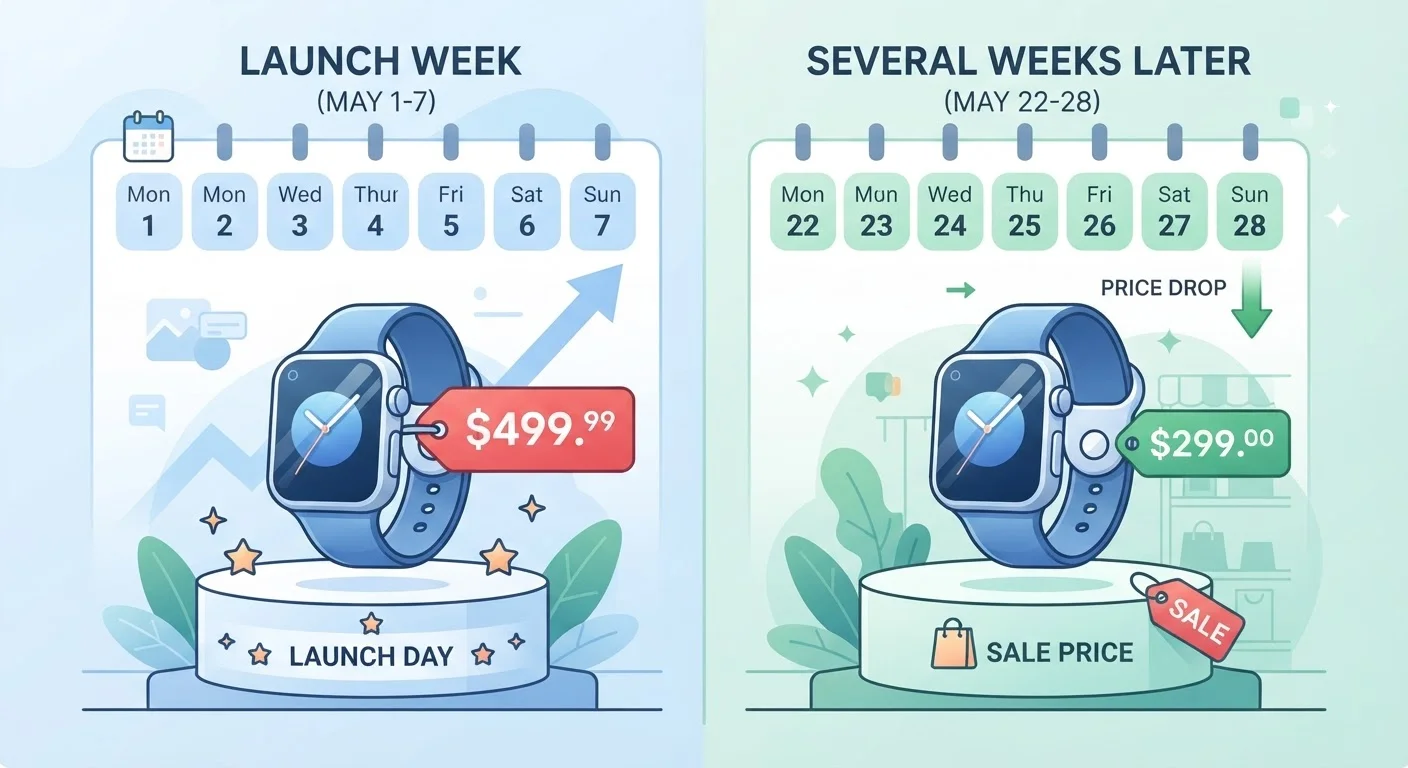
Why Prices Aren't Static - and Who Controls the Movement
Most shoppers treat a product's sticker price as a fixed fact. In practice, it's a variable managed by inventory systems, demand forecasts, and competitive pressure. Retailers set prices to maximize revenue at a given moment - and that moment changes constantly.
Two forces drive the most predictable price reductions: product lifecycle progression and seasonal inventory pressure. When a product launches, the price is set high to capture early adopters willing to pay a premium. As weeks pass and the initial demand wave subsides, the same item faces a new pricing reality: slower turnover, growing competition, and the approaching need to make shelf room for the next thing.
For seasonal goods - clothing, outdoor equipment, holiday merchandise - retailers follow a merchandising calendar with hard deadlines. Inventory that doesn't sell by a certain point becomes a storage and markdown cost. That cost pressure is what triggers the clearance cycles shoppers can benefit from.
Understanding this isn't about gaming the system. It's about recognizing that the retail price you see today reflects supply-and-demand conditions that will change. See our retail pricing calendar guide for a broader look at how prices shift across the year.
20-40%
Typical seasonal clearance markdown range
Retail industry analysts generally observe end-of-season clearance discounts in the 20-40% range for apparel and seasonal goods as retailers clear inventory before new merchandise arrives.
4-8 weeks
Post-launch window for electronics price softening
Consumer technology pricing patterns observed across multiple product categories suggest meaningful price movement commonly occurs within four to eight weeks of a product's initial retail debut.
15-25%
Average price drop on prior model-year vehicles
Industry data on automotive pricing indicates prior model-year vehicles frequently see incentive-driven price reductions of 15-25% once the new model year inventory arrives at dealerships.
The Post-Launch Price Curve: How New Products Get Cheaper
Consumer electronics are the clearest example of post-launch price erosion. When a new device hits the market, it carries a launch premium - partly to recoup development costs, partly because early buyers will pay it. That premium compresses over the following weeks and months as:
- Competing products enter the market or drop their own prices in response
- Review-driven consumer hesitation slows early-adopter purchasing
- Retail buyers who placed large initial orders need to move inventory
- A successor model is announced or rumored, shifting perceived value
The same dynamic applies to new car models - an area where timing strategies are particularly well-documented. When the next model year arrives, prior-year inventory often sees structured dealer incentives. This isn't accidental. It's a predictable response to inventory turnover pressure. For more on auto-specific timing, the Buying & Ownership hub covers how these cycles work in vehicle purchasing.
The practical implication: if you don't need a product on launch day, waiting four to eight weeks is often rewarded with a lower price - without any coupon hunting required.
Reading the Signals That a Price Drop Is Coming
You don't have to guess. Several observable signals reliably precede a markdown:
- Persistent availability
- An item that has been in stock continuously for weeks is not moving as fast as the retailer planned. That gap between forecast and reality creates markdown pressure.
- Newer model announcements
- When a manufacturer announces an updated version - even months before its release - the existing model's price often dips as it loses perceived future value.
- Seasonal calendar milestones
- Post-summer, post-back-to-school, post-holiday, and end-of-quarter periods all carry predictable clearance activity tied to the retail merchandising calendar.
- Price history data
- Browser extensions and dedicated tools let you view an item's price over time. If the current price is near its historical high, waiting for a return to the historical average is often a reasonable strategy. Our guide to reading a price history chart walks through how to interpret that data effectively.
None of these signals guarantee a drop. But when multiple signals align - a product has been available for weeks, a new version is rumored, and the season is ending - the probability of a markdown rises substantially.
When Waiting Pays Off - and When It Doesn't
Timing strategies work best for discretionary, non-urgent purchases in categories with regular inventory cycles: apparel, consumer electronics, home goods, seasonal outdoor gear, and certain travel categories. They work less reliably for necessities, limited-run items, or goods whose supply is genuinely constrained.
The calculation also depends on the cost of waiting. Holding off three months to save 15% on a $40 item may not be worth the wait. The same patience on a $900 appliance represents a more meaningful return on delayed gratification.
For shoppers who want a more structured approach, timing strategies used by experienced bargain hunters offers a practical framework across multiple categories. And if you're researching a retailer's price-match window, price matching policies explained outlines when those policies can capture a post-purchase drop without requiring you to return and rebuy.
The core insight remains consistent across categories: prices are not neutral facts - they're managed decisions that respond to time. Shoppers who understand those mechanics are better positioned to act at the right moment.
This article provides general consumer education about retail pricing patterns and is not financial advice. Savings outcomes vary by product, retailer, and market conditions.
Frequently Asked Questions
For consumer electronics, four to eight weeks after launch often produces a noticeable drop as initial demand cools and competing products emerge. For apparel and seasonal goods, discounting typically begins six to eight weeks before the season's end. The category matters - check price history data for the specific item type.
Not always. Limited-edition items, products with consistent demand, or goods subject to supply constraints may hold their price or even increase. Commodities like lumber or fuel are especially unpredictable. Timing strategies work best for discretionary consumer goods with regular inventory cycles.
Watch for persistent in-stock availability, a newer model announcement, seasonal calendar milestones (like post-summer or post-holiday), and recent markdown activity on related items. Retailers rarely drop prices spontaneously - there's usually a structural reason behind every cut.
Not exactly. A sale is often a temporary promotional discount that returns to the original price afterward. A post-launch price drop is typically a permanent reset to a new lower baseline as the product matures in the market. Price history tools can help you distinguish between the two.
Yes, but differently. Flights and hotels often use dynamic pricing that can move in either direction. Off-peak seasons reliably reduce travel costs, but waiting too long can eliminate availability. For services, the end of a billing period or contract cycle often creates pricing flexibility.
The item could sell out, the discount might be modest relative to the wait, or a competing need may arise. Weigh the realistic savings against the cost of delay - this math is different for a discretionary purchase versus a time-sensitive one.
The content on this site is provided for informational purposes only and should not be considered a substitute for professional advice. While we strive to provide accurate and up-to-date information, we make no guarantees regarding its completeness or accuracy. Always consult a qualified professional for advice specific to your circumstances before making any decisions.