

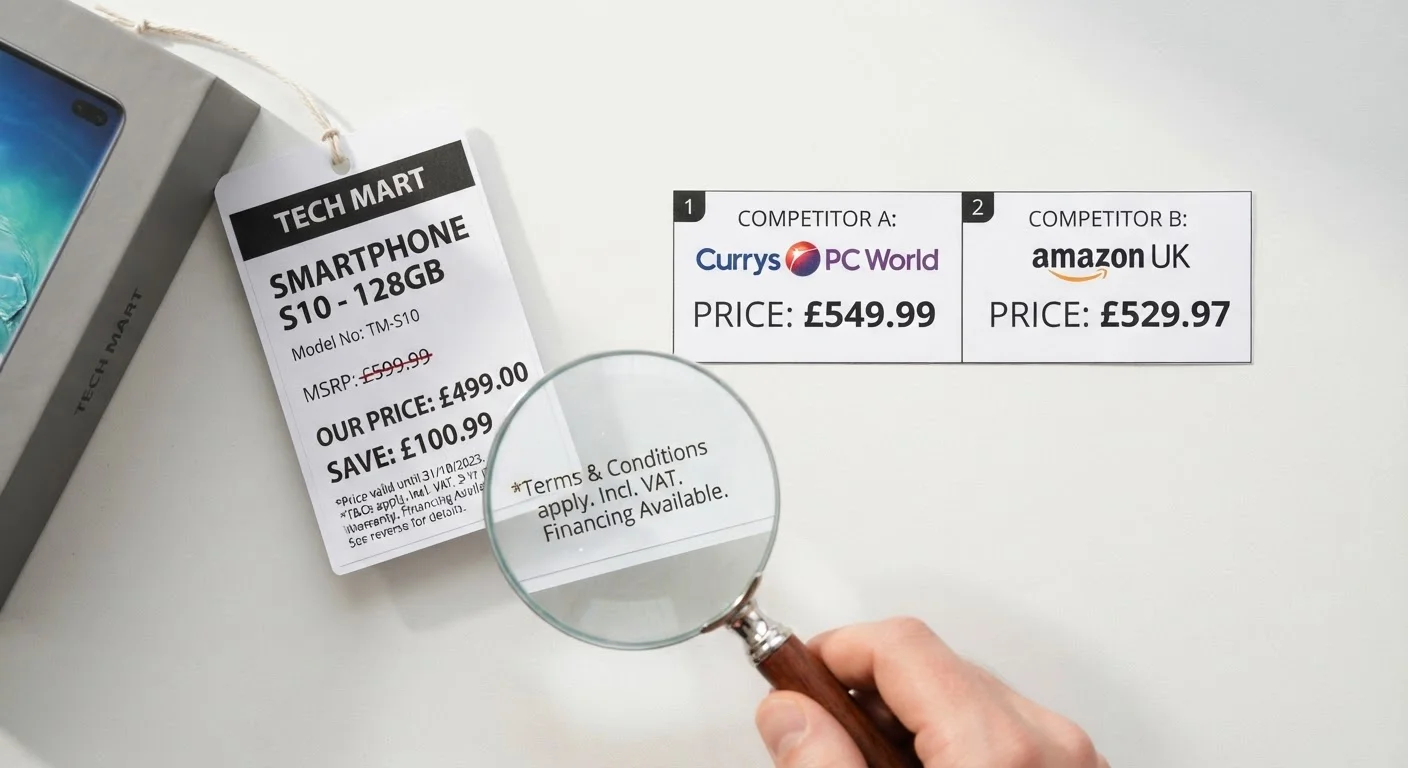
How Price Matching Actually Works
Price matching is straightforward in concept: you find the same item at a lower price from a qualifying competitor, bring evidence to the retailer, and they adjust your price. In practice, the process has friction points that catch many shoppers off guard.
First, the item must be identical - matching model number, color, size, storage capacity, or any other relevant specification. A retailer won't match a competitor's price on a similar appliance if the model number differs even slightly. This matters most in electronics and appliances, where manufacturers often create retailer-exclusive configurations that look nearly the same but carry different model identifiers.
Second, the competing price must come from a qualifying source. Most retailers maintain an approved list of competitors - usually other national or regional chains. Online-only retailers may or may not qualify depending on the store. Third-party marketplace sellers are almost always excluded.
~36%
Shoppers aware of price adjustment policies
Consumer surveys consistently find that a minority of shoppers know post-purchase price adjustment options exist, even at retailers that offer them.
7-30 days
Typical price adjustment window
Most retailers that offer post-purchase price protection set adjustment windows in this range, though terms vary by store and product category.
Most
Retailers exclude limited-time promotions
The majority of major retailer price match policies include explicit exclusions for flash sales, doorbusters, and coupon-dependent pricing.
Third, the price must be currently active. A sale that ended yesterday won't qualify, and a price that requires a coupon code typically won't either. The retailer will usually verify the price is live at the time you make the request.
Common Exclusions That Disqualify a Match
Understanding what's excluded is where most shoppers lose ground. Price match policies are written to protect the retailer's margins, so the exclusion list is often longer than the eligibility criteria.
- Doorbuster and flash sales: Time-limited promotions - especially those tied to major shopping events - are routinely excluded.
- Clearance and open-box inventory: These prices reflect unique stock conditions and are almost never matchable.
- Membership or loyalty pricing: Prices tied to a competitor's loyalty program or membership club typically don't qualify.
- Bundle pricing: If the lower price is part of a package deal, the retailer won't match the component price in isolation.
- Errors and misprints: Obvious pricing errors on competitor sites are excluded - a $500 TV listed at $50 won't trigger a match.
It's worth reviewing the full exclusion list before making a trip to the store. Most retailers publish their price match terms on their website. Return and satisfaction policies follow similarly layered rules - the same habit of reading the fine print applies.
Screenshot the Price Before You Head to the Store
Prices on competitor websites can change within hours. If you spot a qualifying price, capture a screenshot that shows the product name, model number, current price, and the date. This documentation reduces friction when making your request and gives you a fallback if the price changes before you arrive.
Price Adjustment Windows: The Post-Purchase Option
A lesser-known feature of some price match programs is the price adjustment - also called price protection. This allows you to request a refund of the difference if the same item drops in price at that same retailer within a set period after purchase.
Adjustment windows typically range from 7 to 30 days. Some retailers limit adjustments to a set number of times per item or per customer. To use this benefit, hold onto your receipt and monitor the product's price in the days following your purchase.
Price adjustments and price matching are distinct: matching applies before or at purchase using a competitor's price, while adjustments apply after purchase based on the original retailer's own price movement. Not every retailer offers both. If timing your purchase matters to you, waiting a few weeks can sometimes change the price dramatically - especially after product launches or seasonal transitions.
When Price Matching Is Worth Pursuing
Price matching is most valuable when the price gap is significant, the item is a major purchase, and the competing price clearly meets the eligibility criteria. Spending 20 minutes verifying and requesting a match on a $10 difference rarely makes sense. On a $300 to $500 purchase, the same effort can be well worth it.
The most reliable opportunities arise when a large national retailer has a publicly advertised sale that a competitor hasn't matched yet. That's a clean, verifiable scenario that most price match policies are designed to handle. Experienced shoppers also track timing strategies that align with known pricing cycles - combining that awareness with price match eligibility is a practical one-two approach.
Where price matching becomes unreliable is during high-volume sale events, on marketplace platforms, or when buying from categories with high exclusion rates like computers or televisions with retailer-exclusive model numbers. In those cases, direct comparison shopping across retailers before committing is a more dependable strategy than hoping for a post-purchase match.
This article is for general informational and educational purposes only. Retailer policies change frequently - always verify the current terms directly with the retailer before making a purchase decision.
Frequently Asked Questions
It depends on the retailer. Many brick-and-mortar stores will match prices from major online retailers, but few will match online-only flash sales, coupon codes, or marketplace listings from third-party sellers. Always check the policy before assuming an online price qualifies.
Yes, if the retailer offers a price adjustment policy. These typically allow you to request a refund for the difference within a set window - often 7 to 30 days after purchase. Keep your receipt and monitor the item's price during that window.
Usually not. Clearance, liquidation, and open-box items are almost universally excluded from price match programs because they reflect unique inventory conditions rather than standard retail pricing.
Most retailers require a current, live advertisement - either a printed ad or a webpage you can pull up in-store or during a call. Screenshots may be accepted, but the retailer typically reserves the right to verify the price is still active at the time of the request.
Rarely. Most major retailers explicitly exclude third-party marketplace sellers from their price match criteria, even if the listing appears on a major platform. The item must typically be sold and fulfilled directly by the competing retailer.
Many retailers suspend price matching entirely during major sale periods, or exclude competing sale-event pricing from qualifying. Some, however, will match their own prior prices if the item drops further during a promotional window.
The content on this site is provided for informational purposes only and should not be considered a substitute for professional advice. While we strive to provide accurate and up-to-date information, we make no guarantees regarding its completeness or accuracy. Always consult a qualified professional for advice specific to your circumstances before making any decisions.