

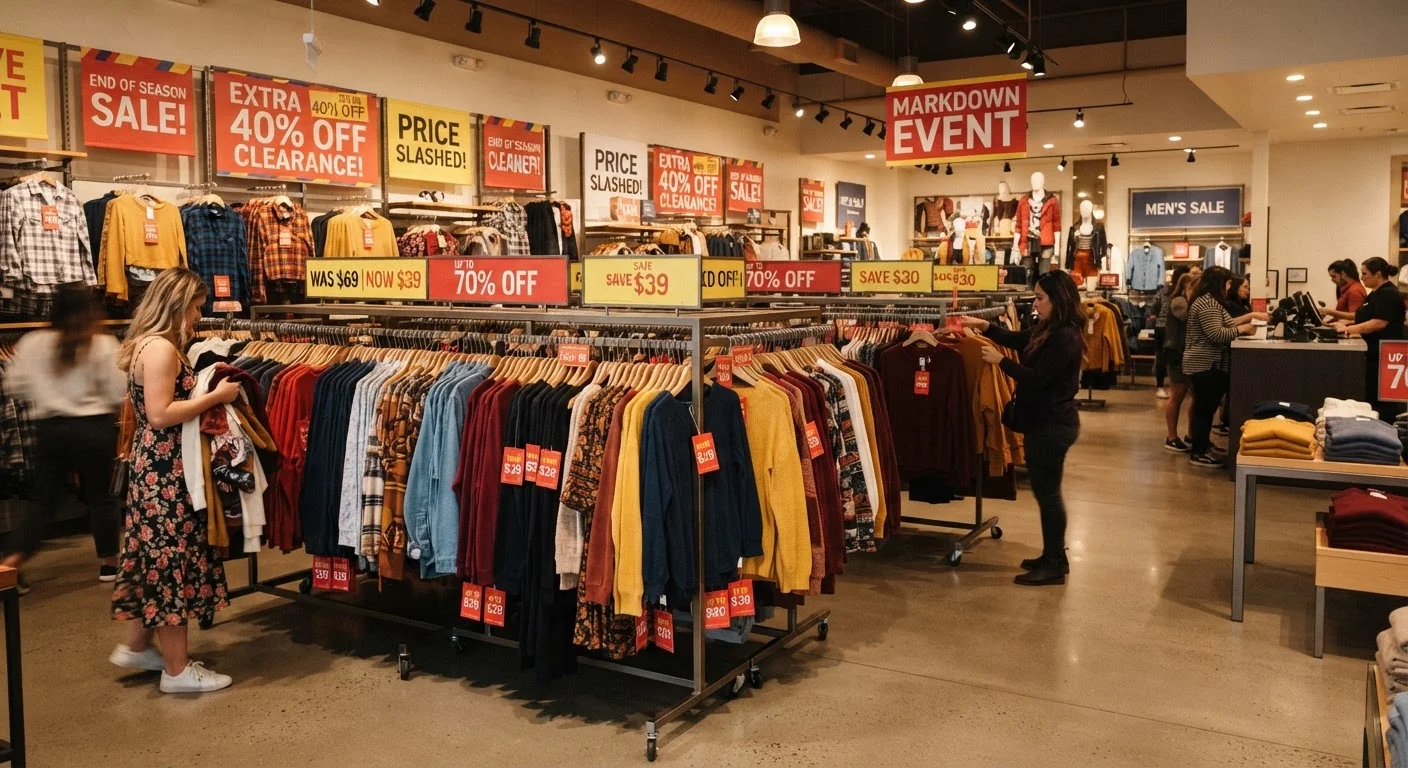
The Mechanics Behind Retail Markdowns
Every clearance sale you've ever browsed was the result of a deliberate, scheduled process - not a spontaneous generosity from a retailer. Stores receive new seasonal merchandise on a fixed floor-set calendar, and the moment that new inventory arrives, the previous season's goods need to move. That pressure creates the markdown cycle.
Retail buyers plan seasons months in advance, negotiating volume with manufacturers based on projected sell-through. When actual sales fall short of forecasts - which happens regularly - excess inventory must be liquidated. Markdowns are the primary tool. The longer merchandise sits, the more floor space it occupies that could otherwise hold higher-margin new arrivals.
This is why markdowns tend to follow a staircase pattern rather than a single price cut. Retailers test each price point: if a 25% reduction moves enough units, they hold there. If not, the next scheduled cut kicks in. For shoppers, this predictability is an advantage. As part of the broader retail pricing picture, understanding markdown mechanics is foundational knowledge.
4x
Typical seasonal floor resets per year
Most major apparel and home goods retailers reconfigure their floor merchandise roughly four times annually, triggering clearance cycles each time.
70%+
Maximum typical clearance discount
Final-stage clearance markdowns in apparel and home goods commonly reach 70%-80% off original retail prices, according to industry pricing analyses.
2-4 weeks
Typical gap between markdown stages
Retail industry practices suggest most structured markdown cycles apply successive price cuts every two to four weeks until sell-through targets are met.
The Four Stages of a Typical Clearance Cycle
While every retailer's exact cadence differs, most brick-and-mortar and online stores move through recognizable stages:
- Initial Markdown (20%-40% off): Triggered when new seasonal inventory hits the floor. Selection is at its widest here - all sizes, colors, and styles are still available. Shoppers who prioritize variety over maximum savings should act during this window.
- Secondary Markdown (40%-60% off): Typically applied two to four weeks after the initial cut. Items that didn't move get a deeper reduction. This is often the sweet spot - meaningful savings with reasonable selection still intact.
- Final Clearance (60%-80% off): The deepest cuts, usually applied to whatever remains after the secondary markdown. At this stage, selection is thin and sizing is often fragmented. This stage works well for shoppers who are flexible on specific styles or sizes.
- Removal/Liquidation: Anything that doesn't sell even at steep discounts gets pulled from the floor. It may be donated, liquidated through off-price channels, or returned to vendors under contractual arrangements.
Knowing which stage a category is in - and how many weeks remain before the floor reset - is what separates strategic shoppers from reactive ones. Experienced bargain hunters track these windows deliberately.
When Clearance Windows Reliably Open
Certain points in the retail calendar are structurally predictable clearance windows. Retail pricing across the year follows recognizable patterns - and clearance is one of the most consistent.
- Post-holiday (January): The largest clearance window of the year for many categories. Seasonal décor, winter apparel, electronics bought for gift-giving, and toys all enter markdown cycles simultaneously.
- Late summer (July-August): Summer clothing, outdoor furniture, and lawn and garden equipment start their clearance cycles as fall merchandise arrives.
- Back-to-school transition (September): School supplies and summer-positioned electronics often hit secondary markdowns as fall items take priority.
- Post-Memorial Day and Labor Day: Bedding, mattresses, and appliances - categories retailers traditionally promote around these holidays - often see clearance activity on outgoing models in the weeks following.
For category-specific timing, seasonal discount patterns by product category provide a useful reference. If you want to plan around these windows systematically, building a personal shopping calendar is a practical next step.
Track the Floor Reset, Not Just the Sale Sign
The most reliable signal that clearance is imminent isn't a sale sign - it's the arrival of new seasonal merchandise. When you see a major influx of new-season items in a category you're watching, that means outgoing inventory is about to start its markdown journey. Check back within one to two weeks for initial clearance tags, then again two to three weeks later for deeper cuts.
How to Use Markdown Cycles to Your Advantage
The most common shopper mistake is treating clearance as a surprise event rather than a scheduled one. Once you internalize that markdowns happen on a schedule, the strategy becomes clearer:
Identify when new floor sets arrive. For most major apparel and home goods retailers, seasonal floor resets happen roughly four times per year. When you see a large influx of new merchandise, the outgoing items are entering their markdown journey.
Watch for in-store or online signage shifts. The transition from a sale sign to a clearance sign is meaningful - it signals that an item has entered the structured markdown cycle rather than being temporarily discounted.
Track specific items across two to three weeks. If an item you want is in its first or second markdown stage, a brief wait often yields a meaningful additional reduction. Price-tracking tools and retailer apps can automate this for online purchases.
Calibrate patience to scarcity. For commodity items - basic apparel staples, standard home goods - waiting for deeper markdowns is low risk. For specific styles, limited sizes, or items with high demand, acting at the secondary markdown stage is usually the practical call.
Connecting this knowledge to the broader context of smart budgeting strategies helps you make these timing decisions within a larger financial framework rather than in isolation.
This article is for general informational purposes only. Pricing practices vary by retailer, region, and product category. Verify current pricing and return policies directly with the retailer before making a purchase.
Frequently Asked Questions
Most major retailers run markdown cycles on a weekly or bi-weekly schedule during clearance periods. Price cuts are often applied on a set day of the week - commonly Monday or Tuesday - so checking back after that window can reveal fresh reductions on items you've been watching.
Initial clearance markdowns typically range from 20% to 40% off original retail prices. Subsequent stages commonly push discounts to 50%-60%, with final clearance sometimes reaching 70%-80% off. Exact percentages vary by retailer and product category.
Apparel clearance for summer merchandise typically begins in late July and runs through August. Winter clearance usually kicks off in late December and continues through January. Exact timing shifts slightly by retailer and regional climate.
Not always, but many retailers restrict return windows or mark clearance items as final sale. Always check the return policy before purchasing clearance merchandise, especially for higher-priced items.
Generally yes, but online clearance sections often have deeper initial discounts because they face additional competition and broader price comparison. Online stores may also clear inventory faster by offering additional promotional codes on top of clearance pricing.
It depends on the item and your flexibility. Waiting maximizes savings but risks the item selling out in your size or style. For non-urgent purchases with multiple options, waiting often pays off. For specific or popular items, earlier stages may be the smarter buy.
The content on this site is provided for informational purposes only and should not be considered a substitute for professional advice. While we strive to provide accurate and up-to-date information, we make no guarantees regarding its completeness or accuracy. Always consult a qualified professional for advice specific to your circumstances before making any decisions.