

Start With a Soil Test, Not a Guess
Many homeowners fertilize by habit - same product, same schedule, every year. But grass doesn't need fertilizer applied on a calendar; it needs specific nutrients, in specific amounts, based on what its soil already contains. A soil test removes the guesswork.
Soil tests measure pH and macronutrient levels (nitrogen, phosphorus, and potassium - the N-P-K on every fertilizer bag) and often flag secondary nutrients like calcium and magnesium. Your local Cooperative Extension Service can process a soil sample for a modest fee and return results with regionally tailored recommendations. Without that baseline, you risk over-applying nutrients that are already adequate, which can lock out others and damage soil health over time.
Check your soil every two to three years, or any time your lawn looks persistently thin or discolored despite good mowing and watering habits. For more on what else might be stressing your turf, see why your lawn has bare patches.
What the N-P-K Numbers Mean
Every fertilizer bag displays three numbers separated by dashes - for example, 28-0-6. These represent the percentage by weight of nitrogen (N), phosphorus (P), and potassium (K) in that order. A 10 lb bag of 28-0-6 contains 2.8 lbs of actual nitrogen. Use these numbers to calculate how much product to apply rather than relying on the bag's general coverage estimates, which can vary by lawn condition.
Match Your Timing to Your Grass Type
Fertilizer applied at the wrong growth stage can feed weeds instead of grass, or push tender growth into conditions that will damage it. Timing should follow your grass type first, your calendar second.
- Cool-season grasses (Kentucky bluegrass, fescues, ryegrass) grow most vigorously in spring and fall. Their primary fertilizer window is late summer through early fall, when roots are actively absorbing nutrients before dormancy. A lighter application in early spring is acceptable; heavy feeding in summer stresses already heat-challenged turf.
- Warm-season grasses (bermuda, zoysia, St. Augustine, centipede) green up and grow through late spring and summer. Begin fertilizing once the lawn has fully exited dormancy - typically when soil temperatures reach around 65-70°F consistently - and stop about six weeks before your region's first expected frost.
For a month-by-month view of when each lawn task fits into the year, the seasonal lawn care calendar is a practical reference.
Best Practices for Fertilizing Your Lawn
Once you know what your soil needs and when to act, consistent technique makes the difference between a lawn that thrives and one that merely survives.
Follow the one-pound rule for nitrogen application per treatment.
Applying more than one pound of actual nitrogen per 1,000 square feet in a single application can burn grass blades and overwhelm soil microbes. Smaller, well-timed doses are absorbed more efficiently and reduce the risk of nutrient runoff into storm drains.
Choose slow-release nitrogen formulas for most routine feeding.
Slow-release fertilizers (often labeled as 'controlled-release' or containing sulfur-coated urea or polymer-coated urea) break down gradually, feeding grass over several weeks rather than all at once. This reduces burn risk, minimizes leaching, and produces steadier, darker green growth without excessive blade surge.
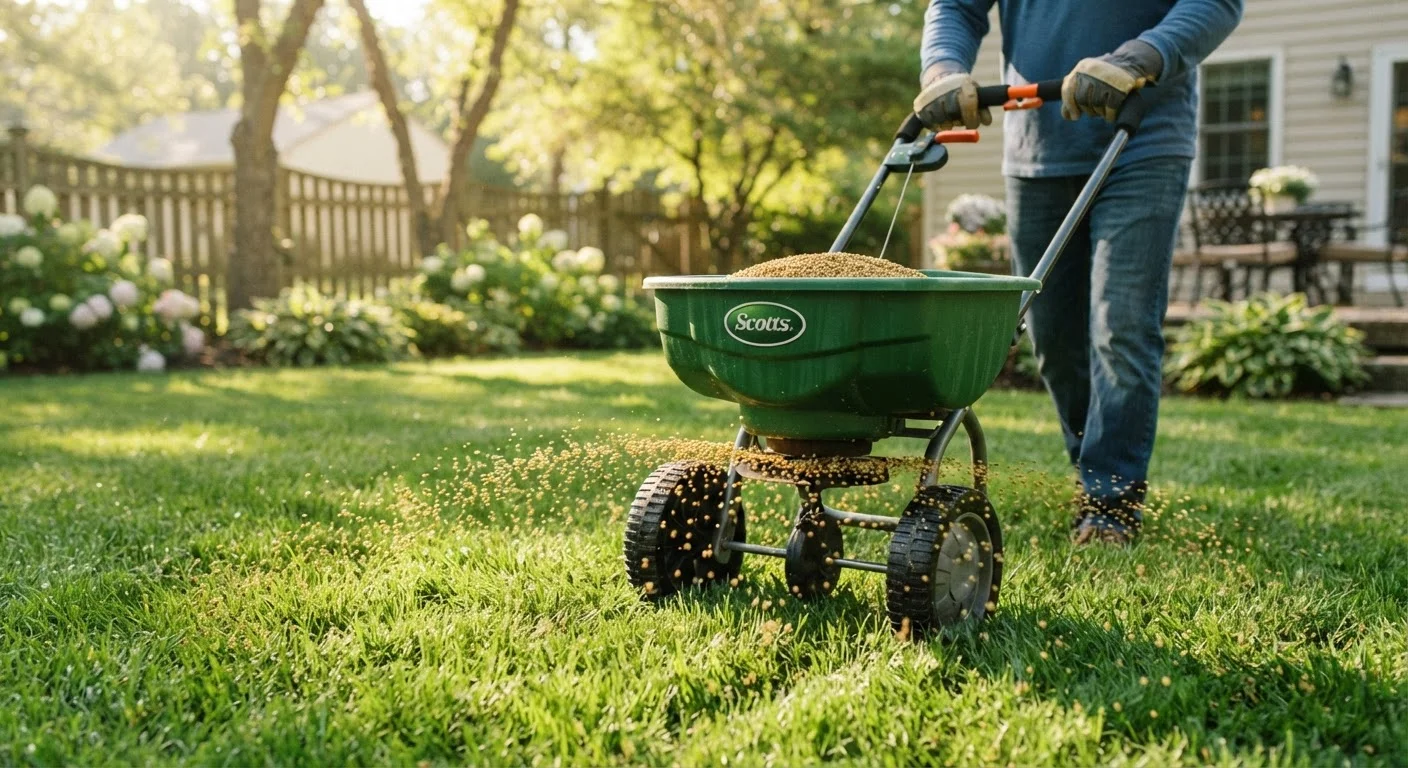
Calibrate your spreader before every application.
Even small setting errors on a broadcast or drop spreader can result in under-feeding in some zones and over-feeding in others, creating streaky color and uneven growth. Calibrating ensures the product lands at the rate recommended on the label.
Water lightly after applying granular fertilizer - but not heavily.
A light watering (about a quarter inch) after granular application helps dissolve the coating and move nutrients into the soil. Heavy watering, however, can wash soluble nutrients past the root zone or into runoff before grass has a chance to absorb them.
Never fertilize dormant, drought-stressed, or newly seeded grass.
Dormant grass cannot take up nutrients, so fertilizer sits at the surface and becomes a runoff hazard. Drought-stressed turf is already struggling; added fertilizer salts increase osmotic stress on roots. Newly seeded areas need a starter fertilizer specifically formulated for seedlings, not a general lawn feed.
Quick Actions You Can Take Right Now
You don't need to wait for the perfect season to improve your fertilizing approach. Several high-impact steps can be taken immediately.
Fertilizing correctly also works best alongside sound watering habits. Shallow or excessive irrigation can move nutrients out of the root zone before grass absorbs them - a problem covered in depth in our guide on watering habits that weaken grass. And if you've encountered advice that contradicts what's here, it may be worth cross-checking against common lawn care myths.
The content on this site is provided for informational purposes only and should not be considered a substitute for professional advice. While we strive to provide accurate and up-to-date information, we make no guarantees regarding its completeness or accuracy. Always consult a qualified professional for advice specific to your circumstances before making any decisions.