

What the Number Actually Tells You
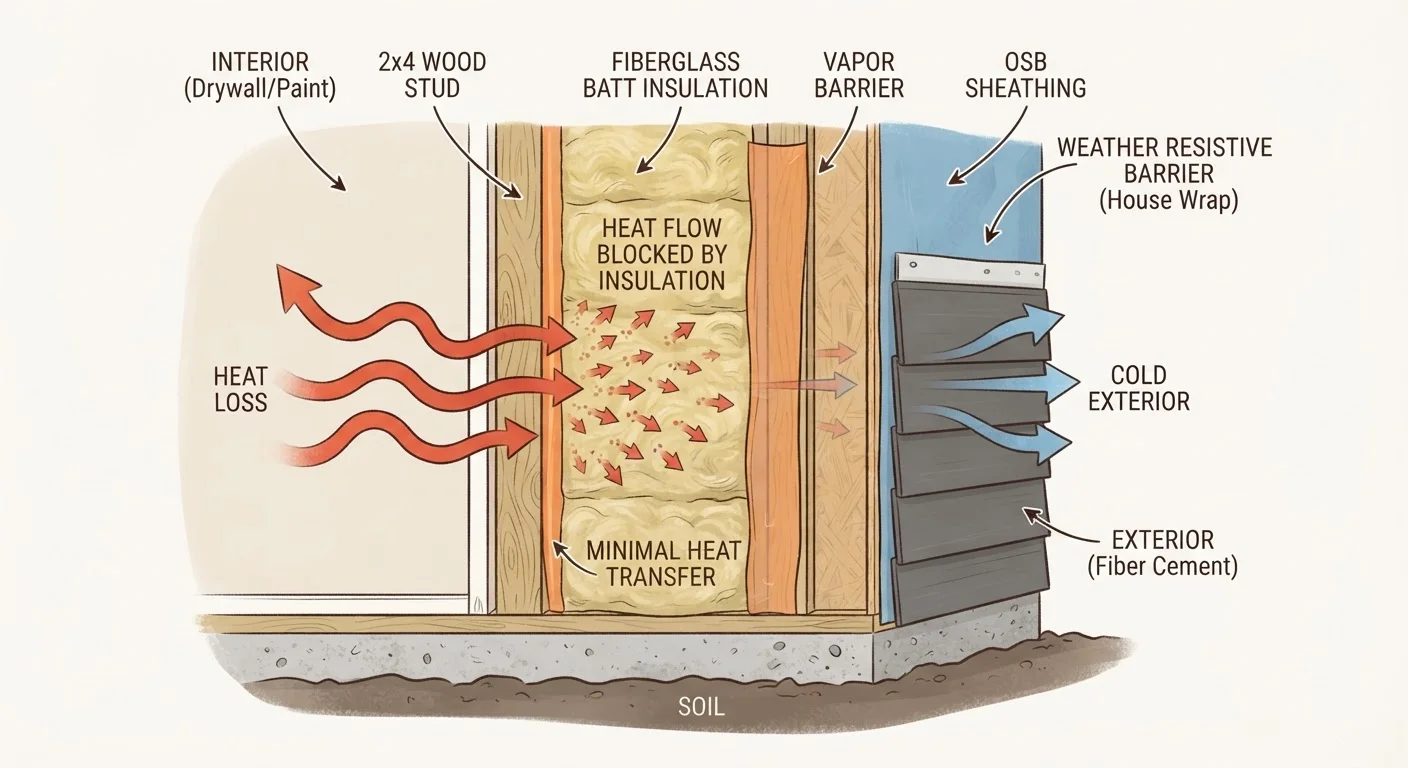
When you see a label that reads "R-19" or "R-38" on an insulation product, that number tells you one specific thing: how strongly the material resists the movement of heat through it. Heat naturally flows from warmer areas to cooler ones, so in winter it tries to escape your warm interior, and in summer it pushes in from outside. Insulation is the barrier that slows that movement down.
Think of R-value like a thickness of a winter coat. A higher rating means a thicker, denser barrier - more resistance against the cold. The rating is additive, too: if you already have R-19 in your attic and add another layer rated R-19, your total becomes R-38. This makes upgrading existing insulation a straightforward calculation.
R-value is also material-specific. Not all insulation is equally efficient per inch of thickness. This matters especially in wall cavities, where space is limited. For a deeper look at how different materials stack up, see our guide to insulation types covering fiberglass, spray foam, and blown-in options.
11%
Energy lost through ceilings and attics in typical homes
The U.S. Department of Energy estimates that heating and cooling accounts for nearly half of home energy use, with attic heat loss being a primary contributor.
8
Climate zones used for U.S. insulation recommendations
The DOE's Building America climate zone map divides the country into eight zones, each with distinct R-value targets for attics, walls, floors, and crawl spaces.
R-60
Maximum attic R-value recommended for coldest U.S. zones
Zones 6-8 - covering states like Alaska, Minnesota, and Montana - carry the highest attic insulation recommendations according to DOE guidance.
Why Location in Your Home Changes Everything
Not every part of your home needs the same R-value. Heat loss is highest where conditioned and unconditioned spaces meet - and the rates differ depending on the surface area, exposure, and physics of each location.
- Attics: This is where the most heat escapes. Recommendations typically range from R-38 to R-60 depending on climate zone.
- Walls: Standard 2x4 framing limits cavity depth, so R-13 to R-21 is a typical range. Some high-performance builds use 2x6 framing or exterior rigid foam to push higher.
- Floors over unconditioned spaces: Crawl spaces and garages below living areas generally call for R-13 to R-30.
- Basement walls: Recommendations range from R-5 to R-19 depending on whether the basement is conditioned and the local climate.
The U.S. Department of Energy divides the country into eight climate zones, each with specific R-value recommendations. You can look up your zone for free on their website using your ZIP code - doing so before purchasing any insulation can save you from under- or over-insulating.
Use the DOE Zone Map Before You Buy
The U.S. Department of Energy offers a free, ZIP-code-based climate zone lookup tool on their website. Always check your zone's recommended R-values before purchasing insulation materials. Buying to match your region's target - rather than just matching what's already in place - ensures you're actually meeting current efficiency standards.
What R-Value Doesn't Measure
R-value is a laboratory measurement of a material's thermal resistance under controlled conditions. It does not account for several real-world factors that significantly affect how well your home actually retains heat or stays cool.
Air infiltration is the biggest gap. Drafts through gaps around outlets, plumbing penetrations, attic hatches, and recessed lights bypass insulation entirely. A well-insulated attic with poor air sealing can still lose substantial energy. Air sealing should happen before or alongside insulation upgrades for best results.
Moisture also reduces performance. Wet or compressed fiberglass batts, for example, lose a meaningful portion of their rated R-value. Proper vapor barriers and ventilation protect the insulation's effectiveness over time.
Installation quality matters too. Insulation fitted with gaps, voids, or compression performs well below its rated value. This is sometimes called the "installation factor" - a perfectly rated product installed sloppily can fall short of a lower-rated product installed correctly.
Understanding these limitations helps you think of R-value as one important specification among several - much like how understanding what specifications actually mean helps you evaluate any product beyond just the headline number.
R-Value Is a Material Rating, Not a System Rating
When manufacturers list an R-value, they're describing the insulation material under standardized lab conditions. Your actual wall or ceiling assembly - including framing, air gaps, and drywall - has a different effective thermal resistance. Building scientists sometimes call this the "whole-wall R-value," which accounts for thermal bridging through studs and other structural elements.
Putting R-Value to Work in Your Home
Before starting any insulation project, take stock of what you currently have. In an attic, you can often measure existing insulation depth and cross-reference it with the material type to estimate your current R-value. If you're not sure what material is in place, a licensed energy auditor can assess your home and identify gaps - many utility companies offer free or subsidized audits.
When shopping for insulation, read the product label carefully. Manufacturers are required to display R-value prominently. Compare R-value per inch if you're working in a space-constrained cavity, and check the total R-value of the thickness you plan to install.
For most attic and crawl space projects, adding insulation is a manageable DIY task. However, work involving spray foam, electrical proximity, or structural components should be left to a licensed professional. Always check with your local building department about permit requirements before starting - some jurisdictions require inspections for insulation work, particularly when it accompanies other renovations.
Improving your home's insulation is one of the more durable energy-efficiency investments you can make. By understanding what R-value means - and what it doesn't - you're equipped to make decisions that translate into genuine comfort and reduced energy use year-round.
Frequently Asked Questions
The U.S. Department of Energy recommends R-38 to R-60 for attics in most climate zones, with colder regions requiring the higher end of that range. Your specific recommendation depends on your ZIP code's climate zone. Checking the DOE's free online zone map gives you the most accurate target for your area.
A higher R-value does mean greater thermal resistance, but it's not the whole picture. Air gaps, moisture, and improper installation can dramatically reduce real-world performance even with high-rated materials. R-value measures the material itself, not the quality of the installation.
In most cases, yes - especially in attics. Adding insulation increases the total R-value of the assembly. However, you should first check that existing insulation isn't wet or moldy, and ensure any air sealing issues are addressed before adding new material.
No. Attics typically require much higher R-values than walls because heat rises and escapes most readily through the roof. Walls, floors over unconditioned spaces, and crawl spaces each have their own recommendations based on climate zone and exposure.
R-value per inch varies by material. Spray foam, fiberglass batts, and blown-in cellulose all have different R-values per inch of thickness. That means a 3.5-inch wall cavity filled with different materials won't achieve the same total R-value depending on which product is used.
Spray foam insulation and any work near electrical panels, HVAC equipment, or in tight spaces should be handled by a licensed contractor. Attic batt or blown-in insulation is often a manageable DIY project, but always consult local building codes first to confirm permit requirements.
The content on this site is provided for informational purposes only and should not be considered a substitute for professional advice. While we strive to provide accurate and up-to-date information, we make no guarantees regarding its completeness or accuracy. Always consult a qualified professional for advice specific to your circumstances before making any decisions.