

Our Verdict
No single insulation type wins across every scenario. Fiberglass batts suit straightforward DIY wall or floor projects on a tight budget. Spray foam is the gold standard for airtight performance in critical areas like rim joists and crawl spaces, but the cost and professional requirement make it a targeted investment. Blown-in insulation is the smart pick for attic top-ups or any space where batts simply cannot fit.
| Best for | Recommended |
|---|---|
| Budget-conscious DIYers insulating open cavities | Fiberglass Batts |
| Homeowners prioritizing maximum air sealing in critical zones | Spray Foam |
| Attic upgrades and irregular or hard-to-reach spaces | Blown-In Insulation |
| Those working within strict time or cost constraints | Fiberglass Batts |
Why the Insulation Type You Choose Matters
Choosing insulation isn't just about stuffing material into a wall cavity and calling it done. The type of insulation you select affects thermal performance, moisture behavior, air infiltration, installation difficulty, and long-term cost. Understanding those differences upfront saves you from a costly re-do later.
Before diving into the comparison, it helps to understand R-value-the measure of thermal resistance that appears on every insulation product. Higher R-values mean better resistance to heat flow. But as our guide to insulation R-value ratings explains, R-value is only part of the picture. Air leakage can undermine even high-R insulation if the material isn't properly installed or paired with air sealing measures.
| Fiberglass Batts | Spray Foam (Closed-Cell) | Blown-In Cellulose | |
|---|---|---|---|
| R-Value per Inch | R-3 to R-4 | R-6 to R-7 | R-3.2 to R-3.8 |
| Air Sealing Ability | Low - gaps common | Excellent - fills voids | Moderate - fewer gaps than batts |
| Typical Cost Range | Lowest upfront cost | Highest upfront cost | Moderate cost |
| DIY Friendly | Yes, with basic safety gear | No - professional required | Attic yes; walls need pro |
| Best Location | Open wall/floor cavities | Rim joists, crawl spaces, roofs | Attics and enclosed retrofits |
| Moisture Resistance | Low - can absorb moisture | High - vapor barrier | Moderate - treated for resistance |
| Environmental Impact | Recycled glass content | Chemical blowing agents used | High recycled content |
Fiberglass Batts: Accessible, Affordable, and Familiar
Fiberglass batts are the pink or yellow rolls and pre-cut panels you've likely seen at any home improvement store. They're made from spun glass fibers and are sized to fit standard stud and joist spacing-typically 16 or 24 inches on center.
Performance
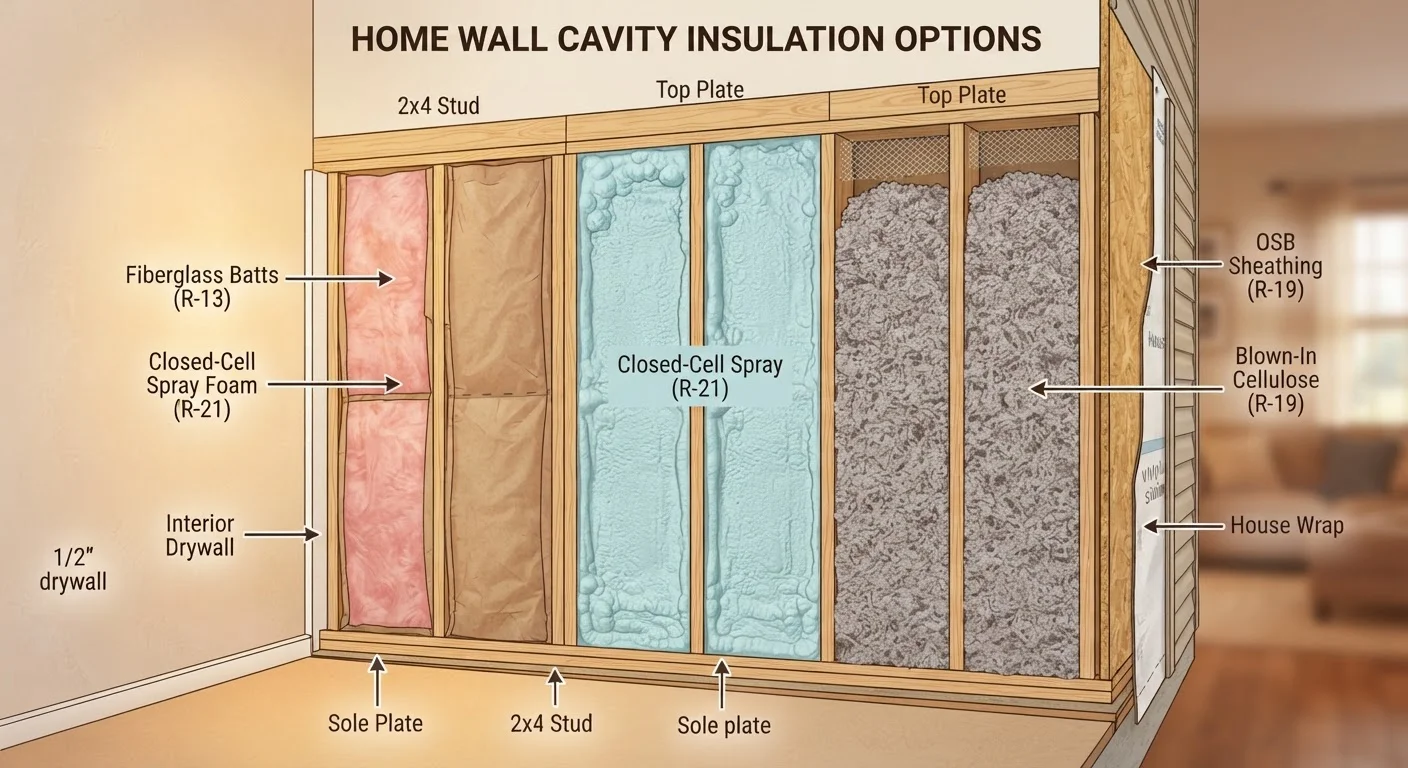
Fiberglass batts generally deliver R-values of about R-3 to R-4 per inch of thickness. A standard 3.5-inch batt for a 2×4 wall provides roughly R-13, while a 5.5-inch batt for a 2×6 wall reaches about R-19 to R-21. Performance depends heavily on installation quality. Gaps, compressions, or voids-even small ones-can significantly reduce effective R-value.
Best Applications
- Open wall cavities during new construction or gut renovations
- Floor assemblies above unheated crawl spaces
- Attic floors with accessible, regularly spaced joists
DIY Suitability
Fiberglass batts are the most DIY-accessible insulation type. You need basic safety gear-gloves, eye protection, an N95 respirator, and long sleeves-because the fibers are irritating to skin and lungs. Installation requires cutting batts to fit around wiring and pipes without compressing the material.
Install Batts Without Compression
Compressing fiberglass batts into a cavity reduces their effective R-value-sometimes significantly. A batt rated R-19 that's squished into a 3.5-inch cavity performs well below R-13. Always match batt thickness to cavity depth, and split batts around wiring rather than compressing them flat against it.
Spray Foam: Superior Air Sealing at a Higher Cost
Spray polyurethane foam (SPF) is applied as a liquid that expands and hardens in place. It comes in two main types: open-cell and closed-cell. Open-cell foam is softer and less dense, offering roughly R-3.5 per inch. Closed-cell foam is rigid, denser, and delivers R-6 to R-7 per inch-the highest R-value per inch of any common insulation material.
Performance
The defining advantage of spray foam is air sealing. It expands to fill irregular cavities, gaps around pipes, and structural voids that batts simply cannot reach. Closed-cell foam also acts as a vapor barrier, making it valuable in humid climates or below-grade applications. Open-cell foam is more vapor-permeable and better suited to interior wall assemblies where drying potential matters.
Best Applications
- Rim joists and band joists in basements
- Crawl space walls and encapsulation projects
- Cathedral ceilings and roof decks (closed-cell)
- Sealing around penetrations in any assembly
DIY Suitability
Small cans of expanding foam are appropriate for DIY gap-sealing. Full spray foam jobs, however, require professional equipment, trained applicators, and proper ventilation during curing. Misapplication can leave uncured foam that off-gasses harmful compounds. For any significant spray foam project, hire a licensed insulation contractor.
Blown-In Insulation: Flexible Coverage for Tricky Spaces
Blown-in insulation-sometimes called loose-fill-is installed using a hose and blower machine that distributes small particles of material evenly across a space. The two most common materials are cellulose (made from recycled paper, treated for fire and pest resistance) and fiberglass loose-fill.
Performance
Cellulose offers roughly R-3.2 to R-3.8 per inch and settles slightly over time, which contractors account for by installing to a higher initial depth. Fiberglass loose-fill runs about R-2.5 to R-3.7 per inch. Both materials conform to irregular framing and flow around obstructions, producing fewer voids than batts.
Best Applications
- Attic floors-especially those being upgraded without removing existing insulation
- Enclosed wall cavities in retrofit projects (using dense-pack cellulose)
- Any space with unusual joist spacing or heavy obstructions
DIY Suitability
Attic blown-in is a realistic DIY project. Many home improvement retailers loan blower machines with material purchase. It does require working in confined, dusty conditions, so a respirator and eye protection are essential. Dense-pack wall applications, by contrast, require specialized equipment and technique-that's a job for professionals.
For a deeper look at how these materials stack up on R-value metrics, see our detailed breakdown of insulation R-value to understand what performance targets to aim for in your climate zone.
Making the Right Choice for Your Project
The best insulation for your home depends on three practical questions: Where are you insulating? Can you do it yourself? And what's your budget?
15-25%
Heating and cooling savings from proper insulation
According to the U.S. Department of Energy, sealing air leaks and adding insulation can reduce heating and cooling costs by roughly 15-25%.
~90%
Recycled content in cellulose insulation
Cellulose loose-fill insulation is typically composed of approximately 80-90% post-consumer recycled paper, making it one of the more environmentally friendly options.
For straightforward open-cavity work in walls or floors, fiberglass batts offer a low cost of entry and easy installation for careful DIYers. For maximum thermal and air performance-especially in spaces like rim joists, crawl spaces, and roof decks-spray foam justifies the higher cost through long-term energy savings and moisture control. When you're topping up an attic or filling enclosed wall cavities during a retrofit, blown-in insulation's flexibility and even coverage make it the practical winner.
One smart strategy many homeowners use: combine types. Spray foam the rim joists and critical penetrations for airtightness, then fill the broader attic floor with blown-in cellulose for cost-effective R-value. Fiberglass batts handle the wall cavities during a remodel. No rule says you must pick just one.
This article provides general home improvement information only. Work involving electrical systems, structural elements, or regulated assemblies may require permits and licensed contractors. Always verify local building codes and requirements before beginning insulation projects.
The content on this site is provided for informational purposes only and should not be considered a substitute for professional advice. While we strive to provide accurate and up-to-date information, we make no guarantees regarding its completeness or accuracy. Always consult a qualified professional for advice specific to your circumstances before making any decisions.