

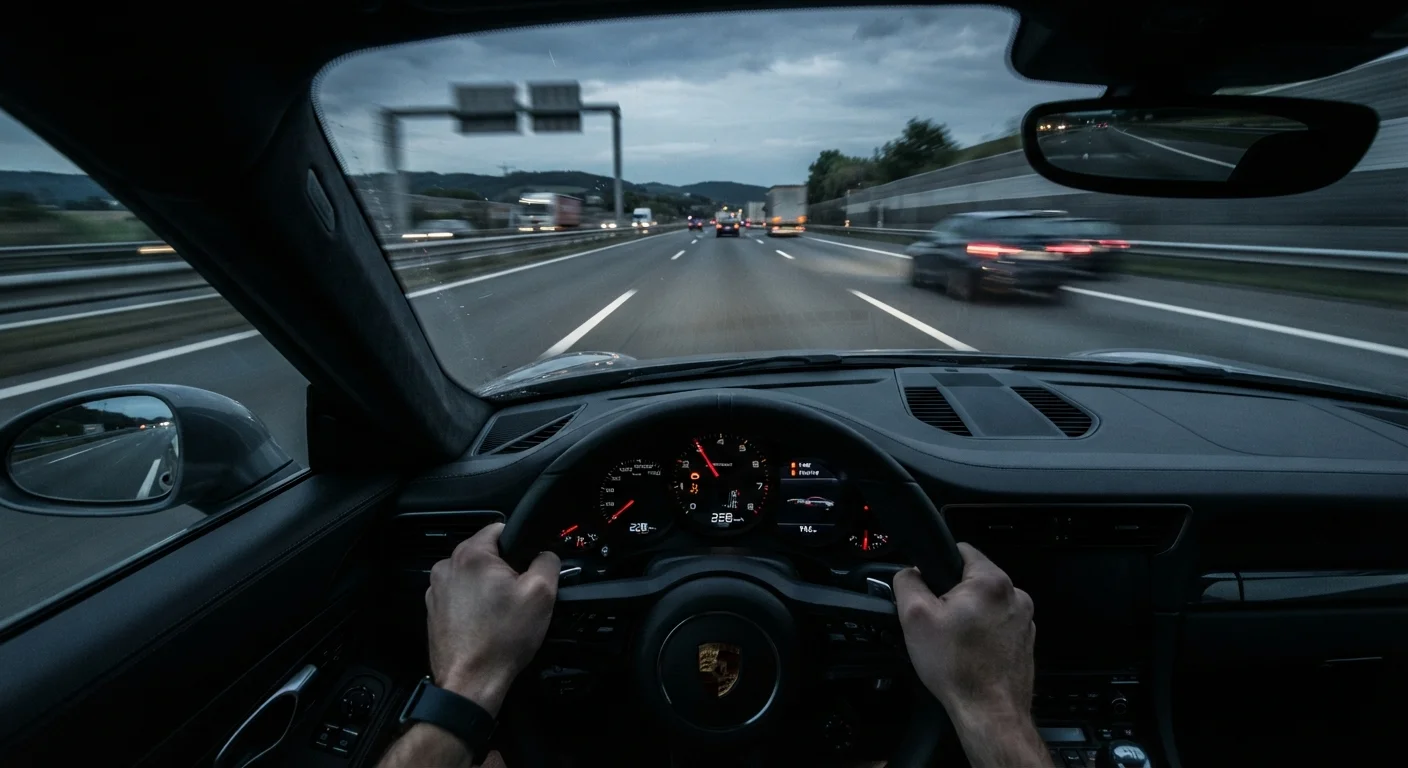
What Your Eyes Actually Do at Speed
At a standstill, a healthy human visual field spans roughly 180 degrees. You can detect movement to your far left and far right without turning your head. The moment your vehicle accelerates onto a highway, that picture begins to shrink.
The mechanism is straightforward: your visual system automatically directs its highest-resolution processing toward the point where you're headed - straight ahead. At higher speeds, incoming visual information arrives faster than the brain can comfortably integrate it, so the system narrows its focus as a coping strategy. What you perceive as a clear, wide view of the road is, neurologically speaking, an edited one.
This isn't unique to inexperienced drivers. It's a hard-wired physiological response. Understanding it - rather than assuming your vision works the same at 75 mph as it does pulling out of your driveway - is foundational to safer high-speed driving.
~180°
Visual field at a standstill
A healthy resting field of vision spans approximately 180 degrees, according to standard optometric references.
~40°
Estimated visual field at 60+ mph
Traffic psychology research suggests the useful peripheral field can narrow to roughly 40 degrees at highway speeds.
103 ft/sec
Distance traveled at 70 mph per second
At 70 mph, a vehicle covers approximately 103 feet every second - before any braking response begins.
The Perception Gap: Why Hazards Seem to Appear From Nowhere
One of the most unsettling experiences for highway drivers is the hazard that "comes out of nowhere" - a stopped vehicle ahead, a tire fragment in the lane, a car cutting in from the right. Speed-induced tunnel vision is a primary explanation.
At 70 mph, your car travels roughly 103 feet every second. If a hazard enters your narrowed visual field and your brain takes 1.5 seconds to perceive it, classify it as a threat, and initiate a braking response, you've already covered more than 150 feet before your foot moves. That's before braking distance even begins. See our guide to stopping distance for a full breakdown of how speed compounds these numbers.
Peripheral threats are most vulnerable to this effect. A vehicle merging from the right, or a pedestrian stepping toward the shoulder, falls precisely in the visual zone that speed degrades first. The blind spot problem is made meaningfully worse when peripheral awareness is already compromised by speed.
Train Your Eyes to Move, Not Stare
Professional and advanced drivers are taught to move their eyes constantly - sweeping across mirrors, the horizon, and the sides of the lane in a regular pattern. This active scanning habit is one of the most effective tools for catching hazards that speed-induced tunnel vision would otherwise hide. Even a simple reminder to check your mirrors every 5-8 seconds on the highway builds the habit over time.
How to Drive With This Limitation in Mind
Knowing that your eyes narrow their focus at speed gives you a practical framework for adjustment - not anxiety, but deliberate compensation.
- Increase your following distance. More space buys processing time. The gap between you and the vehicle ahead is buffer for your perception lag, not just for braking.
- Scan actively, don't stare. Trained drivers make regular eye movements - checking mirrors, scanning the horizon, sweeping left and right - rather than fixating on the car directly ahead. This manually offsets some of the narrowing effect.
- Slow down when conditions add pressure. Rain, glare, construction zones, and heavy traffic all reduce visibility further. Speed-induced tunnel vision is cumulative with other visual stressors. Night driving is a prime example of layered visual challenges.
- Recognize fatigue's role. Tired eyes narrow their focus even at lower speeds. Fatigue amplifies exactly the same perceptual bottleneck that speed creates.
Many highway incidents trace back not to recklessness but to reasonable-sounding assumptions about what we can see - assumptions that don't account for how profoundly speed changes perception.
“Speed doesn't just shorten the time you have to react - it changes what you're capable of seeing in the first place. Drivers who understand their own perceptual limits are far better equipped to manage them.”
— Dr. Gerald Wilde, Professor Emeritus of Psychology, Queen's University; researcher in risk perception and road safety
Frequently Asked Questions
The basic physiological narrowing affects everyone, but age, fatigue, and distraction can amplify the effect. Older drivers and those who are tired tend to experience greater perceptual narrowing at the same speed compared to younger, well-rested drivers.
Studies suggest noticeable perceptual narrowing begins around 30-40 mph and becomes significant above 60 mph. However, even moderate city speeds compress your useful visual field compared to walking pace.
Training can help - advanced driving courses teach deliberate eye-scanning patterns that counteract tunnel vision tendencies. Experience builds awareness of the problem, but it doesn't eliminate the underlying physiology.
The narrower your perceptual field and the faster you're traveling, the more distance you need to identify and react to a hazard ahead. Our related article on <a href="/autos-driving/safe-driving/following-distance-vs-reaction-time-understanding-the-gap-between-them">following distance and reaction time</a> explains this relationship in detail.
Yes. At highway speeds, peripheral vision - the channel through which you'd normally detect a merging vehicle - is significantly degraded. This is one reason lane-change and merge collisions remain common on high-speed roads.
The content on this site is provided for informational purposes only and should not be considered a substitute for professional advice. While we strive to provide accurate and up-to-date information, we make no guarantees regarding its completeness or accuracy. Always consult a qualified professional for advice specific to your circumstances before making any decisions.