

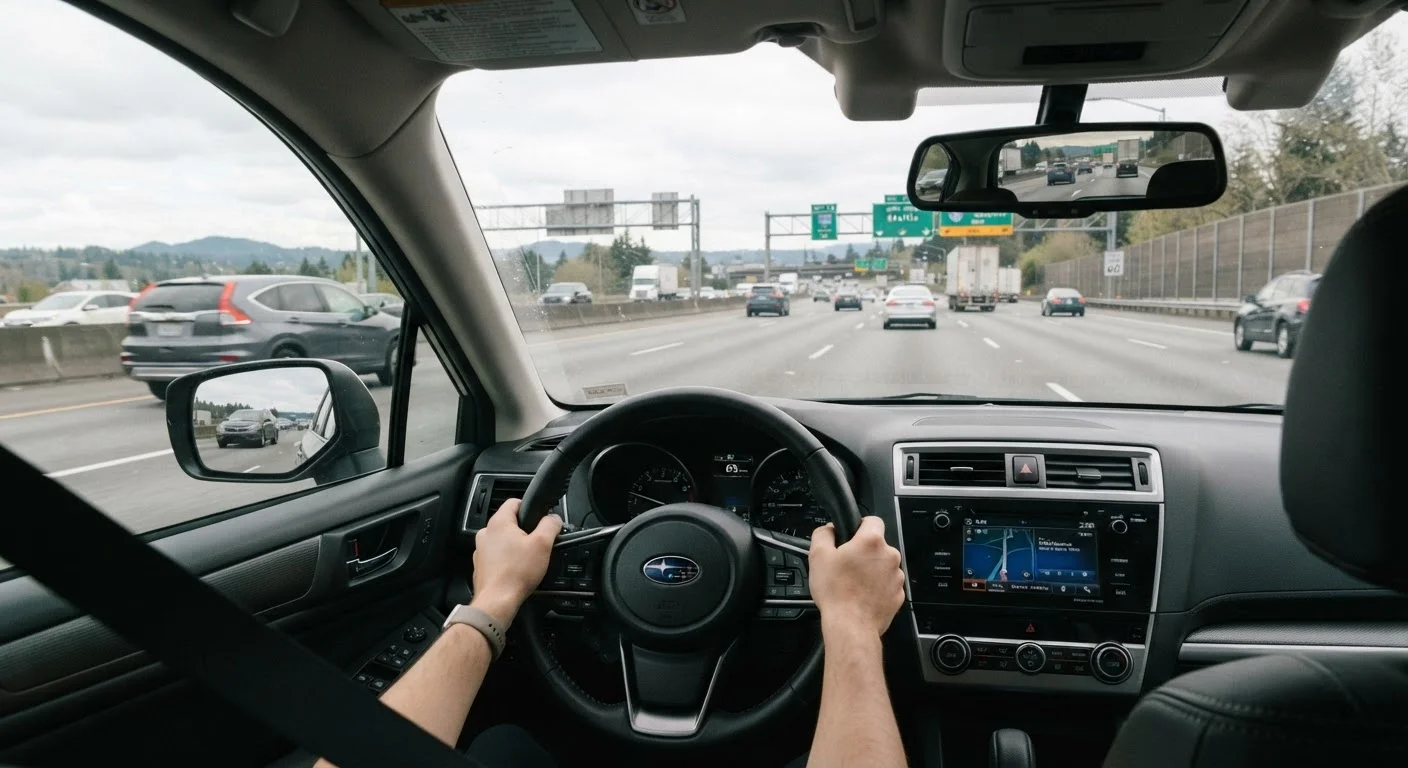
Where Blind Spots Actually Form
Every vehicle has several distinct blind zones created by its physical structure. The most significant are the rear quarter blind spots - the areas to the left and right of the car, roughly level with your rear doors and just behind them. This is the zone a vehicle in the next lane can occupy while remaining completely invisible in both your side and rearview mirrors.
Secondary blind spots include the area directly behind the vehicle (critical when reversing), and the forward corners near the A-pillars - the vertical posts on either side of the windshield. At intersections, A-pillars can obscure cyclists or pedestrians who are narrower than the pillar itself.
Vehicle type matters enormously. A full-size pickup truck or SUV has substantially larger rear-quarter blind zones than a compact sedan, due to higher ride height and longer bodylines. Large commercial trucks operate with blind spots that span multiple lanes and extend dozens of feet in every direction - a reality worth keeping in mind whenever you're driving near them on the highway.
840,000+
Annual U.S. crashes linked to blind spot errors
The National Highway Traffic Safety Administration (NHTSA) has estimated that hundreds of thousands of lane-change crashes each year involve drivers failing to detect vehicles in adjacent blind zones.
~30 ft
Rear blind zone of a large commercial truck
The Federal Motor Carrier Safety Administration notes that large trucks can have blind spots extending approximately 30 feet directly behind the trailer, where the driver cannot see following vehicles.
Why Mirrors Don't Solve the Problem Completely
Mirrors are essential, but they have geometric limitations. Your rearview mirror covers only the area directly behind you through the rear window. Side mirrors each cover a cone-shaped zone angled back from the door - but that cone has edges, and what falls outside those edges is a blind spot.
The most common mirror-adjustment mistake is angling side mirrors inward so you can see your own car's bodywork. While that feels reassuring, it wastes valuable mirror coverage on information you don't need. The better approach: angle each side mirror outward until you can barely see your own vehicle's edge. This expands coverage into the adjacent lane where blind spots live.
Even perfectly adjusted mirrors leave a gap between where the side mirror's view ends and where the rearview mirror's view begins. That gap is the classical blind spot - and it's where a vehicle can sit undetected while you prepare to change lanes.
Adjust Mirrors Before Every Drive
Seat position shifts your sightlines, so mirror angles set for someone else's driving position won't cover your blind spots correctly. Take a few seconds to readjust side and rearview mirrors whenever you get in the car - especially if others drive the same vehicle. This is part of a solid pre-drive routine, which our pre-drive safety walkthrough covers step by step.
The Right Way to Check Your Blind Spots
The shoulder check - a brief, deliberate turn of your head to look over your shoulder toward the blind zone - remains the most reliable way to clear a blind spot before a lane change. It takes less than a second and directly covers the area mirrors cannot.
Effective technique means actually rotating your head enough to see into the zone, not a cursory glance. For most drivers, this means turning roughly 45 degrees toward the side you're moving into, looking through the rear side window.
Signal before you check. Signaling first alerts other drivers to your intention, giving them time to react while you complete your scan. The sequence: signal, check mirrors, shoulder check, then move - not the other way around.
For a broader look at pre-drive preparation habits, including mirror setup, see our pre-drive safety walkthrough. And for how dangerous assumptions about clear lanes can be, our piece on assumptions drivers make that lead to accidents covers that ground in depth.
Technology Helps - But Doesn't Replace Habits
Blind spot monitoring (BSM) systems, now common on newer vehicles, use radar or camera sensors to detect vehicles in adjacent lanes and alert drivers via a warning light in the side mirror or an audible tone. They're a genuine safety asset, particularly on highways where lane changes happen frequently.
Their limitations are real, however. BSM systems can struggle to detect fast-closing vehicles, motorcycles traveling in the outer lane edge, or cyclists. They typically activate only above certain speeds, offering no help in parking lots or low-speed maneuvers. Relying on them exclusively in place of mirror checks and shoulder scans is a common and dangerous assumption.
Night conditions introduce additional complexity - reduced contrast makes it harder to visually confirm what sensors flag. For context on how darkness changes your driving environment overall, our article on night driving challenges is worth reading alongside this one.
Use technology as a backup layer, not the primary one. The habit of checking - mirrors, then shoulder - is what builds the situational awareness that keeps lane changes safe in every vehicle and every condition.
Frequently Asked Questions
The primary blind spots sit on the left and right rear quarters of the vehicle - roughly the zone beside and just behind each rear door that mirrors cannot fully capture. Additional blind zones exist directly behind large vehicles and near the front corners where the hood obscures low objects or pedestrians.
Well-adjusted mirrors reduce blind spots substantially but cannot eliminate them entirely. The geometry of mirror placement means small gaps will always remain, which is why a physical shoulder check before lane changes is still necessary.
No. Blind spot monitoring systems use radar or cameras to flag vehicles in adjacent lanes, but they have detection limits - they may miss fast-approaching vehicles, cyclists, or objects at very close range. Use them as a supplement, not a replacement, for scanning.
Yes. Taller, longer vehicles have larger blind zones, particularly at the rear and sides. Large commercial trucks can have blind spots extending 20 feet or more in front, 30 feet behind, and across multiple lanes on both sides.
Angle each side mirror outward slightly more than you might instinctively set it. You should barely see the edge of your own vehicle in the inner portion of the mirror. This widens coverage of the adjacent lane rather than duplicating what the center mirror already shows.
At highway speeds, a vehicle in your blind spot can be traveling at nearly the same speed as you, making it invisible in mirrors for several seconds. Moving into that lane without a shoulder check creates a collision risk even when mirrors appear clear.
The content on this site is provided for informational purposes only and should not be considered a substitute for professional advice. While we strive to provide accurate and up-to-date information, we make no guarantees regarding its completeness or accuracy. Always consult a qualified professional for advice specific to your circumstances before making any decisions.