

Why Night Driving Is a Different Skill
Most drivers rack up the majority of their miles in daylight, which creates a false sense of readiness for after-dark travel. The road looks familiar, the car behaves the same way, and the routine feels unchanged - but your sensory environment is fundamentally different once the sun goes down.
Approximately half of all traffic fatalities occur at night despite significantly lower overall traffic volume during those hours, according to the National Safety Council. That gap isn't explained by recklessness alone. It reflects how profoundly darkness changes what drivers can see, process, and react to in time.
The challenges below are ones daylight driving rarely forces you to confront directly. Understanding them is the first step toward handling them with confidence.
Reduced Visibility Beyond Your Headlights
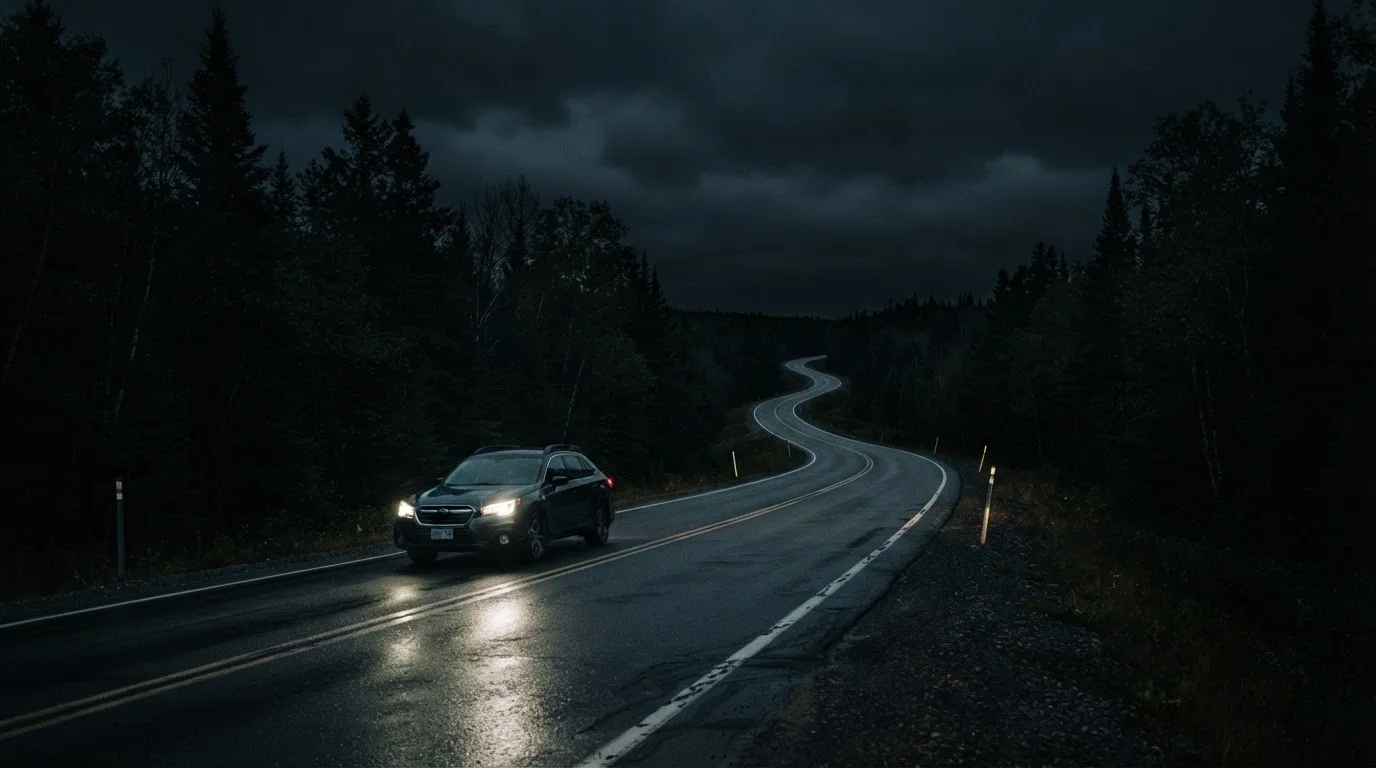
Standard low-beam headlights typically illuminate roughly 160 feet ahead. At 60 mph, your stopping distance - accounting for both reaction time and braking - can exceed 200 feet. That gap between what you can see and what you need to react to is called overdriving your headlights, and it's one of the most common and underappreciated nighttime hazards.
The fix isn't complicated: reduce speed so your stopping distance stays comfortably within your headlight range. On unlit rural roads or highways, use high beams when no oncoming traffic is present, and switch back to low beams within 500 feet of an approaching vehicle or when following another car closely.
At 60 mph, your stopping distance can outrun what your headlights actually illuminate.
Glare From Oncoming Headlights
Modern vehicles use increasingly bright lighting systems - LED and HID (high-intensity discharge) headlights in particular can cause significant temporary vision impairment when they hit your eyes directly. After a bright glare event, your eyes may take several seconds to readjust, and during that window your effective visibility drops sharply.
Instead of looking directly at oncoming headlights, shift your gaze to the right side of your lane and use the painted edge line as a guide. Avoid the impulse to flash your own high beams in response - it worsens the problem for both drivers. If your windshield has any hazing or scratches, glare becomes significantly worse; keeping glass clean inside and out helps considerably.
Shifting your gaze to the road edge during oncoming glare keeps your lane reference intact.
Degraded Depth Perception and Peripheral Vision
Human vision relies on color contrast and ambient light to judge distances and detect motion in peripheral areas. In low-light conditions, both degrade. Your eye's rod cells - which handle low-light vision - are concentrated away from the center of your visual field, meaning objects directly ahead are sometimes harder to see clearly than those slightly off-center at night.
A practical technique called off-center viewing - looking slightly to the side of a dim object rather than directly at it - can make faint hazards easier to detect. This is also why your eyes can mislead you at speed; nighttime compounds those perceptual limitations further.
Looking slightly off-center from a dim object can actually make it easier to see at night.
Pedestrians, Cyclists, and Animals Are Nearly Invisible
Unlit pedestrians wearing dark clothing can be nearly undetectable until they're well within your stopping distance. Cyclists without proper lighting present a similar problem. Animals - especially deer - are drawn to roadways at night and behave unpredictably. Deer-related crashes are heavily concentrated in dawn and dusk hours but remain a genuine threat through the night, particularly in rural and suburban fringe areas.
Scan actively rather than passively. Look for the reflective shine of eyes, movement at road edges, and irregular shapes that break the pattern of the roadside. If you see one deer, assume others may be nearby. Slow down in areas marked with animal crossing signs and through neighborhoods where foot traffic could be present.
If you spot one deer near the road, assume others are close - they rarely travel alone.
Driver Fatigue Peaks After Midnight
The body's circadian rhythm naturally suppresses alertness in the late-night and early-morning hours - roughly 2 a.m. to 6 a.m. - regardless of how much sleep a driver got the night before. Fatigue impairs reaction time, decision-making, and hazard awareness in ways that parallel alcohol impairment, and it compounds every other nighttime challenge on this list.
Warning signs include difficulty keeping your eyes open, drifting from your lane, missing exits, or having no memory of the last few miles driven. If any of these occur, stopping is the appropriate response - not caffeine or music alone. These strategies can briefly delay the onset but don't reverse meaningful impairment.
Late-night fatigue isn't a personal weakness - it's a predictable biological response that affects all drivers.
Unfamiliar Roads Become Harder to Read
During the day, you read a road's layout through a combination of landmarks, signage, road markings, and spatial context. At night, most of that environmental information disappears. Curves arrive with less warning. Intersections are harder to identify early. Lane markings on older roads may be faded or poorly reflective.
On unfamiliar routes, resist the temptation to match the speed of other traffic without verifying you can safely do so. Navigation audio cues become more valuable - glancing at a screen is more disruptive at night when your eyes are already doing more work. As explored in our piece on familiarity and road safety, both unfamiliar and overly familiar roads carry distinct risks.
Nighttime strips away the environmental cues you rely on to read an unfamiliar road.
Driving Smarter After Dark
Each challenge above has a practical countermeasure, and none require advanced skill - just deliberate adjustment. Slow down enough that your stopping distance stays within your headlight range. Keep more space between you and the vehicle ahead. Make sure your headlights, taillights, and windshield are in good working order before every night trip. For a comprehensive pre-departure check, see our pre-drive safety walkthrough.
Fatigue is the factor most drivers underestimate. If you're feeling drowsy, the hidden cost of driving drowsy are real - stopping to rest is not a delay, it's a safety decision. Night driving in poor weather compounds every risk described here; adjusting for weather conditions at night demands extra caution and reduced speed.
Building genuine after-dark confidence means treating the nighttime environment as its own driving context - not just daytime driving with the lights on.
Check Your Headlights Before Night Trips
A surprising number of drivers operate with misaimed or underpowered headlights without realizing it. Headlight lenses can yellow and haze over time, reducing output significantly. Have your headlight alignment and lens condition checked during routine service - it's a quick inspection that meaningfully improves what you can see after dark.
The content on this site is provided for informational purposes only and should not be considered a substitute for professional advice. While we strive to provide accurate and up-to-date information, we make no guarantees regarding its completeness or accuracy. Always consult a qualified professional for advice specific to your circumstances before making any decisions.