

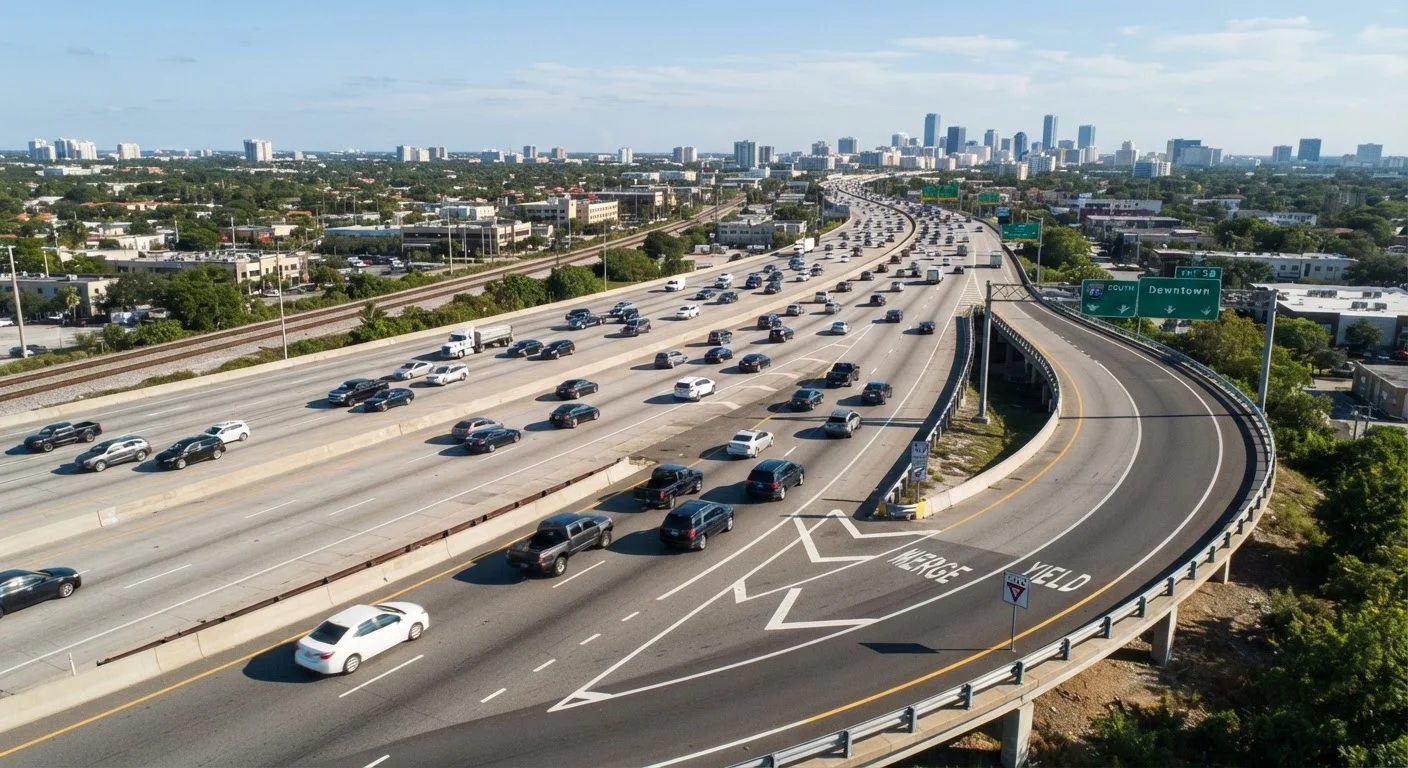
Why Merging Goes Wrong
Highway merging looks straightforward until something goes wrong. Drivers misjudge gaps, accelerate too slowly, or stop abruptly on an acceleration lane - all behaviors that create rear-end and sideswipe risks. Many collisions trace back not to recklessness but to misunderstood fundamentals: who has the right-of-way, how fast to go, and when to commit.
Understanding the mechanics of a safe merge before you reach the on-ramp puts you ahead of most drivers. As noted in our piece on common driver assumptions that lead to crashes, overconfidence in predicting other drivers' behavior is a recurring factor in freeway incidents. Merging is one of the highest-stakes moments where that overconfidence shows up.
“The on-ramp is a transition zone, not a waiting area. Drivers who treat it as a place to hesitate create the very conflicts they're trying to avoid.”
— Traffic Safety Research Community, General consensus from highway safety engineering literature
Right-of-Way on the On-Ramp: The Rule That Matters Most
In every U.S. state, drivers on the highway have the right-of-way over drivers entering from an on-ramp. The merging driver is responsible for finding a safe gap - highway traffic is not legally required to make room, though courteous drivers often do. Treating a yield as optional is one of the most dangerous assumptions a new driver can make.
This does not mean aggressive or panic merging. It means reading the traffic flow early - ideally while still on the ramp - so you arrive at the merge point with a clear plan. Right-of-way rules at on-ramps follow a similar logic to those at intersections, which we break down in detail in our guide to right-of-way at roundabouts and four-way stops.
When Highway Drivers Do Move Over
Some states have laws requiring drivers to move over or yield to merging traffic under specific conditions, though these vary significantly by jurisdiction. Even where such courtesies exist as law, merging drivers should never assume they will be extended. Plan your merge as though you must create your own safe opportunity.
Best Practices for a Safe, Confident Merge
The following practices address the most common points of failure during highway entry. Each one is grounded in established traffic safety principles.
Match highway traffic speed before reaching the merge point
Entering a lane significantly slower than surrounding traffic forces other drivers to brake suddenly, creating rear-end collision risk. Acceleration lanes exist specifically to allow speed-matching before entering traffic - they are not optional.
Scan for your gap early - start while you're still on the ramp
Last-second gap selection reduces decision time and increases the likelihood of a forced or unsafe merge. Early scanning gives you time to adjust your ramp speed to align with an opening in traffic.
Always signal before changing lanes onto the highway
Turn signals communicate your intentions to highway drivers, giving them the option to create space. Merging without signaling removes that option and eliminates an important layer of coordination.
Check your mirrors and blind spot immediately before merging
Mirrors alone do not cover the blind spot alongside and slightly behind your vehicle. A quick over-the-shoulder glance confirms no vehicle is occupying the space your mirrors can't show.
Never stop on an acceleration lane unless traffic is at a complete standstill
Stopping on a ramp designed for acceleration creates a dangerous bottleneck and puts you at risk of a rear-end collision from drivers behind you still building speed. It also makes re-entering highway-speed traffic significantly harder.
Commit to the merge once you've identified a safe gap
Hesitating after beginning a merge - or suddenly aborting - creates unpredictable movement that surprises both highway drivers and vehicles behind you on the ramp. A smooth, deliberate entry is safer than an indecisive one.
Situational Factors That Change the Equation
Not every merge unfolds the same way. Short acceleration lanes - common in older urban interchanges - compress your available time for speed-matching and gap selection. In heavy traffic, gaps may be smaller or require active cooperation from highway drivers. Rain, low visibility, or nighttime conditions reduce your ability to judge distance and closing speed accurately.
Before any trip that involves unfamiliar highways, a brief pre-drive review of your mirrors, surroundings, and vehicle readiness pays dividends. Our pre-drive safety walkthrough covers what to check before you leave. Drivers navigating routes they don't know well face compounded challenges - see how familiarity and novelty affect risk in our article on driving in new cities versus familiar routes.
Regardless of conditions, the core rule stays constant: match speed, check mirrors and blind spots, signal, and commit smoothly. Hesitation is more dangerous than decisiveness once a safe gap exists.
The content on this site is provided for informational purposes only and should not be considered a substitute for professional advice. While we strive to provide accurate and up-to-date information, we make no guarantees regarding its completeness or accuracy. Always consult a qualified professional for advice specific to your circumstances before making any decisions.