

Our Verdict
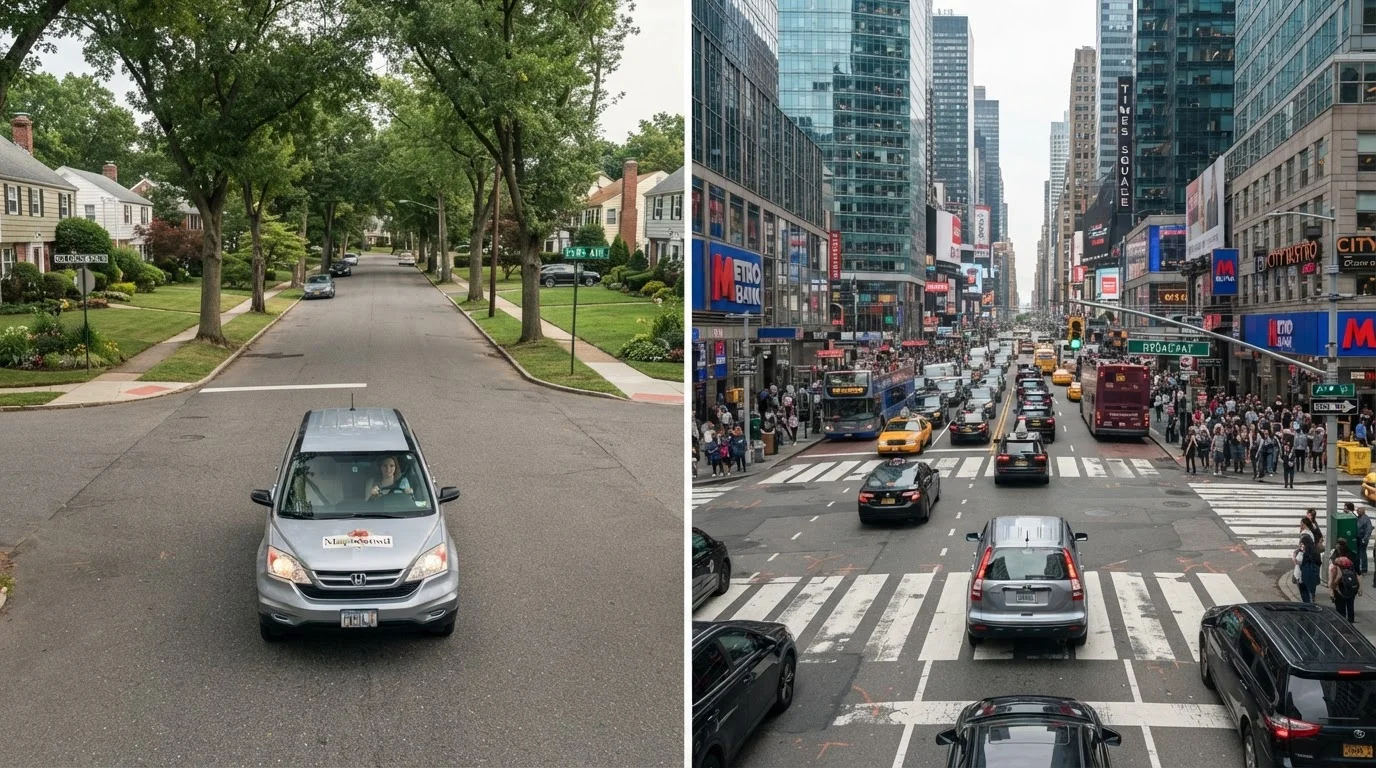
Neither familiar nor unfamiliar driving is inherently safer - each carries a distinct risk profile. Familiar routes lull drivers into passive, autopilot-style behavior, while new cities overload attention and expose gaps in local knowledge. The safest drivers actively manage both scenarios by staying mentally engaged regardless of how well they know the road.
| Best for | Recommended |
|---|---|
| Drivers navigating new cities for the first time | Route preview and reduced speed |
| Daily commuters on familiar roads | Deliberate attention habits and mindfulness checks |
| Drivers balancing navigation and safety simultaneously | Pre-programmed GPS and passenger co-piloting |
The Illusion of Safety on Known Roads
It's a well-documented pattern in traffic safety research: a disproportionate share of crashes happen within a few miles of a driver's home. The reason isn't bad roads or bad luck - it's familiarity itself. When the brain recognizes a route it has traveled hundreds of times, it shifts toward automatic processing, a cognitive shortcut that frees mental bandwidth but dramatically reduces active hazard detection.
On a commute you've driven for years, your mind may genuinely wander - to a work problem, a conversation, your phone - while your hands and feet execute the drive on a kind of autopilot. This isn't carelessness in the ordinary sense. It's a natural feature of how human attention works. The danger is that roads change: a child darts out, a stop sign is added, a pothole appears. Drivers running on autopilot are slower to register those changes.
Common driving assumptions that feel reasonable on a known road - such as predicting that no one will run a particular light - are exactly the kinds of mental shortcuts that lead to collisions. Familiarity doesn't equal safety; it often equals reduced vigilance.
Reset Your Attention on Known Routes
On roads you drive every day, build a habit of narrating hazards aloud - even just mentally noting 'intersection ahead,' 'pedestrian on right.' This simple technique forces the brain back into active scanning mode and counteracts automatic processing. Even a brief mental check-in at the start of your commute can meaningfully improve your alertness over the full trip.
The Real Risks of Driving in an Unfamiliar City
Navigating a new city presents the opposite problem: cognitive overload. The brain is processing unfamiliar intersections, decoding unclear signage, interpreting local traffic patterns, and managing GPS instructions - often simultaneously. This splits attention across too many competing tasks, and something has to give.
What typically suffers first is hazard scanning. Drivers focused on street names and turn cues are less likely to notice a cyclist in a bike lane, a pedestrian stepping off a curb, or a car running a red at an unexpected angle. Research on cognitive distraction while driving shows that mental load - not just physical distraction - meaningfully degrades reaction time and situational awareness.
Unfamiliar road layouts also mean drivers are more likely to make last-minute lane changes, brake sharply before a missed turn, or hesitate at intersections with rules they don't immediately understand. Roundabouts and uncontrolled intersections, for instance, are particularly disorienting in cities where they're common but the visiting driver rarely encounters them at home.
| Familiar Routes | Unfamiliar City Driving | |
|---|---|---|
| Primary risk | Complacency and reduced attention | Cognitive overload and distraction |
| Hazard detection | Slower due to autopilot processing | Reduced by split focus on navigation |
| Decision-making speed | Fast but potentially overconfident | Slower; more hesitation at intersections |
| Crash likelihood context | High - most crashes occur near home | Elevated during first exposure to layout |
| Key mitigation | Active scanning habits, no distractions | Route preview, lower speed, extra following distance |
| Driver confidence level | High - often falsely reassuring | Low - but can prompt useful caution |
Strategies That Work in Both Environments
The good news is that the underlying solution is the same regardless of whether you're driving a route you know by heart or navigating a city for the first time: deliberate, active mental engagement. For familiar routes, that means consciously resisting autopilot. Treat well-known roads with the same visual scanning habits you would apply on day one - check mirrors systematically, look ahead at intersections, and avoid in-car distractions. Drowsy driving is especially likely on routine commutes, so recognize when fatigue is compounding the complacency risk.
For unfamiliar city driving, preparation reduces cognitive load before you ever leave the curb. Study the route in advance so you're confirming turns rather than solving them in real time. Set navigation audio clearly so your eyes stay on the road. Give yourself extra following distance - following distance and reaction time interact in ways that punish drivers who are already processing more than usual. And reduce speed: a slightly slower pace in an unfamiliar environment buys meaningful reaction time.
If you're arriving in a new city for travel, consider familiarizing yourself with the neighborhood layout on foot before attempting to drive it. Visual recognition of landmarks significantly shortens the mental map-building process behind the wheel. For after-dark challenges in any unfamiliar location, see our guidance on night driving challenges that apply regardless of how well you know the route.
The content on this site is provided for informational purposes only and should not be considered a substitute for professional advice. While we strive to provide accurate and up-to-date information, we make no guarantees regarding its completeness or accuracy. Always consult a qualified professional for advice specific to your circumstances before making any decisions.