

Why Intersection Rules Still Confuse Drivers
Intersections are where most traffic conflicts happen - and where right-of-way confusion does real damage. Even drivers with years of experience hesitate at four-way stops, yield incorrectly at roundabouts, or freeze when there's no sign at all. The rules aren't complicated, but they're rarely reviewed after a driver's test. A quick reference can close that gap.
Right-of-way doesn't mean you legally own the road. It means the law assigns one driver priority to proceed - and every other driver is obligated to wait. Understanding that framing matters: yielding isn't optional courtesy, it's a legal duty. As our guide on driver assumptions points out, many crashes happen when drivers assume the other person will yield correctly.
Roundabouts: Yield to Traffic Already Inside
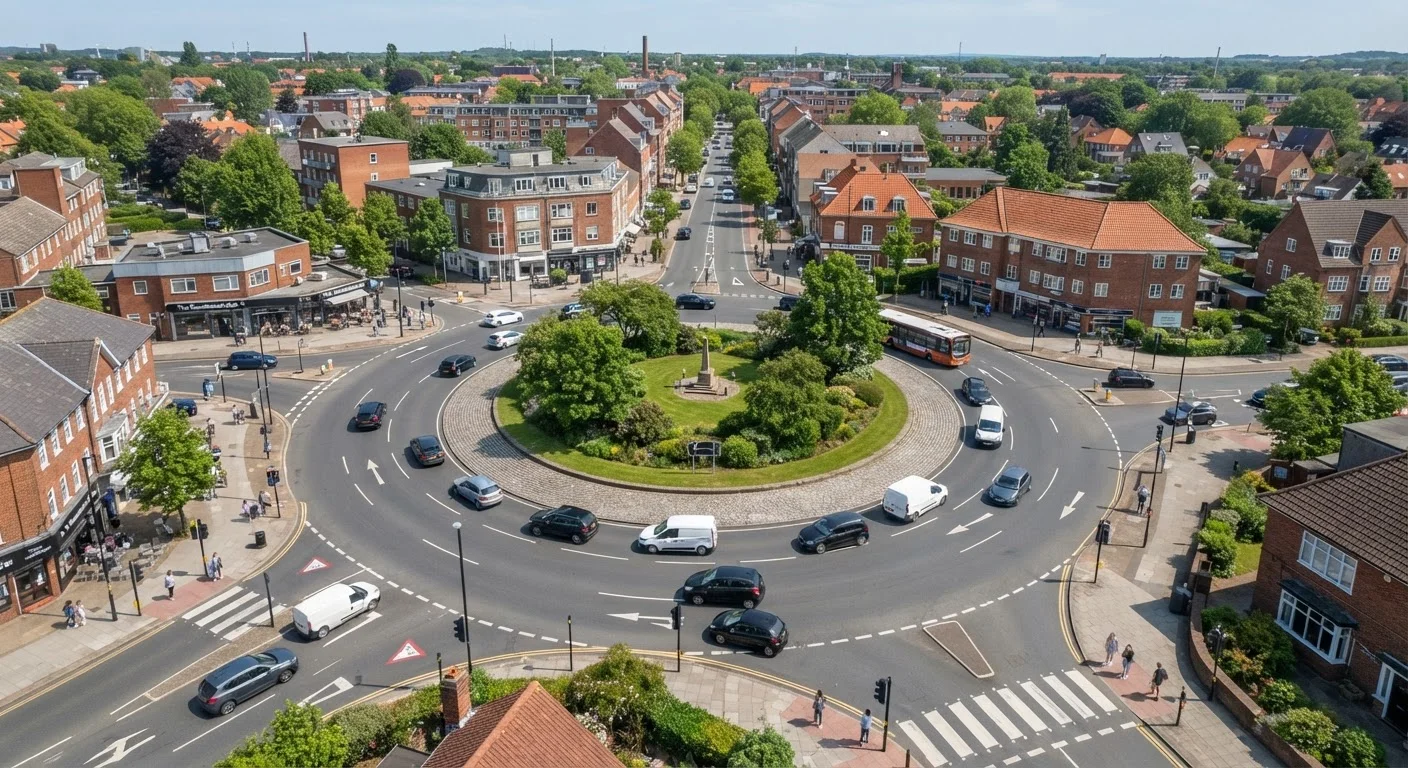
The rule at a roundabout is simple: vehicles already inside the circle have the right of way. Drivers entering from any approach leg must yield - regardless of which direction traffic inside is traveling or how long they've been waiting.
Common mistakes include treating a roundabout like a four-way stop (waiting for permission rather than watching for gaps) and failing to use turn signals. In a multi-lane roundabout, lane discipline is critical: use the right lane for right turns or going straight, and the left lane for going straight or making a full U-turn. Check your state's driver handbook for any local variations, but the yield-on-entry rule is consistent across all 50 states.
Roundabouts dramatically reduce the types of crashes that cause serious injuries - specifically right-angle (T-bone) collisions - because vehicles travel in the same direction at reduced speeds. The Federal Highway Administration has documented significant safety improvements at locations where traditional intersections were converted to roundabouts.
Right-of-way
The legal priority assigned to one driver to proceed through an intersection or roadway while others must wait. It is a duty to yield, not a guarantee of safe passage.
Uncontrolled intersection
An intersection with no traffic signals, stop signs, or yield signs. Drivers must apply default right-of-way rules, typically yielding to the right on simultaneous arrival.
Roundabout
A circular intersection where traffic flows counterclockwise around a central island. Entering drivers must yield to vehicles already circulating inside.
All-way stop
An intersection where stop signs face all approaches, requiring every driver to come to a full stop before proceeding in order of arrival.
Yield
The legal obligation to slow or stop and allow another vehicle to pass before proceeding. Failing to yield when required is a common cause of intersection crashes.
Four-Way Stops: Order, Position, and the Tie-Breaker
A four-way stop (also called an all-way stop) requires all drivers to come to a full stop and then proceed based on a clear priority order:
- First to stop, first to go. Whoever arrived at the stop line first has the right of way to proceed first.
- Simultaneous arrival - yield to the right. If two vehicles arrive at the same time, the driver on the left yields to the driver on the right.
- Opposite traffic going straight vs. turning. If you and the driver directly across from you arrive simultaneously and both go straight, you may proceed together. If one is turning left across the other's path, the turning driver yields.
- Three or four simultaneous arrivals. Use the yield-to-the-right rule and proceed one at a time, watching carefully for any driver who misreads the order.
The most common error at four-way stops is waving another driver through when it's actually your turn. While it feels polite, it can confuse other drivers and create unpredictable movements. Proceed when it's your turn - consistency is safer than improvised courtesy.
Understanding precise gap judgment at stops is also covered in our guide on following distance and reaction time, which helps explain why hesitation at intersections carries real risk.
Uncontrolled Intersections: When There's No Sign at All
An uncontrolled intersection has no stop signs, yield signs, or traffic signals. These appear most often in residential neighborhoods, rural roads, and older grid-pattern streets. The rules here are frequently misunderstood.
The default rule: Yield to traffic already in the intersection. If another vehicle is already passing through, wait.
For simultaneous arrivals: Yield to the vehicle on your right - the same tie-breaker used at four-way stops.
T-intersections: The driver on the road that ends (the top of the T) must yield to traffic on the through road.
Treat uncontrolled intersections with extra caution. Reduce speed as you approach, even if you technically have priority. The risks of unfamiliar road layouts are real - drivers visiting a new area may not immediately recognize an uncontrolled intersection for what it is.
It's also worth reviewing your pre-drive safety habits before navigating any area where intersection types are unpredictable. And if you regularly navigate high-speed entry points, the rules around right-of-way extend beyond intersections - our merging guide covers that territory in full.
The content on this site is provided for informational purposes only and should not be considered a substitute for professional advice. While we strive to provide accurate and up-to-date information, we make no guarantees regarding its completeness or accuracy. Always consult a qualified professional for advice specific to your circumstances before making any decisions.