

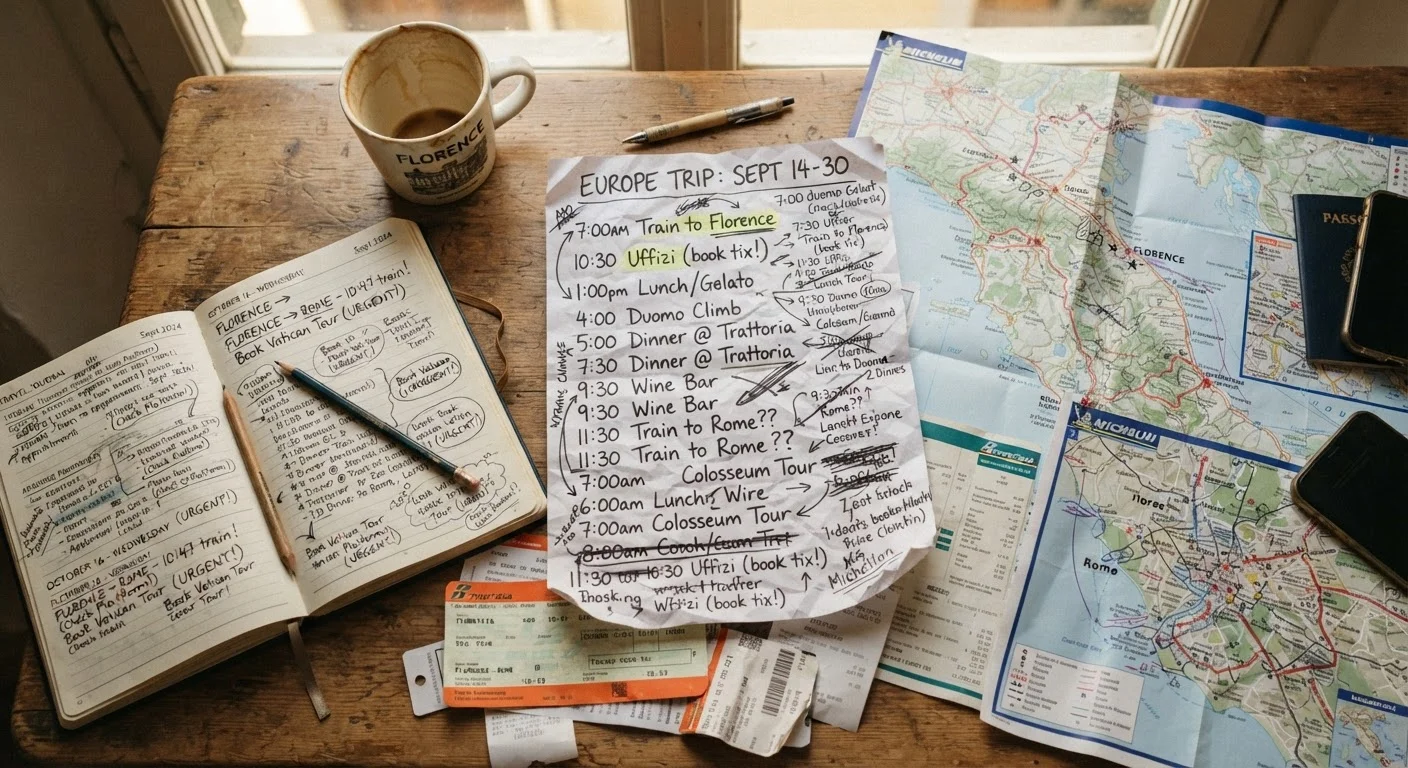
The Overpacked Itinerary Problem Is More Common Than You Think
Most travelers don't realize they've overpacked their itinerary until they're standing exhausted at a train station, having rushed through two museums and a market before noon. The impulse to fill every hour is understandable - travel costs money, time off is limited, and the list of things worth seeing always seems longer than the trip itself. But cramming in too much is one of the most reliable ways to come home feeling like you need a vacation from your vacation.
This isn't about being lazy or lowering your standards. It's about understanding how time actually works when you're traveling - and building a plan that survives contact with reality. See our guide to building an itinerary that actually holds up for a deeper look at pacing structure.
Scheduling back-to-back activities with no transition time between them.
Why it happens: Planners focus on what they want to do, not how long it takes to get from one place to the next. Digital maps that show 15-minute transit times rarely account for real-world friction.
Planning the same number of activities for every day, regardless of what's actually involved.
Why it happens: Itineraries often get built symmetrically - four things Monday, four things Tuesday - without accounting for the fact that some days are inherently heavier than others.
Underestimating how long meals, lines, and logistics actually take.
Why it happens: Travelers budget 45 minutes for lunch at a popular restaurant, but in practice a sit-down meal in an unfamiliar place - including finding it, waiting, ordering, and leaving - often takes 90 minutes or more.
Treating the itinerary as a commitment rather than a framework.
Why it happens: Once something is booked or written down, many travelers feel locked in - especially if money was spent. Deviating from the plan starts to feel like a failure.
Adding destinations or stops to a trip primarily to justify the travel cost.
Why it happens: When flights or accommodations are expensive, travelers often feel pressure to maximize every day, leading to itineraries that are financially efficient but physically and emotionally exhausting.
How to Recognize When Your Plan Has Gone Too Far
Before your trip begins, a few red flags in your itinerary are worth catching early. If you're scheduling three or more distinct attractions in a single day without accounting for travel between them, that's a warning sign. So is any day that has zero unscheduled time - no buffer for a slower morning, a long lunch, or simply wandering without a destination.
Don't Rely on 'Best Case' Transit Estimates
Google Maps and similar tools display ideal transit times under ideal conditions. In practice, delays, crowds, construction, or simply getting lost add time that your itinerary can't absorb if it's already tight. Always plan for the realistic case, not the optimistic one - especially in unfamiliar cities or countries where you're navigating in a second language.
Another common tell: you've booked activities in multiple cities or neighborhoods on the same day, assuming transit will go smoothly. In practice, getting from point A to point B often takes longer than expected - factor in ticket lines, wayfinding, and the time it takes to simply recover from the previous stop. Reviewing the anatomy of a well-planned trip can help you benchmark your own schedule against a realistic framework.
~2x
Time underestimation gap for traveler activities
Travel researchers and trip-planning practitioners commonly note that travelers consistently underestimate activity durations by roughly half, particularly for sightseeing involving queues or transit.
1 in 3
Travelers who report post-trip exhaustion
Surveys by leisure travel organizations have found that a significant share of vacationers return home feeling more tired than rested, often citing overscheduling as a primary cause.
Pay attention to how you feel while building the itinerary. If you're anxious just looking at it - or if you're already mentally calculating how to fit everything in - that's often a signal the plan needs to be cut back, not optimized harder.
Fixing the Problem Before You Leave Home
Editing a travel plan takes discipline, but the payoff is significant. Start by listing every activity you've planned and assigning a realistic time block - including getting there, finding parking or navigating transit, standing in line if applicable, and leaving. You'll almost always find that two or three items are eating up more time than you budgeted.
From there, prioritize ruthlessly. Identify the two or three experiences that are non-negotiable for the trip to feel worthwhile, and let those anchor each day. Everything else can be treated as optional - things you'll do if time allows, not things you've committed to. This also gives you natural fallback options when something is closed, overcrowded, or just not worth the wait.
If you're visiting a destination for the first time, consider that many travel regrets stem from mismatched expectations, not from doing too little. Leaving some of a place unseen is not failure - it's often what makes travelers want to return. For destination ideas that reward a slower approach, smaller European cities are particularly well-suited to open, unscheduled exploration.
The content on this site is provided for informational purposes only and should not be considered a substitute for professional advice. While we strive to provide accurate and up-to-date information, we make no guarantees regarding its completeness or accuracy. Always consult a qualified professional for advice specific to your circumstances before making any decisions.