

Start here
What Happens at Airport Security
Prepare
What to Have Ready Before You Reach the Line
Pack smart
Packing to Pass: Prohibited and Restricted Items
At the checkpoint
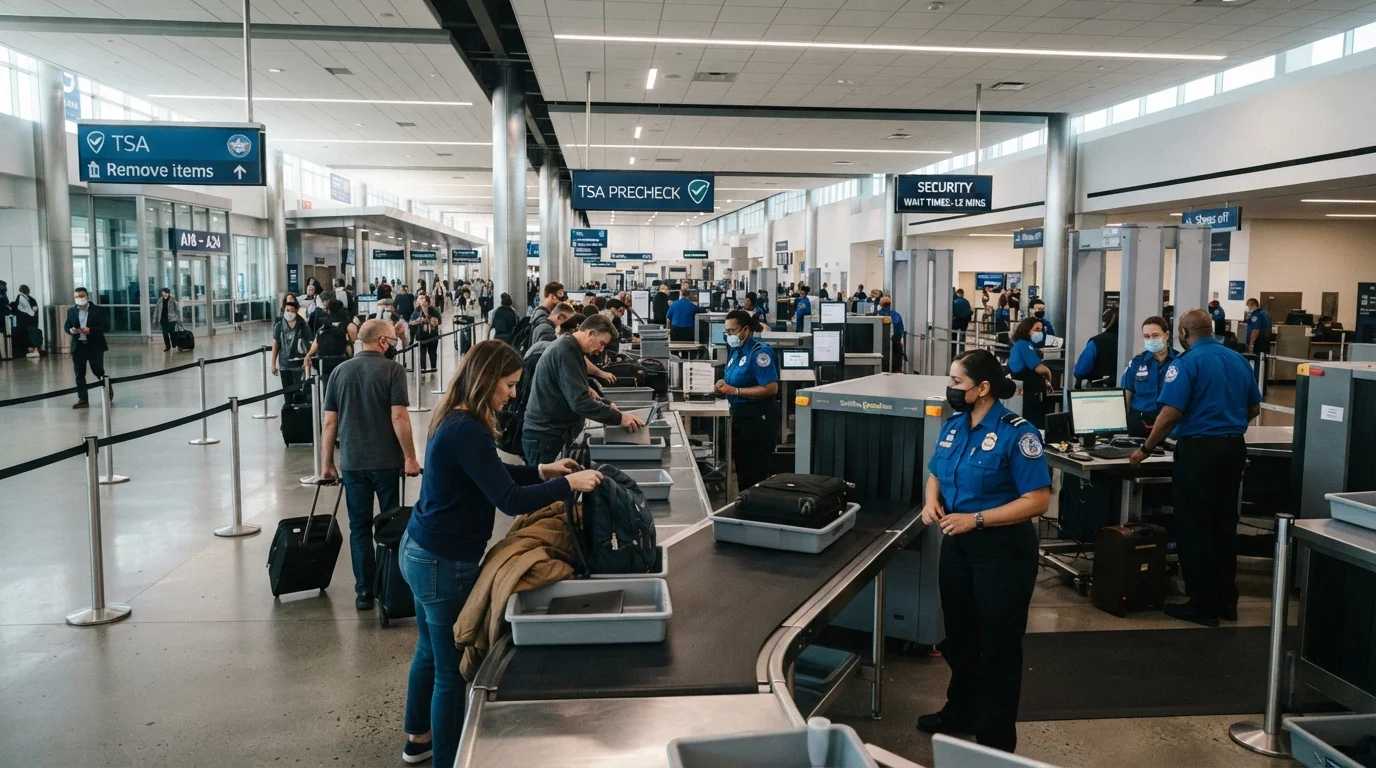
Moving Through the Checkpoint Step by Step
Level up
TSA PreCheck and Other Trusted Traveler Programs
What Happens at Airport Security
Airport security in the U.S. is managed by the Transportation Security Administration (TSA), a federal agency responsible for screening passengers and baggage at commercial airports. For first-time flyers, the checkpoint can feel overwhelming - but the process follows a consistent, predictable sequence.
At its core, security involves three things: verifying your identity and boarding pass, screening your carry-on bags through an X-ray machine, and scanning you through either a metal detector or advanced imaging technology. Understanding this sequence before you arrive removes most of the uncertainty. See our end-to-end travel roadmap for how security fits into the broader departure day picture.
TSA
The Transportation Security Administration is the U.S. federal agency that screens passengers and baggage at commercial airports to prevent prohibited items from boarding aircraft.
3-1-1 rule
A TSA policy requiring that carry-on liquids be in containers of 3.4 oz or less, all fitting in one quart-sized clear bag, with one bag allowed per passenger.
Boarding pass
A document (paper or digital) issued by your airline that authorizes you to board a specific flight. Required at the security ID check and at the gate.
Advanced imaging technology
A type of body scanner used at security checkpoints that uses radio waves to detect concealed items without physical contact. It produces a generic outline, not a photo.
REAL ID
A federally compliant form of state-issued ID that meets minimum security standards set by federal law. Required for domestic air travel at TSA checkpoints.
TSA PreCheck
A trusted traveler program that grants pre-approved passengers access to expedited screening lanes where fewer items need to be removed from bags.
What to Have Ready Before You Reach the Line
Preparation before you join the security line saves time for everyone - including you. Have your boarding pass (printed or on your phone, screen brightness turned up) and your government-issued ID out and accessible before you reach the document checker. Fumbling through a bag at that point creates delays and unnecessary pressure.
Wear shoes that slip on and off easily, and avoid heavy metal accessories like belts or large jewelry. If you're traveling with a passport or other travel documents, keep them in one easy-to-reach pocket rather than buried in a bag. Check your pre-trip checklist before leaving home to confirm you have everything you'll need at the checkpoint.
Pack Your Carry-On with Security in Mind
Before you leave home, do a quick mental run-through of your bag's contents using the TSA rules as a checklist. Place your quart-sized liquids bag near the top of your carry-on so it's easy to pull out. Keeping electronics together in one pouch also speeds up the process at the bin stage.
Packing to Pass: Prohibited and Restricted Items
The most common source of checkpoint delays is carry-on packing. Two rules cover the majority of issues:
- The 3-1-1 liquids rule: Each liquid, gel, or aerosol in your carry-on must be in a container of 3.4 oz (100 ml) or less. All containers must fit in a single quart-sized, clear, resealable plastic bag. One bag per passenger.
- Prohibited items: Firearms (unless properly declared and checked), most sharp objects, and certain sporting goods are not allowed in carry-ons. The TSA maintains a searchable database of what is and isn't permitted at tsa.gov - always verify before packing.
Firearms and ammunition can sometimes be transported in checked baggage under specific conditions - but the rules are strict and must be confirmed directly with TSA and your airline before travel.
Packing Prohibited Items Has Real Consequences
Accidentally packing a prohibited item - even if you forgot it was there - can result in confiscation, a missed flight, or in serious cases, civil penalties. Never assume an item is fine without checking. TSA's website has a searchable 'What Can I Bring?' tool that covers thousands of specific items. Check it before you pack, not after.
Moving Through the Checkpoint Step by Step
Once your ID is verified, follow these steps through the screening lane:
- Collect a bin. Use the plastic bins provided for your shoes, jacket, belt, and personal items.
- Remove electronics. Laptops and tablets must come out of bags and be placed flat in a bin. Phones generally stay in your bag or pocket.
- Separate your liquids bag. Place your quart-sized liquids bag in a bin, not inside your carry-on.
- Send bags through the X-ray. Push your bins and bags onto the conveyor belt and walk through the body scanner when directed.
- Collect your belongings. Move to the end of the belt, step aside to re-dress, and re-pack before walking away.
If the scanner alarms, or if an officer flags your bag for a secondary check, stay calm and follow instructions. Officers are trained to explain the process and will tell you what to expect. Additional screening is routine and does not indicate suspicion of wrongdoing.
TSA PreCheck and Other Trusted Traveler Programs
TSA PreCheck is a program that allows pre-approved travelers to use dedicated, expedited screening lanes. In PreCheck lanes, you typically do not need to remove shoes, laptops, liquids, or light jackets - which significantly speeds up the process. To enroll, applicants complete an online form, submit to a background check, and attend a brief in-person appointment. Approval is valid for five years.
Global Entry is a related program through U.S. Customs and Border Protection that includes PreCheck benefits and expedites re-entry for international travelers. CLEAR is a separate private service that uses biometric identity verification to reduce wait time at the ID check stage - it works alongside, not instead of, TSA screening.
None of these programs eliminate security screening. They streamline the experience for travelers who fly often enough to justify the enrollment process. For occasional travelers, mastering the standard lane is the practical priority. Review the pre-departure checklist to make sure your documents and packing are ready well before departure day.
TSA 'What Can I Bring?' Tool
The official TSA searchable database lets you check whether any specific item is allowed in carry-on or checked baggage. Essential for packing preparation.
TSA PreCheck Enrollment
The official TSA page walks through eligibility, the application process, and what to expect at your enrollment appointment for the PreCheck trusted traveler program.
Frequently Asked Questions
Most U.S. airports recommend arriving at least two hours before a domestic flight. If you're unfamiliar with the airport or flying during peak times, add an extra 30 minutes. International flights generally require at least three hours.
Solid foods are generally allowed through TSA checkpoints, though some items may be pulled for additional screening. Liquids like soups, yogurt, and similar foods must comply with the 3.4 oz liquid rule. When in doubt, pack snacks in your checked bag or buy them after security.
For domestic flights, TSA accepts a driver's license, state ID, passport, or other approved government-issued ID. Starting May 7, 2025, REAL ID-compliant identification is required for federal facilities including domestic air travel - check that your state ID meets this standard.
Officers will notify you and you'll have the option to surrender the item, return it to your vehicle, or check it if time permits. Prohibited items are confiscated and, depending on the item, you could face additional screening or civil penalties.
If you plan to fly more than once or twice a year, many travelers find the convenience worthwhile. The application involves a background check and in-person appointment, and approval is valid for five years. It's best evaluated after your first few trips.
Yes - prescription medications, medical devices, and related supplies are generally permitted. Inform officers before screening if you have items that require special handling. TSA recommends carrying medications in their original labeled containers when possible.
The content on this site is provided for informational purposes only and should not be considered a substitute for professional advice. While we strive to provide accurate and up-to-date information, we make no guarantees regarding its completeness or accuracy. Always consult a qualified professional for advice specific to your circumstances before making any decisions.