

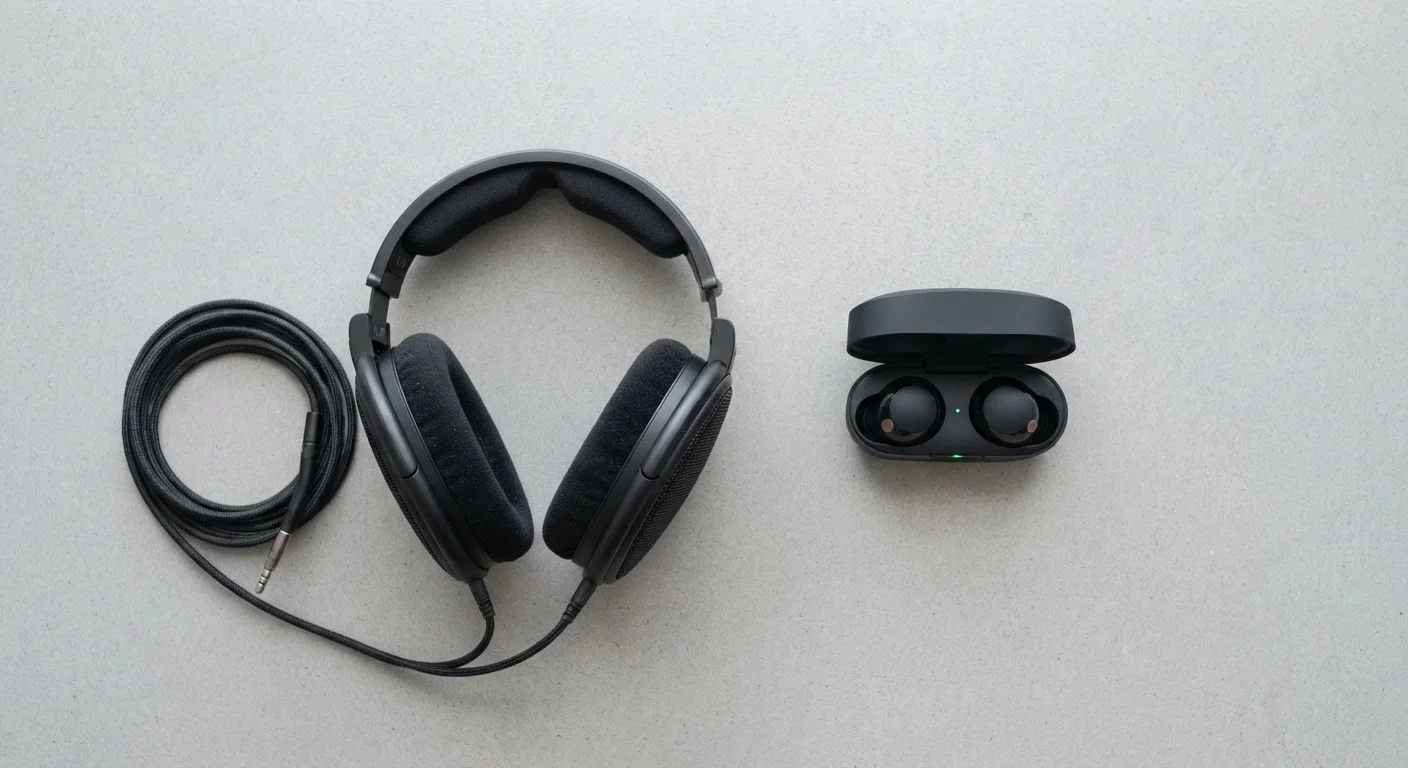
Our Verdict
Neither wired nor wireless headphones are objectively better - they solve different problems. Wired models remain the gold standard for audio fidelity, zero latency, and reliability, while wireless designs win on freedom of movement and everyday practicality. For most casual listeners, modern wireless headphones are more than capable; for critical listening, gaming, or professional audio work, wired connections still hold real advantages.
Wireless headphones suit commuters, gym-goers, and everyday listeners who prioritize convenience; wired headphones are the better fit for audiophiles, video editors, gamers sensitive to lag, and anyone who dislikes managing battery life.
How Each Connection Type Actually Works
Wired headphones use a physical analog or digital connection - typically a 3.5mm jack or USB-C - to receive an audio signal directly from the source device. The signal travels as electrical current through a cable, converted to sound by the headphone's driver. There is no encoding, no transmission, and no middleman in the process.
Wireless headphones most commonly use Bluetooth, a short-range radio protocol that operates on the 2.4GHz band. The audio signal is compressed using a codec - such as SBC, AAC, aptX, or LDAC - transmitted wirelessly, then decoded inside the headphones. This compression-decompression cycle is what distinguishes wireless from wired performance. For a deeper look at how Bluetooth operates compared to other wireless technologies, see how Bluetooth differs from Wi-Fi.
The Case for Wired Headphones
Wired connections have endured not out of nostalgia but because they carry genuine technical advantages.
No audio compression or signal degradation
A wired connection delivers audio without the encoding and decoding that Bluetooth requires, preserving the original signal quality from source to ear.
Zero latency for real-time audio sync
The electrical signal travels near-instantaneously, making wired headphones the reliable choice for video editing, gaming, and any task where timing matters.
No battery to charge or degrade over time
Wired headphones are always ready to use and don't lose capacity after years of charging cycles - a practical durability advantage most users overlook.
Generally lower cost for equivalent audio quality
Without wireless electronics, ANC chips, and batteries, wired headphones often deliver better driver quality at a given price point than comparably priced wireless models.
The most significant is audio fidelity. Because the signal is never compressed for wireless transmission, wired headphones can reproduce audio at higher bit depths and sample rates without loss. This matters most for audiophiles and professionals working with high-resolution audio files. For everyday listeners, the difference may be subtle, but it is real and measurable.
Latency - the delay between a sound being produced and you hearing it - is effectively zero with a wired connection. That makes wired headphones the default for video editing, gaming, and any scenario where audio-visual sync is critical. Even low-latency Bluetooth modes introduce some delay, which can be distracting when watching video or reacting to in-game audio cues.
The Case for Wireless Headphones
For the majority of everyday listeners, wireless headphones solve a more immediate problem: the physical constraint of a cable.
Require battery charging and management
Wireless headphones need regular charging, and a dead battery renders them unusable mid-commute or workout - a friction point wired users never face.
Bluetooth compression affects audio quality
All Bluetooth audio is compressed to some degree during transmission; while modern codecs like LDAC reduce the impact, the signal path is inherently less direct than a wired connection.
Latency can affect video and gaming sync
Even low-latency Bluetooth modes introduce measurable delay, which may cause audio to feel out of sync with video or reduce responsiveness in competitive gaming.
Wireless interference in crowded environments
The 2.4GHz band used by Bluetooth is shared with Wi-Fi and other devices; in dense environments like airports or apartment buildings, signal dropouts can occur.
Battery capacity degrades over time
Lithium-ion batteries in wireless headphones lose capacity with repeated charge cycles, meaning a two- or three-year-old pair may offer noticeably shorter playback than when new.
Freedom of movement is the central appeal. Commuters, people exercising, and anyone who frequently moves between rooms benefit from not managing cable tangles or being tethered to a device. Modern Bluetooth headphones can maintain stable connections at distances of 30 feet or more in typical indoor environments.
Active noise cancellation (ANC) - a feature that uses microphones and processing to counteract ambient sound - is almost exclusively found in wireless headphones. For frequent flyers or open-office workers, this can be more practically valuable than marginal audio fidelity differences.
990 kbps
Maximum bitrate of Sony's LDAC Bluetooth codec
LDAC, now part of Android's open-source stack, transmits audio at up to 990 kbps - roughly three times the bandwidth of the standard SBC codec used in most Bluetooth devices.
~30-40 ms
Typical Bluetooth audio latency
Standard Bluetooth audio introduces roughly 30 to 40 milliseconds of latency; while imperceptible for music, this delay can cause noticeable audio-visual mismatch in video playback.
It's worth understanding that Bluetooth audio quality has improved substantially. The LDAC codec, developed by Sony and now supported across many Android devices, can transmit audio at up to 990 kbps - significantly higher than earlier Bluetooth standards. The quality gap between wired and wireless has narrowed, even if it hasn't fully closed.
Battery Life, Durability, and Long-Term Costs
Battery management is the trade-off wireless users most frequently underestimate. Most wireless headphones offer between 20 and 40 hours of playback per charge, with charging cases extending that for earbuds. But batteries degrade over time - typically losing meaningful capacity after 300 to 500 charge cycles. After two or three years, you may find your headphones no longer hold a charge through a full commute.
Wired headphones have no battery to degrade. Their failure points are the cable, the jack, and the drivers themselves - all of which tend to have longer functional lifespans under normal use. A quality wired pair can last a decade or more.
The 3.5mm Jack Is Disappearing
Many modern smartphones have removed the 3.5mm headphone jack, which means wired headphone users may need a USB-C or Lightning adapter to connect to their phone. These adapters work reliably, but add a small accessory to manage. Some dedicated audio devices - including many laptops and audio interfaces - still include the traditional jack, so wired headphones remain practical depending on your primary device.
Wireless headphones also introduce more electronic complexity: Bluetooth chips, microphones, ANC processors, and charging circuits. More components mean more potential failure points. Repairability varies widely by manufacturer, and many wireless models are not designed to be serviced.
Choosing Based on Your Actual Use Case
The honest answer is that the right headphone type depends on what you're actually doing with them. Here are the clearest scenarios:
- Commuting or travel: Wireless wins outright. Freedom from cable management and access to ANC make the daily experience significantly easier.
- Gaming: Wired is strongly preferable if audio-visual sync matters. Wireless gaming headsets have improved, but any Bluetooth latency can affect immersion or competitive performance.
- Critical or professional listening: Wired remains the standard for recording studios, audio engineers, and serious audiophiles who want uncompressed signal paths.
- Casual everyday use: Modern wireless headphones perform more than adequately. The quality difference from wired is unlikely to matter for streaming music or podcast listening.
If you're thinking through other technology trade-offs in your daily life, syncing apps across devices involves a similar balance between convenience and control.
The content on this site is provided for informational purposes only and should not be considered a substitute for professional advice. While we strive to provide accurate and up-to-date information, we make no guarantees regarding its completeness or accuracy. Always consult a qualified professional for advice specific to your circumstances before making any decisions.