

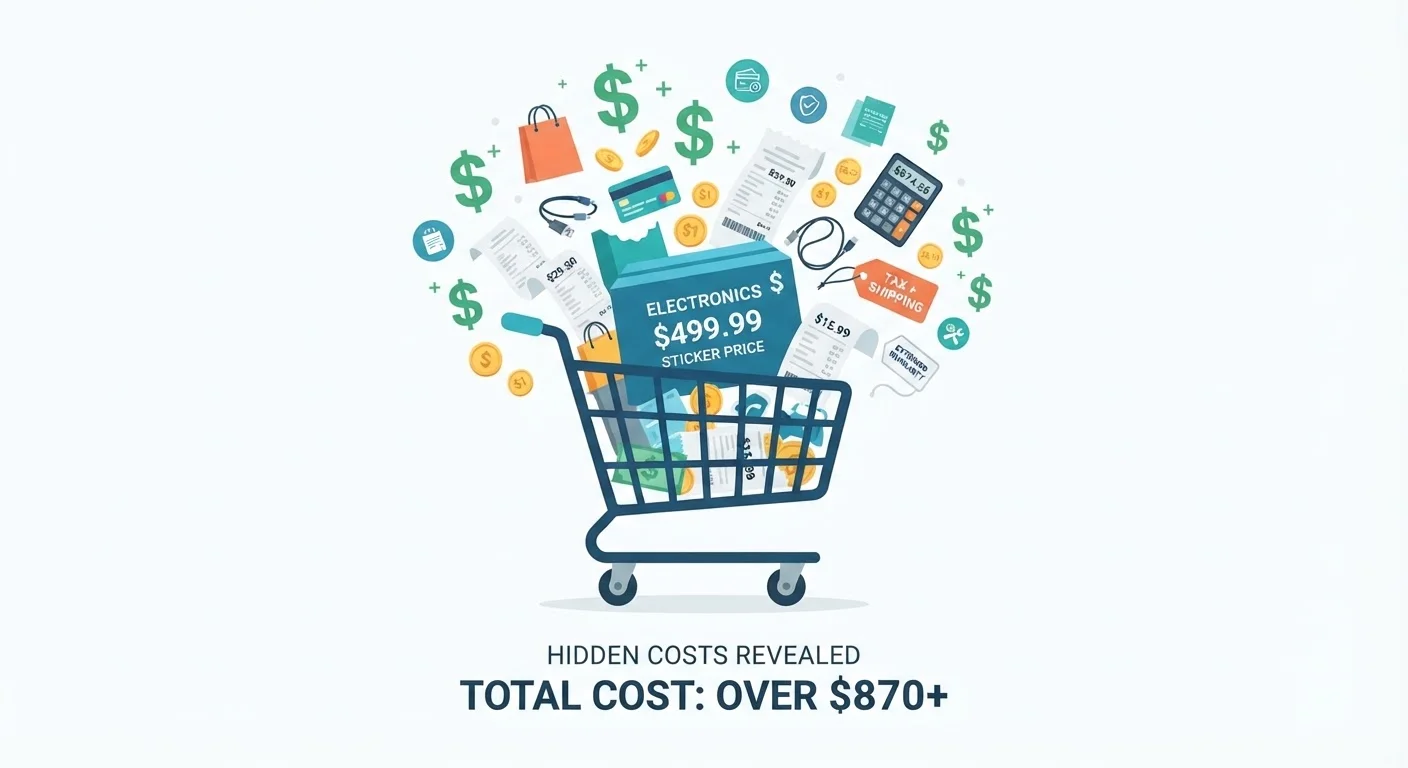
Why the Price Tag Is Just the Opening Bid
Retailers and manufacturers compete hard on purchase price - it's the number that shows up in search results and drives comparison shopping. But the purchase price is often the smallest part of what you'll spend. Consumables run out, accessories are required, components fail, and services get bundled in. By the time a product has lived out its useful life, the total spend can be double or triple what the tag said.
This isn't accidental. Product pricing strategies frequently separate the upfront cost from the ongoing revenue stream. Recognizing that pattern is the first step toward smarter evaluation. The Smart Budgeting hub covers broader strategies for spending wisely, but this article zeroes in on the product-level costs shoppers most often underestimate.
The Four Main Categories of Post-Purchase Cost
Most hidden costs fall into one of four buckets. Understanding each helps you spot them before the purchase - not after.
1. Consumables
These are the items a product uses up and requires you to replenish: ink cartridges, replacement filters, razor blades, pods, batteries, cleaning solutions. Manufacturers routinely sell hardware at thin margins and recoup profit through proprietary consumables. Before buying, look up the cost of refills and how frequently they're needed. On an annual basis, consumable costs often exceed the original device price.
2. Required Accessories
Some products are genuinely incomplete at the listed price. A camera sold without a memory card. A power tool that doesn't include a battery or charger. Software that requires a separately purchased license for core features. These aren't optional upgrades - they're prerequisites. Check exactly what's in the box and what you'll need to purchase separately before the item is functional for your use case.
3. Maintenance and Repairs
All products degrade. The question is how fast, how much it costs to maintain them, and whether repair is even practical. Some items are designed with serviceable components; others are effectively disposable. Look for published service intervals, parts availability, and repair cost estimates before committing. Spending leaks that quietly drain household budgets explores how small recurring costs compound over time - maintenance is a prime example.
4. Subscriptions and Service Fees
An expanding category: products that require an ongoing subscription to function fully - or at all. Cloud storage tiers, software licenses, connected-device service plans, and feature unlocks billed monthly or annually. These fees are sometimes disclosed clearly and sometimes buried in setup screens. Multiply the monthly rate by 36 or 60 months to put them in honest perspective relative to the purchase price.
2-3×
Typical lifetime spend vs. purchase price
Consumer research consistently finds that total ownership costs over a product's lifespan frequently exceed the original purchase price by a factor of two or more, depending on product category.
$300+
Annual ink cost for some home printers
Industry estimates suggest households that print regularly can spend several hundred dollars per year on replacement ink - often more than the printer itself cost.
40%
Shoppers who underestimate ongoing costs
Surveys on consumer purchasing behavior suggest a large share of buyers do not factor in maintenance, consumables, or accessory costs when evaluating a product's affordability.
Compatibility Gaps: The Sneaky Cost Nobody Budgets For
Beyond consumables and maintenance, compatibility mismatches generate their own category of unplanned expense. A new appliance that requires a different electrical outlet. A smart home device that only works within one ecosystem. A software upgrade that orphans your existing hardware. These gaps surface after the purchase and force a choice: spend more money to bridge the gap, or absorb a product that underperforms for your situation.
The fix is straightforward in theory: verify compatibility with your existing setup before buying. In practice, compatibility details are often buried in spec sheets or described in ecosystem-specific language. Reading owner reviews from people with setups similar to yours is frequently more reliable than manufacturer documentation.
Check Ecosystem Lock-In Before You Buy
If a product ties you to a specific brand's accessories, consumables, or platform, factor that dependency into your evaluation. Switching costs later - whether hardware, software, or service migration - are real costs even if they're not on the receipt today. Ask: 'If I want to change or upgrade in two years, what does that cost me?'
Putting It Together: A Simple Pre-Purchase Check
Before finalizing any significant purchase, run through a brief mental audit:
- What consumables does this product require, and what do they cost annually?
- What's not included that I'll need immediately?
- What does routine maintenance cost, and what's the realistic repair cost if something goes wrong?
- Are there subscriptions or service fees, and what do they total over three to five years?
- Does this work with what I already own?
This doesn't require a spreadsheet - a rough estimate is enough to reveal whether the true cost of ownership changes the value equation. The same logic scales up to major purchases: ownership costs that catch new drivers off guard and real trade-offs in renting vs. buying involve the same principle applied to much larger numbers. Honest cost accounting before the purchase - not regret after it - is what separates confident shoppers from reactive ones.
Frequently Asked Questions
Consumables (ink, filters, batteries), required accessories, maintenance and repairs, and subscription fees are the most frequent post-purchase costs. Compatibility limitations can also force you to buy additional gear you hadn't planned for.
Estimate the purchase price plus the projected cost of consumables, accessories, maintenance, and any subscriptions over a realistic ownership period (2-5 years is common). Compare that figure across your options, not just the upfront price.
It depends on the product, failure rate, and what the warranty actually covers. Many warranty plans exclude the most common failure points. Read the fine print carefully - see our guide on <a href="/smart-shopping/product-knowledge/warranty-terms-that-shoppers-routinely-misread">warranty terms shoppers routinely misread</a> before deciding.
Not always, but it's a common pattern. Lower upfront prices can be offset by proprietary consumables, shorter lifespans, or limited compatibility. Higher-priced items sometimes carry lower long-run costs - though neither rule is universal.
Owner forums, consumer advocacy organizations, and long-term product reviews are practical sources. Manufacturer documentation often lists consumable specifications and recommended service intervals.
Absolutely - and the stakes are higher. Vehicles carry fuel, insurance, registration, and maintenance costs well beyond the sale price. Real estate adds property taxes, insurance, and upkeep. See related guidance on <a href="/autos-driving/buying-ownership/the-true-cost-of-owning-a-car-beyond-the-sticker-price">the true cost of owning a car</a> and <a href="/real-estate-basics/buying-a-home/closing-costs-explained-who-pays-what-and-why">closing costs explained</a>.
The content on this site is provided for informational purposes only and should not be considered a substitute for professional advice. While we strive to provide accurate and up-to-date information, we make no guarantees regarding its completeness or accuracy. Always consult a qualified professional for advice specific to your circumstances before making any decisions.