

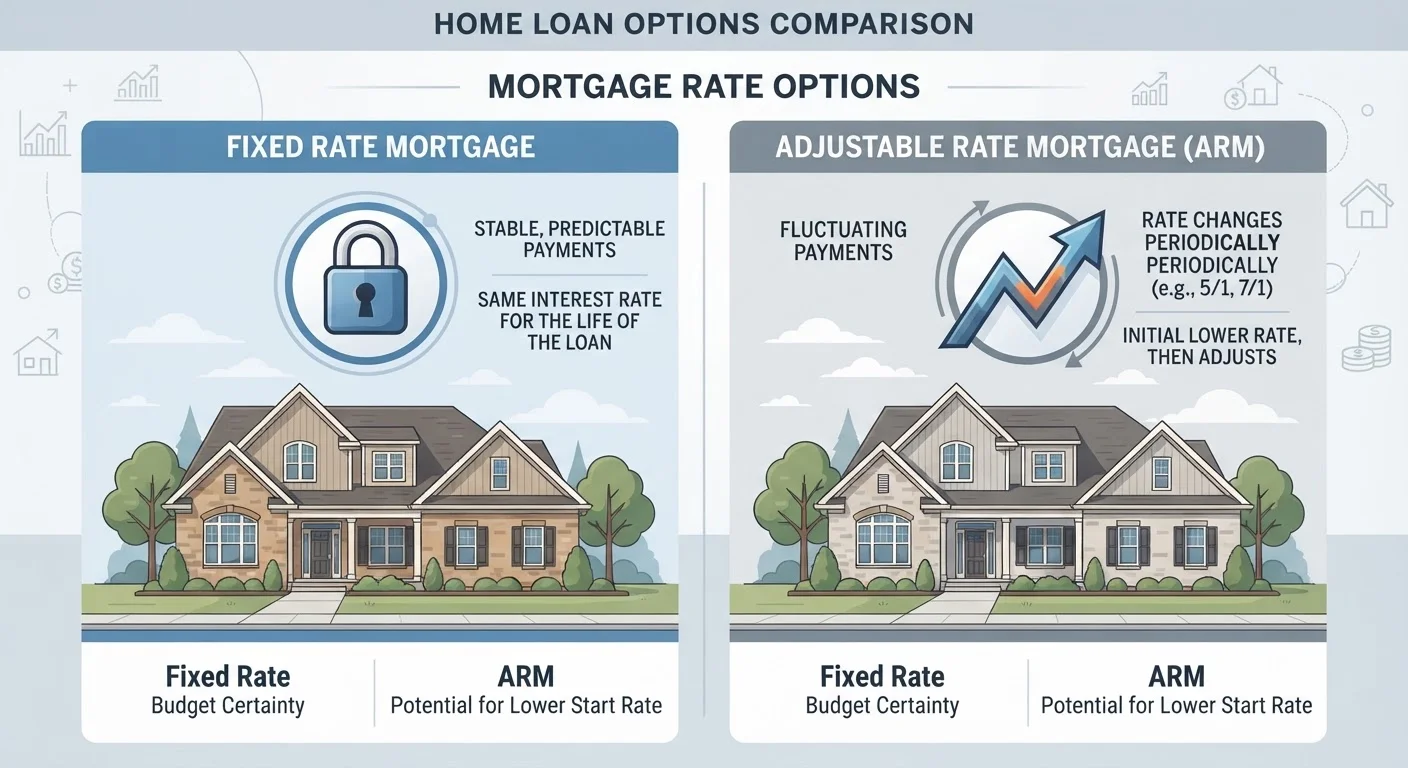
Option A
Fixed-Rate Mortgage
The predictable, stable choice for long-term homeowners.
Best for: Buyers who plan to stay in the home long-term and want consistent monthly payments regardless of market shifts.
Option B
Adjustable-Rate Mortgage (ARM)
The lower-entry-cost option with built-in rate flexibility.
Best for: Buyers who expect to sell or refinance within a few years and want to take advantage of a lower initial interest rate.
How Each Loan Type Is Structured
A fixed-rate mortgage sets your interest rate at closing and keeps it there for the life of the loan - whether that's 15 years or 30. Your principal-and-interest payment never changes, even if market rates climb dramatically. This makes budgeting straightforward and eliminates rate-related surprises.
An adjustable-rate mortgage (ARM) works differently. It begins with an introductory period - often 5, 7, or 10 years - during which the rate is fixed and typically lower than comparable fixed-rate loans. After that period ends, the rate adjusts at regular intervals (commonly every 6 or 12 months) based on a benchmark index, such as the Secured Overnight Financing Rate (SOFR), plus a set margin determined by your lender. A 5/1 ARM, for example, carries a fixed rate for five years, then adjusts annually.
ARMs include built-in protections called caps, which limit how much the rate can move at each adjustment, how much it can change per year, and how high it can go over the life of the loan. These caps matter: always ask for the cap structure before agreeing to an ARM. For a deeper look at how these structures evolve month by month, see our guide to how each loan behaves over time.
| Criterion | Fixed-Rate Mortgage | Adjustable-Rate Mortgage (ARM) |
|---|---|---|
| Interest rate over time | Stays the same for the full loan term | Fixed initially, then adjusts periodically |
| Initial monthly payment | Higher than comparable ARMs | Lower during introductory period |
| Payment predictability | Completely predictable | Varies after introductory period ends |
| Rate-change risk | None | Yes - rate can rise at each adjustment |
| Rate-drop benefit | Must refinance to capture lower rates | May decrease automatically at adjustment |
| Best holding period | Long-term (10+ years) | Short- to mid-term (5-7 years) |
| Rate caps | Not applicable | Per-adjustment, annual, and lifetime caps apply |
Cost Comparison: Upfront Savings vs. Long-Term Certainty
The ARM's introductory rate is almost always lower than the rate on a comparable fixed loan. On a $400,000 loan, even a half-point difference can reduce your monthly payment by over $100 during the introductory period - meaningful savings if you sell or refinance before the first adjustment.
The tradeoff is uncertainty. If you hold the loan past the introductory period and market rates have risen, your payment could increase substantially at each adjustment interval, up to the lifetime cap. A fixed-rate loan costs more per month at the outset but that payment is permanent - no recalculation, no exposure to index fluctuations.
~1%
Typical introductory rate discount for ARMs
ARM introductory rates have historically averaged roughly 0.5-1.5 percentage points below 30-year fixed rates, though the gap shifts with market conditions.
30 years
Most common fixed mortgage term in the U.S.
The 30-year fixed-rate mortgage remains the most widely chosen loan product among American home buyers, according to Freddie Mac mortgage market data.
5/1, 7/1, 10/1
Most common ARM introductory structures
These ARM variants, denoting the fixed period and adjustment frequency in years, account for the large majority of adjustable-rate loan originations in the U.S.
When comparing loan offers, looking only at the interest rate misses part of the picture. The Annual Percentage Rate (APR) folds in fees and gives a fuller sense of true borrowing cost. Our article on interest rate vs. APR explains how these two numbers interact on every mortgage offer.
Deciding Which Fits Your Situation
The most important variable is how long you expect to hold the loan. If you plan to stay in the home well beyond the ARM's introductory period, the stability of a fixed rate almost always wins out. If your timeline is shorter - a job relocation, a growing family likely to upsize, or a property you plan to sell - an ARM lets you capture a lower rate during the window you actually need it.
Your financial flexibility matters too. If a significant payment increase would strain your household budget, the predictability of a fixed-rate loan reduces that risk. If you have the income cushion to absorb potential adjustments - or a clear plan to refinance - an ARM is easier to manage responsibly. Speaking of refinancing: switching from an ARM to a fixed loan later is always an option, though it carries its own costs and timing considerations. Our full guide to refinancing walks through when that move makes sense.
Whichever structure you lean toward, compare multiple lenders on equal terms. Our strategies for comparing lender offers explains how to evaluate quotes beyond the headline rate. For a broader view of loan types available to you, the comparison of conventional, FHA, VA, and USDA loans covers eligibility and trade-offs across the main programs.
This article is for general informational and educational purposes only and does not constitute financial, legal, or mortgage advice. Consult a licensed mortgage professional or financial adviser regarding your specific circumstances before making any borrowing decisions.
The content on this site is provided for informational purposes only and should not be considered a substitute for professional advice. While we strive to provide accurate and up-to-date information, we make no guarantees regarding its completeness or accuracy. Always consult a qualified professional for advice specific to your circumstances before making any decisions.