

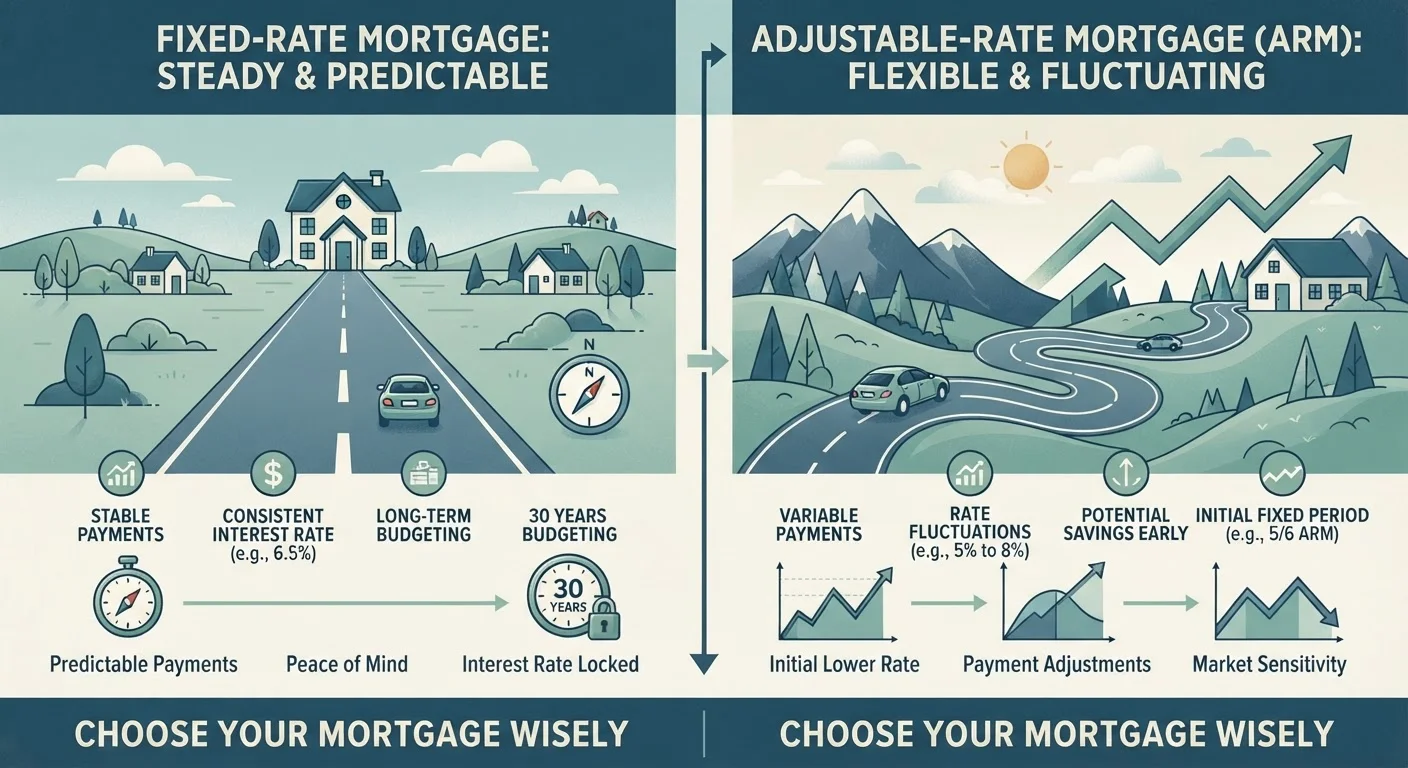
Option A
Fixed-Rate Mortgage
The predictable, locked-in choice.
Best for: Buyers who plan to stay in their home long-term and want a consistent monthly payment throughout the loan.
Option B
Adjustable-Rate Mortgage (ARM)
The flexible, market-linked alternative.
Best for: Buyers who expect to move or refinance within a few years and want a lower initial interest rate.
How Each Mortgage Is Structured
A fixed-rate mortgage does exactly what its name implies: the interest rate is set at closing and never changes for the life of the loan - whether that's 15 or 30 years. Your principal and interest payment stays the same every month, regardless of what happens in the broader economy or financial markets.
An adjustable-rate mortgage (ARM) is more complex. It begins with a fixed introductory period - commonly three, five, seven, or ten years - during which the rate is locked. After that period ends, the rate resets periodically (often annually) based on a benchmark market index, such as the Secured Overnight Financing Rate (SOFR), plus a lender margin. The result is a monthly payment that can go up or down. To understand what drives those benchmark rates, see our article on how mortgage interest rates are actually set.
ARMs are typically named by their structure. A 5/1 ARM has a five-year fixed period and then adjusts once per year. A 7/6 ARM has a seven-year fixed period and adjusts every six months thereafter.
| Criterion | Fixed-Rate Mortgage | Adjustable-Rate Mortgage (ARM) |
|---|---|---|
| Interest rate over time | Never changes | Fixed initially, then adjusts periodically |
| Initial rate | Typically higher | Typically lower |
| Monthly payment predictability | Fully predictable | Predictable during intro period only |
| Rate increase risk | None | Yes, after introductory period ends |
| Rate cap protection | Not applicable | Yes - initial, periodic, and lifetime caps |
| Common loan terms | 15 or 30 years | 30 years, with 3-10 year fixed intro |
| Best time horizon | Long-term homeownership | Short-to-medium ownership or refinance plan |
Rate Caps: The Safety Rails on an ARM
One of the most misunderstood features of an ARM is its cap structure. Caps are contractual limits on how much your interest rate can move. There are typically three types:
- Initial cap: The maximum the rate can increase at the first adjustment - often 2 percentage points above the introductory rate.
- Periodic cap: The maximum increase allowed at each subsequent adjustment, commonly 1-2 percentage points.
- Lifetime cap: The maximum total increase over the full life of the loan, often 5-6 percentage points above the initial rate.
These caps prevent worst-case scenarios, but a loan starting at 5% with a 5-point lifetime cap could still reach 10% - a significant payment increase. Before signing an ARM, ask your lender to show you payment scenarios at various rate levels so you understand your exposure.
5-6 pts
Typical ARM lifetime rate cap
Most ARM contracts limit the total rate increase over the loan's life to 5 or 6 percentage points above the initial rate, per standard lending disclosures.
~1-1.5%
Common ARM introductory rate discount vs. fixed
Historically, ARM introductory rates have run roughly 0.5 to 1.5 percentage points below comparable fixed rates, though the gap varies with market conditions.
30 years
Most common fixed mortgage term in the U.S.
The 30-year fixed-rate mortgage has long been the most widely used home loan product in the United States, according to federal mortgage market data.
Cost Comparison Over Time
In the early years, ARMs almost always carry a lower interest rate than comparable fixed-rate loans. Lenders offer this discount - sometimes called the teaser rate - because the borrower accepts the risk that the rate may rise later. If you sell or refinance before the adjustment period begins, you may never experience a rate increase at all.
For borrowers who stay in the home long-term, however, the math can shift. If market rates rise and your ARM adjusts upward, you could eventually pay more in interest than you would have with a fixed loan from the start. The break-even point depends on how much your rate rises, how quickly, and how much lower your introductory rate was.
It's also worth considering loan type alongside rate structure. Our comparison of conventional, FHA, VA, and USDA loans explains how program eligibility and costs interact with your rate choice.
If your situation changes after closing - rates drop, your credit improves, or your needs shift - refinancing from an ARM to a fixed loan is a common strategy. The full picture of refinancing is worth reviewing before you rely on that as a backup plan, since it carries its own costs.
This article provides general educational information about mortgage structures and is not personalized financial or lending advice. Consult a licensed mortgage professional or financial adviser to evaluate options based on your specific circumstances.
The content on this site is provided for informational purposes only and should not be considered a substitute for professional advice. While we strive to provide accurate and up-to-date information, we make no guarantees regarding its completeness or accuracy. Always consult a qualified professional for advice specific to your circumstances before making any decisions.