

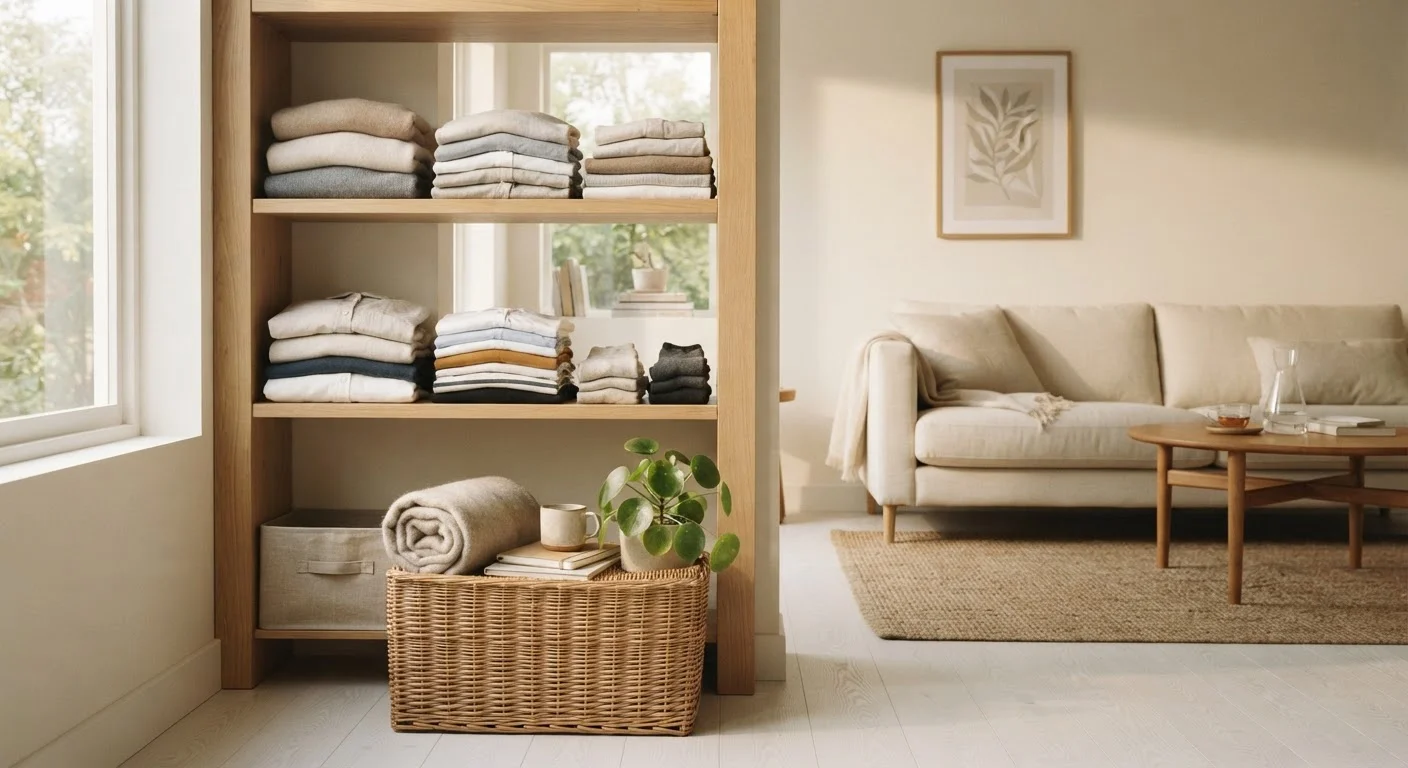
Option A
The KonMari Method
The intentional, all-at-once transformation approach.
Best for: People who want a complete mindset shift and are ready to commit to a single intensive decluttering event.
Option B
Traditional Decluttering
The gradual, room-by-room practical approach.
Best for: People who prefer steady, manageable progress without disrupting their entire home at once.
Two Different Philosophies of Letting Go
Decluttering is one of those tasks that almost everyone agrees is worthwhile - but far fewer people agree on how to actually do it. The KonMari Method, developed by organizing consultant Marie Kondo, approaches the home as a single project to be completed once and thoroughly. Traditional decluttering, by contrast, is the more common incremental approach: tackle a drawer today, a closet next weekend, a room next month.
Both aim to clear out what you don't need and make room for what matters. But they differ fundamentally in their logic, their emotional framework, and the time commitment they require. Understanding those differences - rather than treating one as automatically superior - is the key to choosing the approach you'll actually stick with.
As we explore in our guide on why decluttering before organizing matters, the sequence and intent behind your process shapes whether your results hold up over time.
| Criterion | KonMari Method | Traditional Decluttering |
|---|---|---|
| Organizing unit | By category (all at once) | By room or zone |
| Decision filter | Does it spark joy? | Do I use it / need it? |
| Time commitment | Intensive, front-loaded | Flexible, spread over time |
| Home disruption | High during the process | Low; localized to one area |
| Emotional approach | Values-based, reflective | Practical, usage-focused |
| Best for households | Committed individuals | Families, shared spaces |
| Clutter recurrence risk | Lower if method is followed | Higher without ongoing routine |
How Each Method Works in Practice
The KonMari Method asks you to gather every item in a category - all your clothes, for instance - into one place at the same time, handle each piece, and keep only what genuinely sparks a positive feeling. The prescribed sequence moves from easiest (clothing) to hardest (sentimental items), deliberately building your ability to make decisions as you go. The idea is that working by category rather than by room prevents you from simply shuffling items from one space to another.
Traditional decluttering typically works location by location. You pick a room, a zone, or even a single shelf, and apply a practical filter: Do I use this? Do I need it? Does it work? Items that fail the test go into donate, sell, or trash piles. Sessions can be as short as 15 minutes or as long as a full Saturday, which makes this approach easier to fit around family life and work schedules.
54%
Americans feel overwhelmed by clutter
A survey by the National Association of Professional Organizers found that more than half of Americans describe their homes as disorganized, citing clutter as a significant source of stress.
80%
Clutter comes from disorganization, not lack of space
Professional organizers frequently cite research suggesting the vast majority of household clutter is a result of poor systems rather than insufficient storage capacity.
If you're new to either approach, our guide on starting your first real declutter walks through the mindset and first steps to help you begin without feeling overwhelmed.
Strengths, Limitations, and Who Each Suits
KonMari's greatest strength is the clarity of its decision-making filter. Asking whether something sparks joy sidesteps the rationalizing that often undermines decluttering - the "but I might need it someday" loop that keeps unused items in circulation indefinitely. Its biggest limitation is the time and disruption it demands. Pulling every piece of clothing out of every closet in the house is genuinely disruptive, and households with young children, variable schedules, or resistant family members often struggle to complete it.
Traditional decluttering's main strength is accessibility. You don't need a dedicated weekend or an empty house - a focused 20-minute session in one kitchen cabinet counts as real progress. The risk is that without structure, it can become reactive: you tidy when things get overwhelming, but never fundamentally reduce what you own. It can also lead to disorganized storage if you organize before properly paring down. That's a pattern explored in depth in our article on organization myths that keep spaces cluttered.
Some people find that a hybrid works best: use KonMari logic (the joy question) inside a traditional structure (one room at a time). The method matters less than whether it matches your actual lifestyle and produces lasting change.
The content on this site is provided for informational purposes only and should not be considered a substitute for professional advice. While we strive to provide accurate and up-to-date information, we make no guarantees regarding its completeness or accuracy. Always consult a qualified professional for advice specific to your circumstances before making any decisions.