

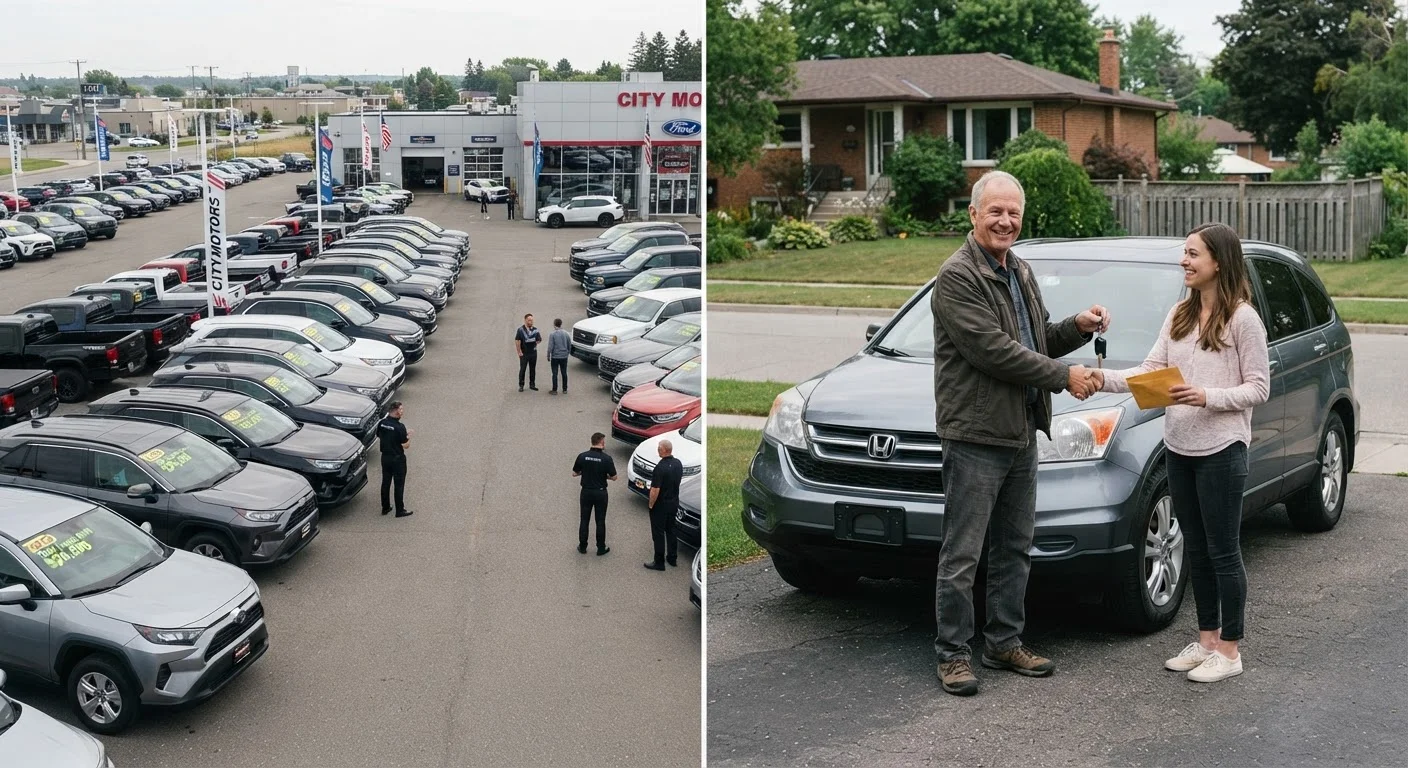
Option A
Private Seller
The flexible, lower-overhead alternative.
Best for: Buyers comfortable doing their own research, inspection, and paperwork who want to negotiate directly without dealer fees.
Option B
Licensed Dealership
The structured, full-service buying channel.
Best for: Buyers who want financing options, legal protections, trade-in processing, and a managed purchase process under one roof.
Price and Negotiation Dynamics
The sticker price at a dealership reflects overhead: staff wages, facilities, floor plan financing, and profit margin. Private sellers have none of those costs baked in, which is why their asking prices are often lower - but also why the variance between a fair deal and an overpriced listing is wider. There's no regulated pricing structure in a private sale.
Dealers are trained negotiators working within defined margin structures. A private seller may be emotionally attached to the vehicle or simply unfamiliar with current market values, which can cut either way - in your favor or theirs. Tools like independent vehicle valuation resources can help you anchor any negotiation, whichever channel you use.
One cost buyers sometimes overlook at dealerships is the add-on layer: documentation fees, dealer-installed accessories, and optional protection packages. See our breakdown of dealer fees to understand which line items have room to move. Private transactions carry none of these fees by default, though you'll be responsible for arranging your own title transfer and registration.
| Criterion | Private Seller | Licensed Dealership |
|---|---|---|
| Typical price positioning | At or below market; highly variable | Marked up to cover overhead and profit |
| Negotiation dynamic | Direct with owner; outcome unpredictable | Structured; trained sales staff |
| Legal consumer protections | Minimal; mostly "as-is" | State-regulated; FTC Buyers Guide required |
| Warranty availability | Rarely available | Certified pre-owned and extended options common |
| Financing access | Must arrange independently | Multi-lender access at point of sale |
| Trade-in handling | Not possible | Accepted and applied to purchase |
| Paperwork burden on buyer | Higher - buyer manages title, registration | Lower - dealer handles most documentation |
| Vehicle history transparency | Buyer must source independently | Often provided; legally required disclosures |
Legal Protections and Consumer Rights
This is the most consequential difference between the two channels. Licensed dealerships in every state are subject to dealer licensing laws, the Federal Trade Commission's Used Car Rule (which requires a Buyers Guide disclosing warranty terms), and in many states, lemon law or implied warranty protections. If a dealer misrepresents a vehicle's condition or history, you have defined legal remedies.
Private sellers operate under a fundamentally different standard. Most private sales are completed "as-is," meaning the seller bears no legal obligation to disclose defects they weren't aware of - and in many states, even known defects may not trigger liability unless you can prove intentional fraud. The burden of discovery falls almost entirely on the buyer.
"As-Is" Has Real Consequences
When a private sale contract includes "as-is" language, it generally means the buyer accepts the vehicle in its current condition, with no recourse if mechanical problems surface after the sale - even significant ones. This isn't a technicality; courts routinely uphold as-is clauses. Always have an independent mechanic inspect the vehicle before you sign anything or hand over payment in a private transaction.
This asymmetry is why a pre-purchase inspection by an independent mechanic is essential in a private transaction - and still strongly advisable when buying from a dealer. No paperwork substitutes for eyes-on mechanical evaluation.
For more context on how disclosure obligations vary by transaction type, our guide on what first-time buyers should know before signing covers the full purchase process in plain language.
Financing, Trade-Ins, and the Full Transaction Picture
If you're not paying cash, the dealership has a structural advantage. Dealers work with networks of lenders and can often arrange financing at the point of sale - including manufacturer-backed rates on newer vehicles. Private-party auto loans are available through banks and credit unions, but they typically carry higher interest rates and may require additional documentation or appraisal steps.
Trade-ins are exclusively a dealer transaction. A private seller cannot accept your current vehicle as partial payment; you'd need to sell it separately - which may net more money but adds time and complexity. For buyers carrying negative equity on a current vehicle, the math can get complicated quickly. Our article on car buying moves that cost more than people realize addresses how rolling negative equity into a new loan can inflate total costs.
The full financial comparison between vehicle types is worth understanding before you narrow to a channel. New vs. used vehicle trade-offs - covering depreciation, warranties, and financing rates - can help frame that decision before you decide where to shop.
~40%
Share of used vehicles sold privately in the U.S.
Industry estimates suggest private-party transactions account for a significant portion of the used car market, though the majority of used vehicles still move through dealer channels.
1-2%
Typical rate premium on private-party auto loans
Credit unions and banks generally charge higher interest rates on loans secured by vehicles purchased from private sellers compared to dealer purchases, reflecting higher perceived risk.
The content on this site is provided for informational purposes only and should not be considered a substitute for professional advice. While we strive to provide accurate and up-to-date information, we make no guarantees regarding its completeness or accuracy. Always consult a qualified professional for advice specific to your circumstances before making any decisions.