

Our Verdict
No single Italian coastline is universally superior - each rewards a different kind of traveler. The Amalfi Coast delivers unmatched scenery but demands patience with logistics and crowds. Cinque Terre is compact and walkable but works best outside peak summer. The Adriatic is the practical choice for families, budget travelers, and anyone who wants breathing room.
| Best for | Recommended |
|---|---|
| Travelers prioritizing dramatic scenery and iconic experiences | Amalfi Coast |
| Hikers and village-hoppers seeking a compact, car-free base | Cinque Terre |
| Families, budget travelers, and those wanting uncrowded beaches | Adriatic Coast |
| First-time visitors to Italy wanting manageable logistics | Cinque Terre |
The Amalfi Coast: Spectacle with Strings Attached
The Amalfi Coast - stretching roughly 25 miles along the Sorrentine Peninsula in southern Italy - is the version of Italy most people picture when they close their eyes. Vertiginous cliffs, pastel villages, lemon groves, and water that shifts from green to deep blue. It earns its reputation. It also earns its reputation for being genuinely hard to navigate.
The single coastal road, the SS163, is the only through-route. In July and August, it can turn a 10-mile drive into a two-hour ordeal. Buses run regularly between Amalfi, Positano, and Ravello, but they're cramped and slow in high season. Ferries between the main towns are often the smarter option. Parking is scarce and expensive, and many hotels require guests to carry luggage uphill on foot.
Costs here are among the highest in Italy. Waterfront dining and accommodation command significant premiums. That said, the interior villages - Ravello, Scala, Tramonti - offer comparable scenery at noticeably lower prices with fewer crowds.
Stay Overnight, Not Just the Day
The Amalfi Coast rewards travelers who stay at least four nights. Day-trippers from Naples or Sorrento swell the main towns between 10am and 5pm; overnighting lets you experience the coast before and after the rush. The same logic applies in Cinque Terre - village life after 6pm is a completely different, calmer experience.
The Amalfi Coast rewards travelers who stay at least four nights. Day-trippers from Naples or Sorrento swell the main towns between 10am and 5pm; overnighting lets you experience the coast before and after the rush.
Cinque Terre: Five Villages, One Very Crowded Trail
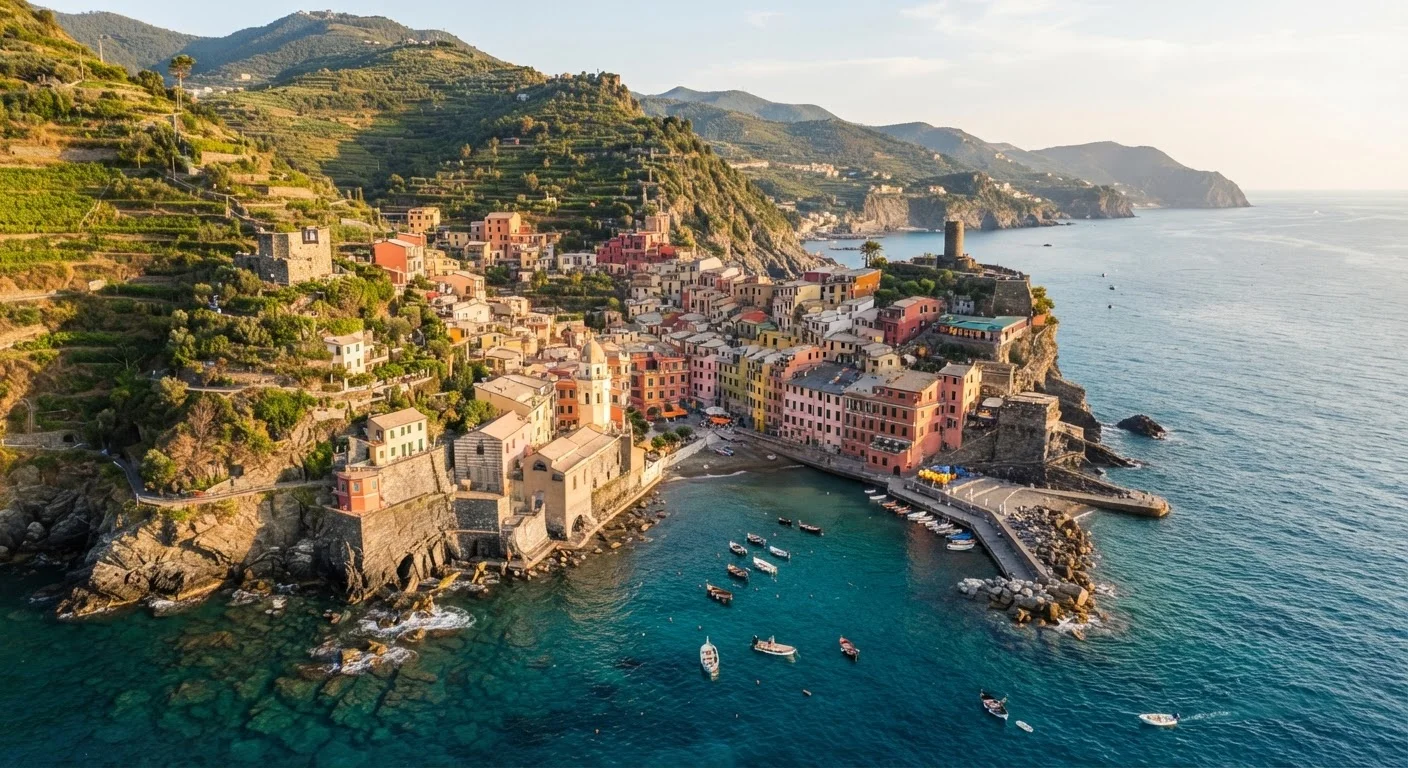
Cinque Terre - five cliff-hugging villages on the Ligurian coast in northwestern Italy - became a UNESCO World Heritage Site in 1997, and tourism followed accordingly. The villages (Monterosso, Vernazza, Corniglia, Manarola, Riomaggiore) are connected by train and a network of coastal hiking paths. That combination of accessibility and scenery made it wildly popular with American travelers in particular.
The logistics here are genuinely easier than the Amalfi Coast. Trains run frequently between all five villages and connect to La Spezia, which has direct rail links to major cities. No car is needed - or wanted. The Cinque Terre Card covers train hops between villages and trail access fees, keeping costs manageable.
The tradeoffs: the villages are small, and volume of visitors relative to village size can make peak summer feel suffocating. The famous Sentiero Azzurro (the coastal trail linking all five villages) has sections that have been closed or restricted at various points due to landslide damage - check the Cinque Terre National Park's official site for current trail status before planning your itinerary around a specific hike.
Monterosso has the largest proper beach. Vernazza and Manarola are the most photogenic. Corniglia sits highest and sees the fewest visitors. Staying overnight in any of the villages - rather than day-tripping - makes a meaningful difference in how the experience feels.
The Adriatic Coast: Italy's Overlooked Shoreline
The Adriatic side of Italy runs from the heel of the boot northward through regions like Puglia, Abruzzo, and the Marche. American travelers visit far less frequently than they visit the Tyrrhenian west coast, which means the Adriatic offers something increasingly rare in Italian tourism: space.
The coastline is generally flatter and more beach-forward than the Amalfi or Ligurian coasts. Wide sandy beaches, clear shallow water, and modest coastal towns are the norm rather than the exception. Cities like Bari, Pescara, and Ancona provide practical transport hubs, and coastal towns like Polignano a Mare, Vieste, and Numana offer genuine local character without the tourist infrastructure - or prices - of western Italy's coast.
Puglia in particular has attracted growing attention for its whitewashed hill towns (Alberobello, Ostuni, Locorotondo) just inland from the coast, making it an easy combination trip. The food culture here - orecchiette, burrata, fresh seafood - is excellent and generally inexpensive by Italian standards.
| Amalfi Coast | Cinque Terre | Adriatic Coast | |
|---|---|---|---|
| Scenery | Dramatic cliffs, iconic views | Colorful cliff villages, sea views | Wide beaches, flatter terrain |
| Crowd Level (Peak Summer) | Very high | Very high | Moderate |
| Getting Around | Bus, ferry, or car (difficult) | Train and foot (easy) | Car or regional train (moderate) |
| Typical Cost Level | High | Moderate | Moderate to low |
| Best For | Scenery-first travelers | Hikers, village-hoppers | Families, beach seekers |
| Shoulder Season Appeal | Strong (May, Sept) | Strong (May, Sept) | Good year-round |
| Car-Free Travel | Possible but stressful | Yes, recommended | Difficult without a car |
Getting around the Adriatic coast typically requires either a rental car or careful planning around regional trains, which are less frequent than in Liguria or Campania. This is the main practical barrier for first-time visitors who aren't comfortable with Italian regional rail or self-driving abroad.
How to Choose: Matching the Coastline to Your Trip
The right coastline depends almost entirely on what you're optimizing for. If scenery and atmosphere are paramount and you're willing to absorb logistical friction and higher costs, the Amalfi Coast justifies itself. If you want easy movement between compact, walkable villages without renting a car, Cinque Terre is the practical call - just go in shoulder season. If you want beaches, local culture, and more money left in your pocket at the end of the week, the Adriatic is worth the extra planning effort.
A few practical notes that apply across all three: accommodation books up months in advance for July and August. Travel insurance that covers delays and cancellations is worth considering, particularly if your itinerary involves ferries or hiking in areas subject to weather closures. Entry requirements and any regional travel advisories should always be verified through official U.S. government and Italian government sources before booking.
Combining coastlines in a single trip is possible but takes honest planning. Amalfi and Cinque Terre are on opposite ends of the country - routing between them means a significant train journey or a domestic flight. Either Adriatic region or Cinque Terre pairs more naturally with a central Italy base (Rome, Florence) in terms of travel time.
The content on this site is provided for informational purposes only and should not be considered a substitute for professional advice. While we strive to provide accurate and up-to-date information, we make no guarantees regarding its completeness or accuracy. Always consult a qualified professional for advice specific to your circumstances before making any decisions.