

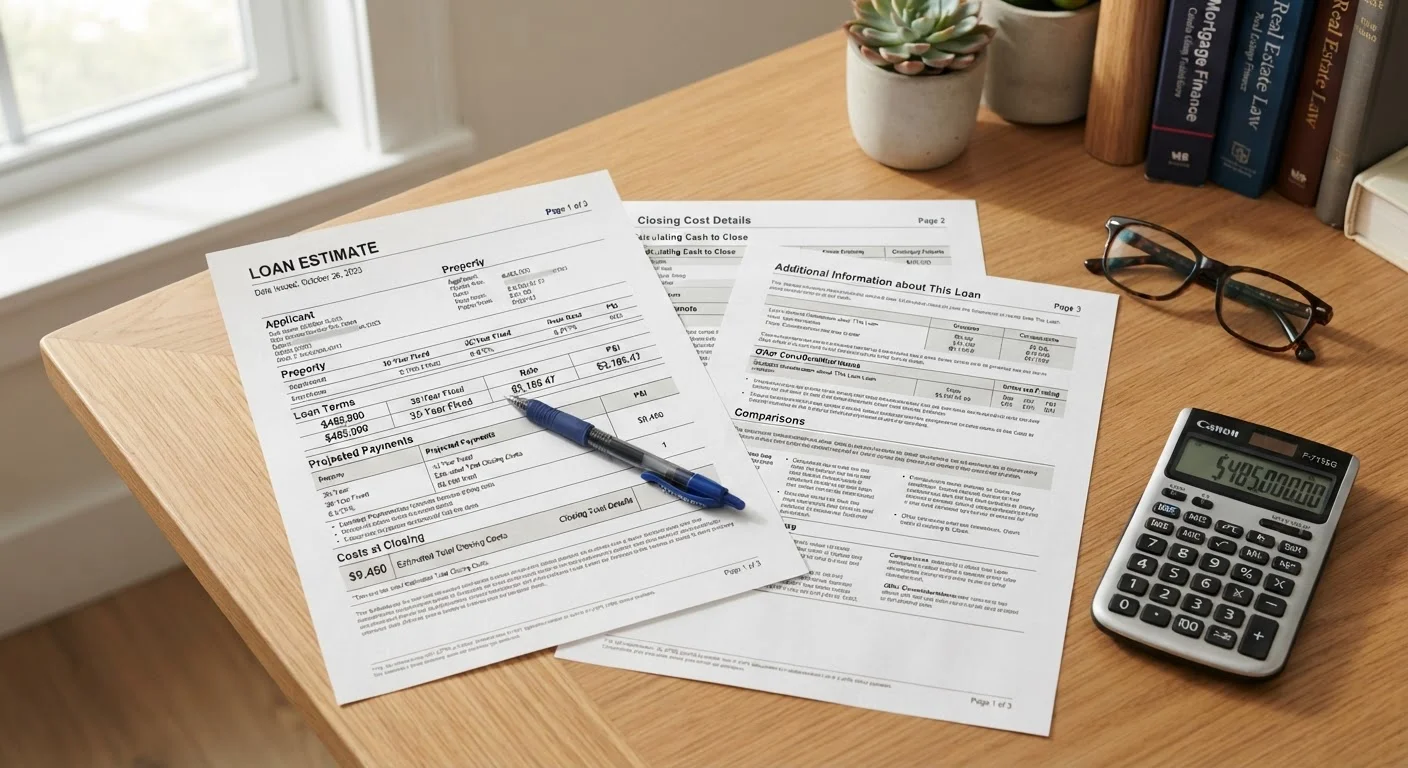
What the Loan Estimate Is - and Why It Exists
The Loan Estimate (LE) is a federally standardized three-page form that every lender must provide within three business days of receiving your mortgage application. Mandated under the TILA-RESPA Integrated Disclosure (TRID) rules overseen by the Consumer Financial Protection Bureau (CFPB), it uses a uniform format so you can compare offers from multiple lenders side by side - without decoding different layouts or terminology.
The form is an estimate, not a contract. Figures can change before closing, but federal rules limit how much certain costs can increase. Understanding what each number means - and which ones carry the most weight - is one of the most practical skills in the home-buying process.
For a line-by-line breakdown of every field on the form, see The Anatomy of a Mortgage. This article focuses on the figures that matter most when comparing lenders.
| Form name | Loan Estimate (LE) (Consumer Financial Protection Bureau (CFPB)) |
| Delivery deadline | Within 3 business days of application (TILA-RESPA Integrated Disclosure (TRID) rules) |
| Pages | 3 standardized pages (CFPB) |
| Best comparison metric | Annual Percentage Rate (APR) |
| Zero-tolerance fees | Lender origination charges (Section A) (TRID regulations) |
| Long-run cost indicator | Total Interest Percentage (TIP) on page 3 (CFPB Loan Estimate form) |
The Five Numbers That Drive Comparison
When you receive multiple Loan Estimates, these are the figures to isolate and examine side by side:
1. Interest Rate vs. Annual Percentage Rate (APR)
The interest rate determines your monthly principal-and-interest payment. The APR rolls in most lender fees and expresses the loan's true annual cost as a percentage. A lender offering a lower rate but higher fees may have a higher APR than a competitor - making the APR the more accurate comparison tool for total cost.
2. Loan Costs (Section A + Section B)
Section A lists origination charges: points, origination fees, and underwriting fees set entirely by your lender. These are fully negotiable and zero-tolerance under TRID (they cannot increase after the LE is issued without a valid change-of-circumstance). Section B covers services you cannot shop for, such as the appraisal. Compare Section A carefully across lenders - it is where pricing differences are most visible.
3. Cash to Close
Found on page 2, this is the total funds you need to bring to the closing table, including down payment and closing costs minus any credits. A lender offering a credit (sometimes called a lender credit) can reduce cash to close but typically raises your rate. This trade-off is real - see why closing costs surprise many buyers for more context.
4. Total Interest Percentage (TIP)
Page 3 shows the Total Interest Percentage - the total interest you will pay over the life of the loan expressed as a percentage of the loan amount. On a 30-year fixed loan it is often larger than buyers expect. Use it to compare the long-run cost of different loan terms or rates.
5. Estimated Monthly Payment
This includes principal, interest, mortgage insurance (if applicable), and estimated escrow for taxes and insurance. A lower payment resulting from a longer loan term does not automatically mean a better deal - the math behind stretched loan terms often works against borrowers over time.
Annual Percentage Rate (APR)
The yearly cost of a loan expressed as a percentage, incorporating the interest rate plus most lender fees. It allows apples-to-apples comparison across loan offers.
Origination Charge
A fee charged by the lender for processing the loan, listed in Section A of the Loan Estimate. It may include points, underwriting, and application fees.
Lender Credit
Money a lender contributes toward your closing costs in exchange for a higher interest rate. It reduces cash needed at closing but increases your long-term interest costs.
Total Interest Percentage (TIP)
The total amount of interest you will pay over the life of the loan, expressed as a percentage of the loan amount. Found on page 3 of the Loan Estimate.
Tolerance Cure
When a lender's closing costs exceed the legally allowed tolerance limits, the lender must reimburse the borrower for the excess amount at or after closing.
Cash to Close
The total amount you need to bring to closing, including your down payment and all closing costs, minus any credits or deposits already paid.
Which Costs Can Change - and by How Much
Federal TRID rules divide closing costs into three tolerance categories:
- Zero tolerance: Lender fees (Section A) and transfer taxes cannot increase at all unless a valid change of circumstance occurs (e.g., the loan amount changes).
- 10% tolerance: Third-party services you cannot shop for (Section B) and recording fees can collectively increase by no more than 10% at closing.
- No tolerance limit: Prepaid items (homeowners insurance, prepaid interest) and escrow reserves can change without a cap because they depend on timing and local tax rates.
If a lender's final Closing Disclosure shows fees that exceed their tolerance category limits, they are legally required to cover the difference - a process called a tolerance cure. Knowing these rules protects you from unexpected cost increases between application and closing. For strategies on evaluating offers once you have multiple Loan Estimates in hand, see how experienced borrowers compare lender offers.
This article is for general informational purposes only and does not constitute financial, legal, or mortgage advice. Consult a licensed mortgage professional or financial adviser for guidance specific to your situation.
The content on this site is provided for informational purposes only and should not be considered a substitute for professional advice. While we strive to provide accurate and up-to-date information, we make no guarantees regarding its completeness or accuracy. Always consult a qualified professional for advice specific to your circumstances before making any decisions.