

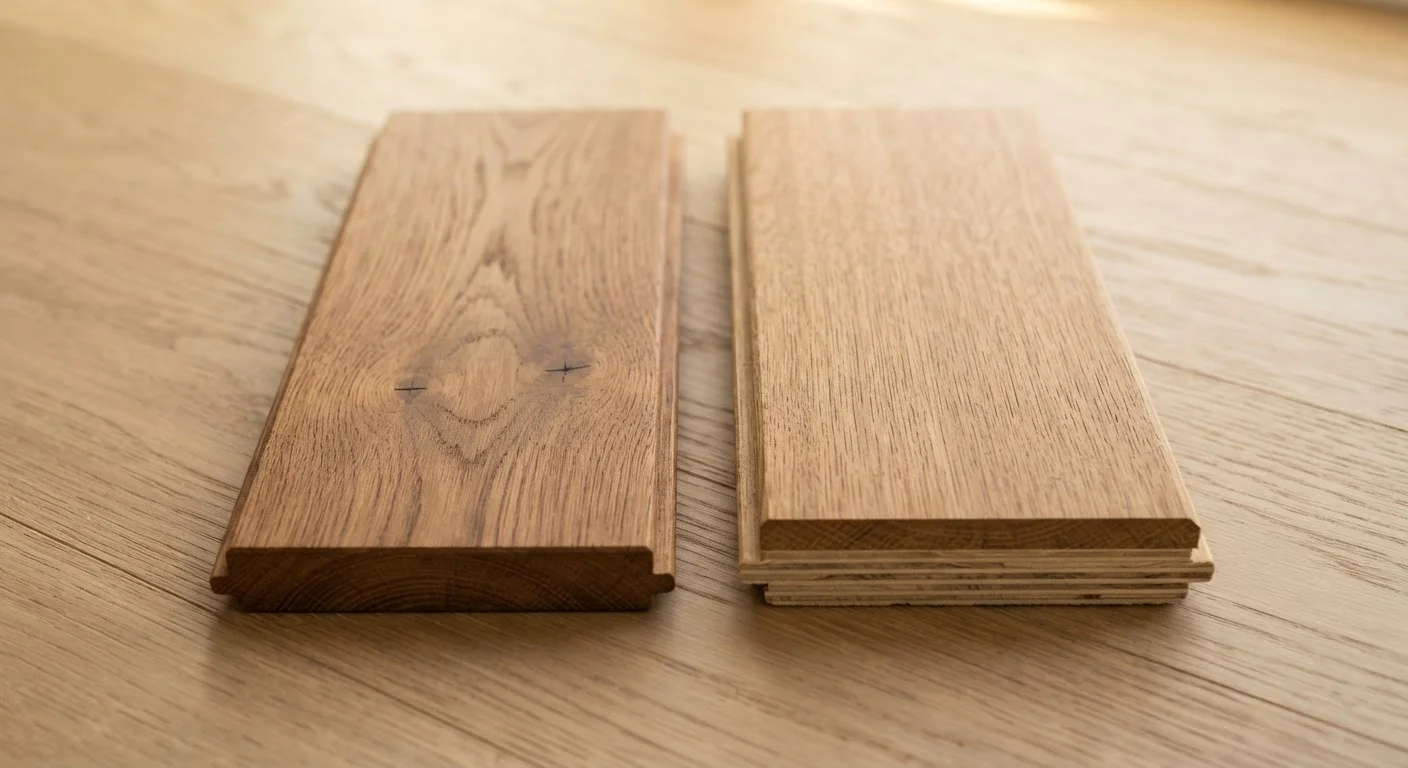
Option A
Engineered Hardwood
The moisture-resilient, versatile modern option.
Best for: Homeowners installing flooring below grade, over concrete slabs, or in rooms with fluctuating humidity levels.
Option B
Solid Hardwood
The timeless, refinishable classic for dry living spaces.
Best for: Homeowners prioritizing long-term refinishability and traditional aesthetics in above-grade, climate-controlled rooms.
How Each Type Is Constructed
Understanding the structural difference between these two flooring types is the foundation of every other comparison. Solid hardwood is exactly what it sounds like: a single, solid piece of milled wood - typically ¾ inch thick - from top to bottom. The entire plank is one species, whether oak, maple, hickory, or another hardwood.
Engineered hardwood, by contrast, is a manufactured plank built from multiple layers. A real hardwood veneer (called the wear layer) sits on top, bonded over several layers of plywood or high-density fiberboard (HDF) arranged in alternating grain directions. This cross-ply construction is what gives engineered hardwood its dimensional stability - the alternating layers resist the expansion and contraction that changes in humidity cause.
It is worth clarifying a common misconception: engineered hardwood is not the same as laminate flooring. Laminate uses a photographic image layer to simulate wood; engineered hardwood has a genuine hardwood surface. Both product categories use a layered core, but only engineered hardwood delivers a real wood top.
Moisture Tolerance and Where Each Belongs
Moisture tolerance is the most practical distinction between the two options, and it directly determines where each floor belongs in your home.
| Criterion | Engineered Hardwood | Solid Hardwood |
|---|---|---|
| Construction | Real wood veneer over cross-ply core | Single solid wood plank |
| Moisture tolerance | Higher - suitable at/below grade | Lower - above grade only |
| Refinishing cycles | 1-2 (wear-layer dependent) | 4-6 over lifetime |
| Radiant heat compatibility | Generally compatible | Not recommended |
| DIY installation ease | High (float/click-lock option) | Moderate to low (nail/staple required) |
| Typical plank thickness | 3/8 inch to 9/16 inch | 3/4 inch standard |
| Installation locations | Above, at, and below grade | Above grade only |
Solid hardwood expands and contracts significantly with seasonal humidity changes. Installed in environments with high moisture - basements, over concrete slabs, or in kitchens with limited ventilation - it can cup (edges rise above the center) or gap (planks pull apart) as the wood responds to its surroundings. Most flooring manufacturers and installation guidelines restrict solid hardwood to above-grade installations in conditioned living spaces.
Engineered hardwood's cross-ply core dramatically reduces this movement. It can be installed at, below, or above grade, including directly over concrete with an appropriate moisture barrier. That said, neither flooring type is appropriate for full bathrooms or any area where standing water is a recurring risk.
A Note on Moisture Testing
Before installing either flooring type, test your subfloor for moisture content. Concrete slabs should be tested with a calcium chloride test or in-situ relative humidity probe per ASTM F2170 standards. Wood subfloors should measure below 12% moisture content for most hardwood installations. Skipping this step is one of the most common causes of flooring failure after installation.
Refinishing Potential and Long-Term Value
One area where solid hardwood holds a clear advantage is refinishability. Because each plank is solid wood all the way through, a floor installer or flooring contractor can sand it down and apply a fresh finish multiple times - often four to six times over the life of the floor. This means scratches, dents, and worn finish can effectively be erased, resetting the floor's appearance entirely.
Engineered hardwood's refinishability depends entirely on the wear layer's thickness. A thicker wear layer - typically 3mm or more - can support one or two light sandings. Thinner wear layers (under 2mm) cannot be sanded without risking damage to the underlying core. When shopping, always check the wear layer thickness stated in the product specifications, not just the total plank thickness.
If your priority is a floor that can be refreshed repeatedly over 50 or more years, solid hardwood offers a longer refinishing runway. If you expect to renovate within 20-30 years, a quality engineered floor will perform comparably in practice.
Installation Methods and DIY Feasibility
Solid hardwood is almost always nailed or stapled through the tongue-and-groove profile into a wood subfloor. This limits it to above-grade applications over plywood subfloors and requires either a flooring nailer tool or a professional installer. It is not typically a flooring type suited to first-time DIYers without prior experience.
Engineered hardwood offers more flexibility. Depending on the product, it can be:
- Floated - planks click together and rest on an underlayment without fasteners or adhesive, ideal for DIY projects
- Glued - adhered to concrete or plywood with flooring adhesive, appropriate for below-grade or slab installations
- Stapled or nailed - similar to solid hardwood, over a wood subfloor
If you are planning a DIY renovation and want a real wood floor, a floating engineered hardwood system is the most accessible starting point. Always verify that your subfloor is level within manufacturer tolerances - typically no more than 3/16 inch over a 10-foot span - before beginning any hardwood installation. An uneven subfloor causes squeaks, joint stress, and premature wear regardless of which type you choose.
The content on this site is provided for informational purposes only and should not be considered a substitute for professional advice. While we strive to provide accurate and up-to-date information, we make no guarantees regarding its completeness or accuracy. Always consult a qualified professional for advice specific to your circumstances before making any decisions.