

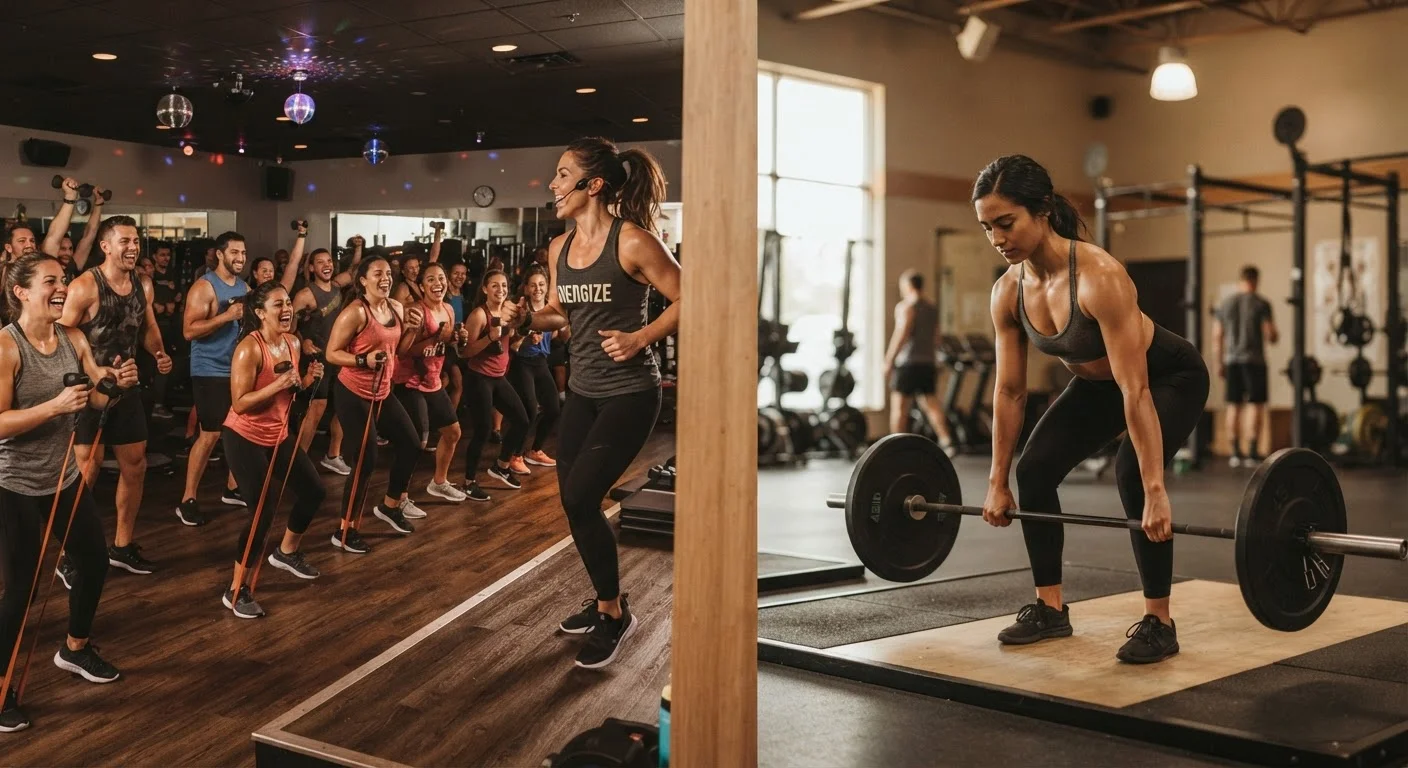
Our Verdict
Neither group classes nor solo training is universally superior - the best approach is the one you'll return to week after week. Group settings tend to work well for people who thrive on external motivation and community, while solo training suits those who need schedule flexibility and prefer to move at their own pace. For many adults, a thoughtful blend of both delivers the consistency that drives real long-term wellbeing.
| Best for | Recommended |
|---|---|
| Those who need social accountability to show up | Group Classes |
| Those with unpredictable or demanding schedules | Solo Training |
| Beginners who want guided instruction and structure | Group Classes |
| Those with specific performance or rehabilitation goals | Solo Training |
Why the Format of Exercise Actually Matters
Most conversations about fitness focus on what to do - which exercises, how many sets, how often. But research into exercise adherence consistently points to a quieter question: what environment makes you actually come back?
Long-term health benefits from physical activity depend heavily on showing up over months and years, not just weeks. That means the psychological and logistical fit of your workout format is just as important as the workout itself. Understanding the real tradeoffs between group classes and solo training can help you design a routine that holds up - not just one that looks good on paper.
For a broader look at how habits, goals, and tracking interplay with consistency, see how fitness goals and habit science fit together.
What Group Classes Do Well
Group fitness classes - whether in-person or streamed - offer several genuine advantages that are easy to underestimate.
- Built-in accountability: Having a class scheduled at a specific time, and knowing an instructor and classmates expect you, raises the psychological cost of skipping. Research in behavioral science calls this "social commitment" - and it's a meaningful driver of consistency.
- Structured programming: You don't have to plan the workout. The instructor sequences the session, cues form, and adjusts intensity. This removes a significant mental load, especially for beginners.
- Energy and motivation: The collective effort of a group, combined with music and instructor enthusiasm, can help people push past the point they'd stop on their own. This is sometimes called the "Köhler effect" - people tend to work harder when exercising alongside others.
- Community: For many people, regular group classes provide a sense of belonging that makes exercise feel less like a chore and more like a social anchor.
The limitations are real too. Classes run on fixed schedules, which can clash with unpredictable workdays or family demands. Intensity is set for the group, not the individual, which can be frustrating if you're recovering from an injury or training for a specific goal.
Try Before You Commit to One Format
Many gyms and studios offer trial classes or drop-in options. Sampling a few different group formats - cycling, yoga, circuit training - before deciding can reveal what genuinely energizes you versus what you tolerate. The same applies to solo training: experimenting with different environments (gym floor, outdoor paths, home) helps you find where you actually want to be.
What Solo Training Does Well
Training on your own - whether at a gym, at home, or outdoors - offers a different but equally valid set of strengths.
- Flexibility: You move when it fits your life, not when a class is scheduled. For adults with variable work hours, caregiving responsibilities, or travel, this flexibility is often what makes consistency possible at all.
- Personalization: You control the pace, the exercises, the rest periods, and the progression. If you're working around a knee issue, managing fatigue, or chasing a specific strength goal, solo training adapts to you.
- Introspection and focus: Many people find solo sessions meditative. Without external cues, you develop a sharper sense of how your body actually feels - a skill that pays off over years of training.
The challenges are also real. Without external structure, it's easier to skip sessions, cut them short, or fall into a comfortable rut of doing the same thing indefinitely. Motivation can erode when progress stalls and no one notices.
If your goal is to integrate more movement throughout your full day - not just during designated workout windows - movement throughout the day is worth exploring alongside whichever format you choose.
| Group Classes | Solo Training | |
|---|---|---|
| Scheduling | Fixed class times | Fully flexible |
| Accountability | Social and instructor-led | Self-directed |
| Programming | Pre-designed by instructor | Customized to your goals |
| Motivation style | External energy and group effort | Internal focus and autonomy |
| Adaptability to injury/goals | Limited mid-class | High - fully adjustable |
| Social connection | Strong community potential | Minimal by default |
| Barrier to starting | Low - structure provided | Higher - requires self-planning |
How to Choose - or Mix Both
There's no formula that works for everyone, but a few questions can help clarify your fit:
- Do you skip workouts more when you're not accountable to anyone? If yes, group settings may provide the external structure you need.
- Does a fixed schedule feel freeing or frustrating? If your week is genuinely unpredictable, solo training may be the only realistic option some weeks.
- Do you have specific physical goals or limitations? Individual programming - ideally guided by a qualified fitness professional - tends to be more precise than general group formats.
- What do you actually enjoy? Enjoyment is a powerful predictor of long-term adherence. If you dread group settings, the accountability benefit erodes quickly.
Many adults find that a hybrid approach works best: anchoring the week with one or two group sessions for social energy and accountability, while using solo sessions for flexibility and targeted work. The weekly movement planning guide can help you structure this practically. And for perspective on what sustains exercise over years rather than months, see fitness habits that hold up over decades.
This article is for general informational and educational purposes only and is not a substitute for professional medical or fitness advice. If you have any health conditions, injuries, or concerns, consult a qualified healthcare or fitness professional before beginning or changing an exercise routine.
The content on this site is provided for informational purposes only and should not be considered a substitute for professional advice. While we strive to provide accurate and up-to-date information, we make no guarantees regarding its completeness or accuracy. Always consult a qualified professional for advice specific to your circumstances before making any decisions.